The newest Starlink satellites are called V3, and they are a very different machine from the ones that came before. They are much bigger, they are designed to carry far more traffic, and they are too large for Falcon 9, so they launch on SpaceX’s Starship. According to public reports and tracking data, the first working batch of 26 reached orbit in late September 2026, and more have followed. Here is what that means, and how to find them yourself.
What makes V3 different
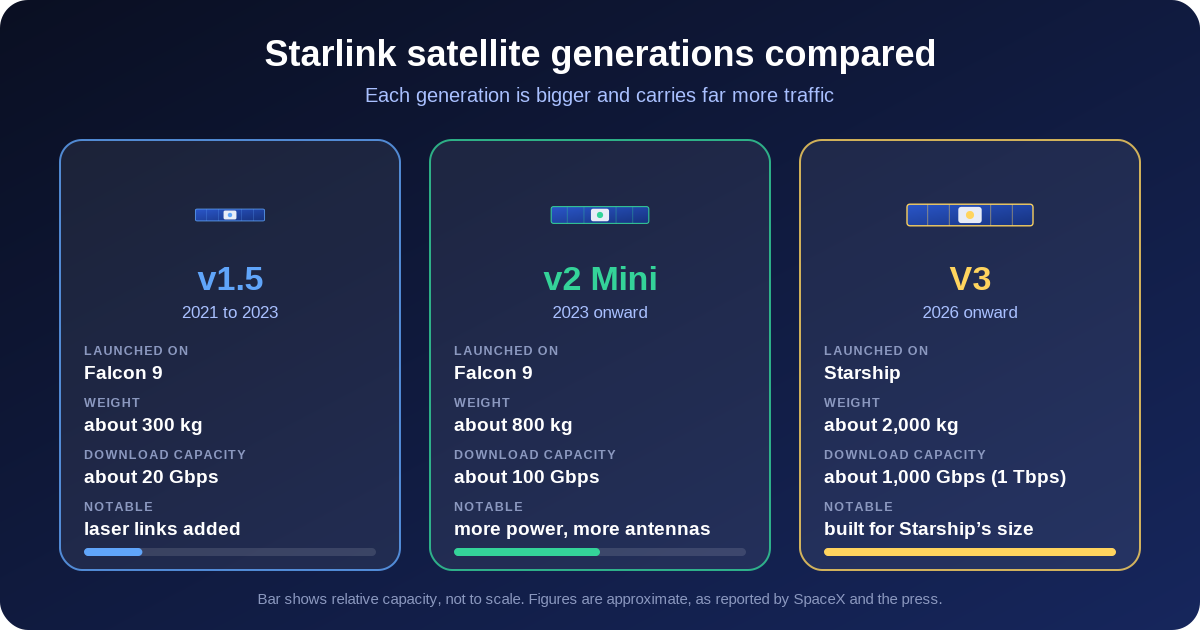
Size is the headline. An early v1.5 satellite weighed roughly 300 kilograms, a v2 Mini about 800, and V3 is reported at around 2,000. That extra bulk is mostly power and antennas, and it is why a single V3 is designed to carry on the order of a terabit per second of download capacity, many times what its predecessors managed. A satellite that size does not fit in a Falcon 9 fairing in useful numbers, which is the reason the whole programme leans on Starship’s enormous payload bay. It also means each launch can deliver far more total capacity than a Falcon 9 batch, even if the satellite count is similar.
Where they are right now
In the public tracking data we use, there are currently 51 satellites flying in a new orbit tilted at about 30.5 degrees. That tilt is not used by any earlier Starlink group, which is how we identify them, and they sit low, around 330 kilometres, while they are tested and raised. You can see them on our live Starlink satellite map: open the filters, set “Colour by” to Model and look for the V3 colour, or turn the other models off to see only these. Tap one and the map shows its height, speed and the path it will follow over the next hundred minutes.
One caution about the label. Tracking data does not say which model a satellite is, so the map infers it, and the V3 group here is a best estimate based on the distinctive orbit. If the way Starlink launches changes, the rule may need updating.
Can you see them in the sky?
Sometimes. Like other Starlink satellites, they reflect sunlight and are easiest to spot soon after sunset or before sunrise. Newly launched satellites travel close together for a while, which makes them easier to notice, and larger satellites can be brighter. Our guide to seeing Starlink satellites tonight explains when and where to look.
What it means for Starlink customers
Probably not much overnight. A few dozen V3 satellites are a tiny share of a fleet of more than eleven thousand, and the benefits show up as more capacity in busy areas and, later, new services, as more are launched. Nobody has published a date by which you should notice faster speeds, and your own experience still depends mostly on your sky view, local demand and Wi-Fi. If you are deciding whether to buy now or wait for V3, there is no sign the current service is about to change. Check availability at your address on Starlink’s site and judge by what you are offered today.
V3 questions
What is a Starlink V3 satellite?
It is the newest and largest generation of Starlink satellite, designed to carry far more data than earlier ones. It launches on Starship rather than Falcon 9.
When did the first V3 satellites launch?
According to public reports, the first working batch of 26 reached orbit on Starship’s first orbital flight in late September 2026. Earlier test flights are reported to have carried prototypes that did not stay in orbit.
How many V3 satellites are in orbit?
Our live data currently shows 51, identified by their 30.5 degree orbit. The number grows as more launch.
Will V3 make my Starlink faster?
Not directly or immediately. V3 adds capacity to the network, which helps most in busy areas over time. Your own speed still depends on your sky view, local demand and home Wi-Fi.
How is V3 different from v2 Mini?
V3 is roughly two to three times heavier and designed for far greater capacity. V2 Mini launches on Falcon 9 and V3 launches on Starship.
Affiliate disclosure: this article contains an affiliate (referral) link. If you sign up for Starlink through it, we may earn a reward at no extra cost to you. Read our disclosure.
We’ve launched an official Tesla Owners Online Forum. Join early and claim your "Founding Fuel" badge.