
Tesla hopes to build SpaceX’s Starlink satellite internet into every car it sells by around the end of 2027, Chief Executive Elon Musk said on Sunday, and he tied the plan to the company’s goal of cars that drive with no one watching the road.
Musk made the comment on X in reply to former PayPal president David Marcus, who wrote that he wanted an embedded Starlink option on all Tesla models and not just the Cybercab robotaxi. Musk answered that the feature would hopefully be ready near the end of next year. “This will be important for unsupervised FSD, so passengers have high bandwidth everywhere for work and entertainment,” he wrote.
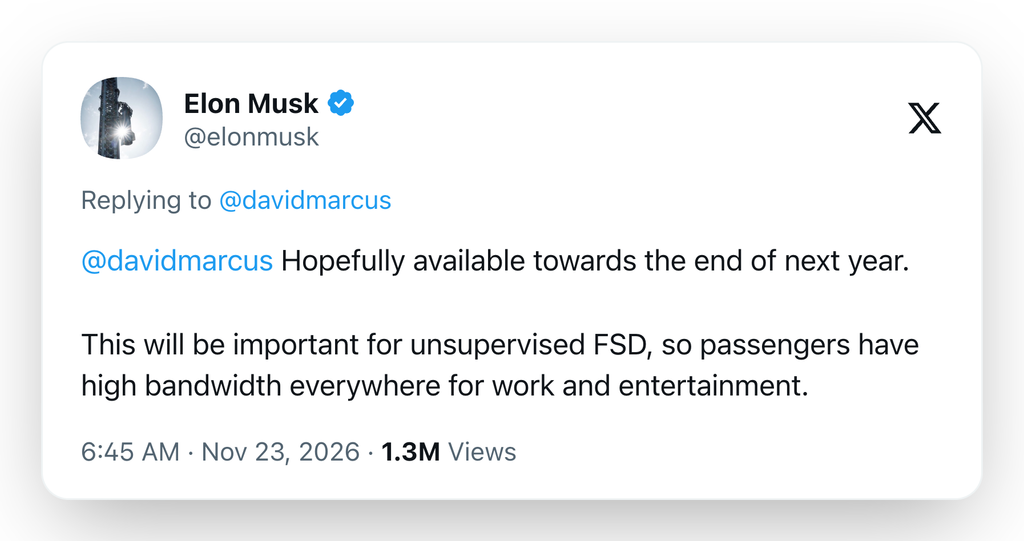
In a later post he named one exception: “Except in China, as Starlink is illegal there.” Musk called the date a hope and not a promise, and he gave no price, hardware details or list of models.
Only the Cybercab has it today
So far the two-seat Cybercab, which has no steering wheel or pedals, is the only Tesla with a Starlink terminal. Tesla said in July that the robotaxi would carry a Starlink V5 unit next to its cameras, self-driving computer and GPS/LTE antennas, and on Aug. 10 it revealed the first car with the dish built into the rear of the roof. SpaceX rates the V5 for peak downloads above 375 megabits per second.
But the link isn’t there to drive the car. Tesla AI chief Ashok Elluswamy has said the vehicle runs safely without it and that the connection mostly serves navigation, customer service and fleet management. Cybercabs that began public rides in Dallas this week carry the terminal, though riders don’t appear able to log on to it at this stage.
Musk raised the idea of a wider rollout on Tesla’s July earnings call, saying Starlink would go into all of its vehicles in markets where the service runs, since a robotaxi needs coverage everywhere and cell service is weak or missing even in parts of Silicon Valley. Sunday was the first time he put a date on it.
On the hardware side, Musk said Tesla’s cars will stay on the current AI4 computer, which he said is enough for superhuman driving, and the next-generation AI5 chip will go to the Optimus humanoid robot instead. An interim AI4.5 upgrade will have 24 gigabytes of memory, not the 32 GB he described earlier this year, as memory prices have climbed sharply.
Why China is left out
Beijing has never licensed Starlink, which could let users get around state-controlled networks. The ban reaches into Chinese waters, where authorities fined a foreign ship at Ningbo port for using Starlink gear, and a rule on direct-to-device satellite services took effect in June 2025. Back in 2021, Tesla China said its cars and chargers in the country run on Chinese carriers’ networks and keep vehicle data inside China.
Merger talks
The Starlink plan would bind two Musk companies more closely just as they discuss a combination. People familiar with the talks have said a SpaceX-Tesla deal could be announced as soon as December, with early 2027 possible. SpaceX, which went public in June, has been valued at about $1.9 trillion and Tesla at roughly $1.5 trillion.
Tesla holds its annual shareholder meeting on Dec. 3, but no merger proposal is on the ballot. Any deal would need backing from holders of at least half of Tesla’s outstanding shares, a bar Musk has called high.
Discuss this on Tesla Owners Forum →
We’ve launched an official Tesla Owners Online Forum. Join early and claim your "Founding Fuel" badge.