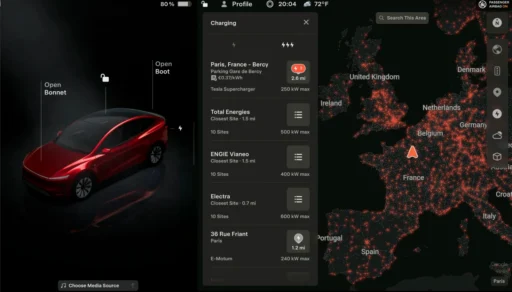
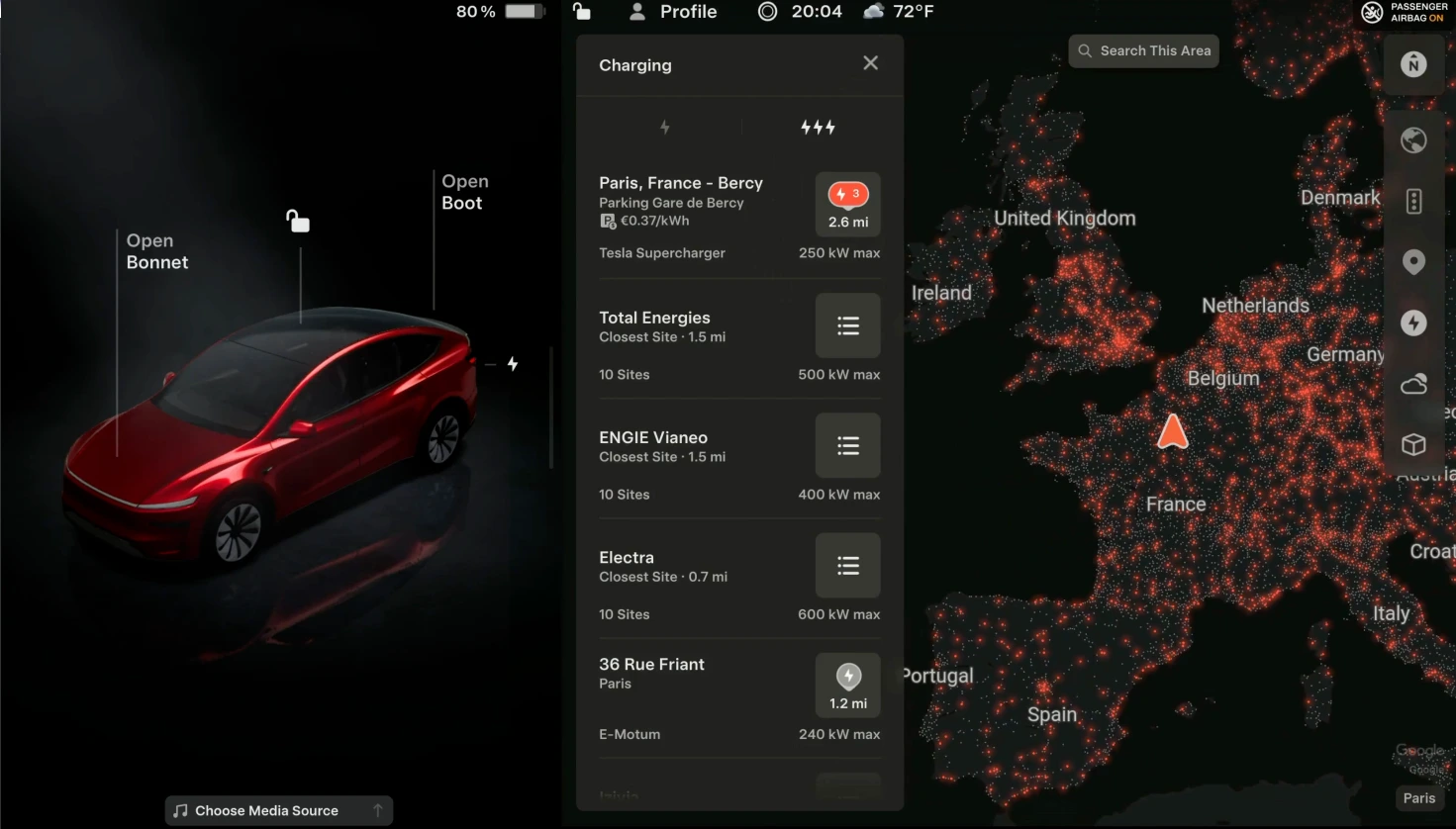

Tesla has posted new videos of the updated Charger Network View that arrived with software version 2026.44.1, and the change gives drivers a cleaner way to see where the company’s chargers sit on the in-car map. Charger pins now group together at normal zoom levels, and pulling the map all the way back reveals how densely Superchargers cover large stretches of the country and the continent.
In a post on its official charging account on X, the company called it a “vehicle touchscreen improvement” and said “charger pins on the map now cluster” as drivers zoom out. In the same post, Tesla confirmed that more third-party charging stations now appear on the map in Europe.
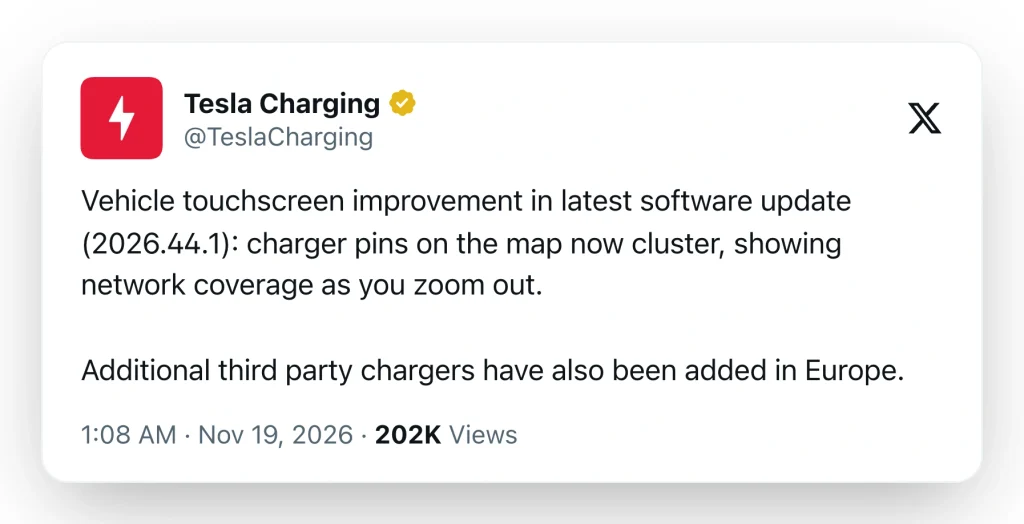
The update started reaching cars on November 17, 2026, a few weeks before Tesla’s larger holiday software release.
How the clustered map works
Until this release, every nearby charger got its own pin, and in busy areas those icons stacked on top of one another until the map became hard to read. Now the car folds neighboring sites into a single pin with a number on it, and zooming back in splits each group into individual locations again.
Since the zoomed-out map works as a coverage view that makes it easy to spot where stations are dense and where they thin out, a useful check before a long holiday road trip.
The update goes past the pins, too. Tapping the lightning bolt button on the map without an active route brings up a list of major charging operators and their individual sites, along with MultiPass pricing, and with a route set, the same button lists every charging location along the way.
Tesla is making Charger Network View available to its full lineup, including cars with Intel and AMD infotainment computers and legacy Model S and Model X vehicles.
More third-party stations in Europe
The release notes inside the car give this change a single line, stating that more third-party fast charger locations have been added to the map.
The automaker only lists outside chargers in its European navigation when they meet its reliability standards, and its Qualified Third-Party Charger Program, introduced in 2022, requires a compatible connector and a charging success rate of at least 90%.
Earlier in 2026, Tesla told owners it had started listing third-party charging services in Belgium, the Netherlands, Germany, Switzerland and Austria. Separately, its Charging MultiPass, which lets owners pay at partner stations, launched in the Netherlands and has since reached Germany, France, Sweden, Belgium and the U.K.
On the screen, third-party fast chargers appear as dark gray pins in supported markets. Drivers can turn them on under Controls > Navigation > Third-Party Charging Stations, but Trip Planner won’t add them to a route on its own, so drivers have to place them in the route by hand. Still, picking one as the destination preconditions the battery before arrival, the same way the car prepares for a Supercharger stop.
What else comes with 2026.44.1
Charger Network View is the main attraction, but this is a fairly light release as Tesla prepares its bigger holiday update for next month.
Alongside the charging map, the official notes list Emergency Drive Away, a feature that lets drivers put the car into Drive with a Supercharger cable still connected. Tesla says it is for emergencies only, and it warns that pulling away with the cable attached will damage both the car and the charger, with owners possibly on the hook for repair costs. The notes round out with a set of security fixes.
On the driver-assistance side, the firmware carries FSD (Supervised) v14.3.13 for HW4 vehicles and FSD v14.3 Lite for eligible HW3 cars.
A few changes are visible in the car without appearing in the notes. The Service menu under Controls now uses two tabs, with Maintenance holding tire pressures, recommended service, battery health and other vehicle details, and Actions grouping tools like Car Wash Mode, Wiper Service Mode, camera previews and headlight adjustments. The large tire-pressure image that once filled much of that screen has been shrunk to make room for the other controls.
In the software section, the AI Computer now goes by SI Computer. It is a name change only, and nothing about the hardware is different.
Other features sit in the code but don’t appear to be live yet. A look through the firmware turned up an alert that warns drivers if a Supercharger’s price changes during the drive there, a new routing preference that favors major roads, and syncing of in-car Grok conversations with the Grok app.
Rollout and network growth
Tesla began sending 2026.44.1 to cars on November 17 and moved to a wide release within about a day, pushing large waves that included eligible HW3 vehicles.
The redesign comes as the charging network keeps getting bigger. In early October, Tesla said its Supercharger network had passed 85,000 stalls across more than 9,000 sites, up from 77,682 connectors at 8,182 stations at the end of 2025. With that many locations on the map, single pins tended to pile up at regional zoom levels, and grouping them turns the same data into a view drivers can actually read.
The European third-party additions serve a similar purpose, filling gaps between Supercharger sites on routes where Tesla’s own coverage is thinner.
Discuss this on Tesla Owners Forum →
We’ve launched an official Tesla Owners Online Forum. Join early and claim your "Founding Fuel" badge.