
Italy has given provisional approval to Tesla’s driver-assistance software, sold in Europe as Tesla Assisted Driving and once called Full Self-Driving (Supervised), and that makes it the first large European Union market to clear the system before the bloc reaches its own decision.
Deputy Prime Minister and Transport Minister Matteo Salvini announced the move on X on Friday. He said his ministry acted after a detailed technical feasibility check and got ahead of an EU recognition process that is still being defined, calling the decision a step forward for innovation and future mobility with the safety of citizens kept first.
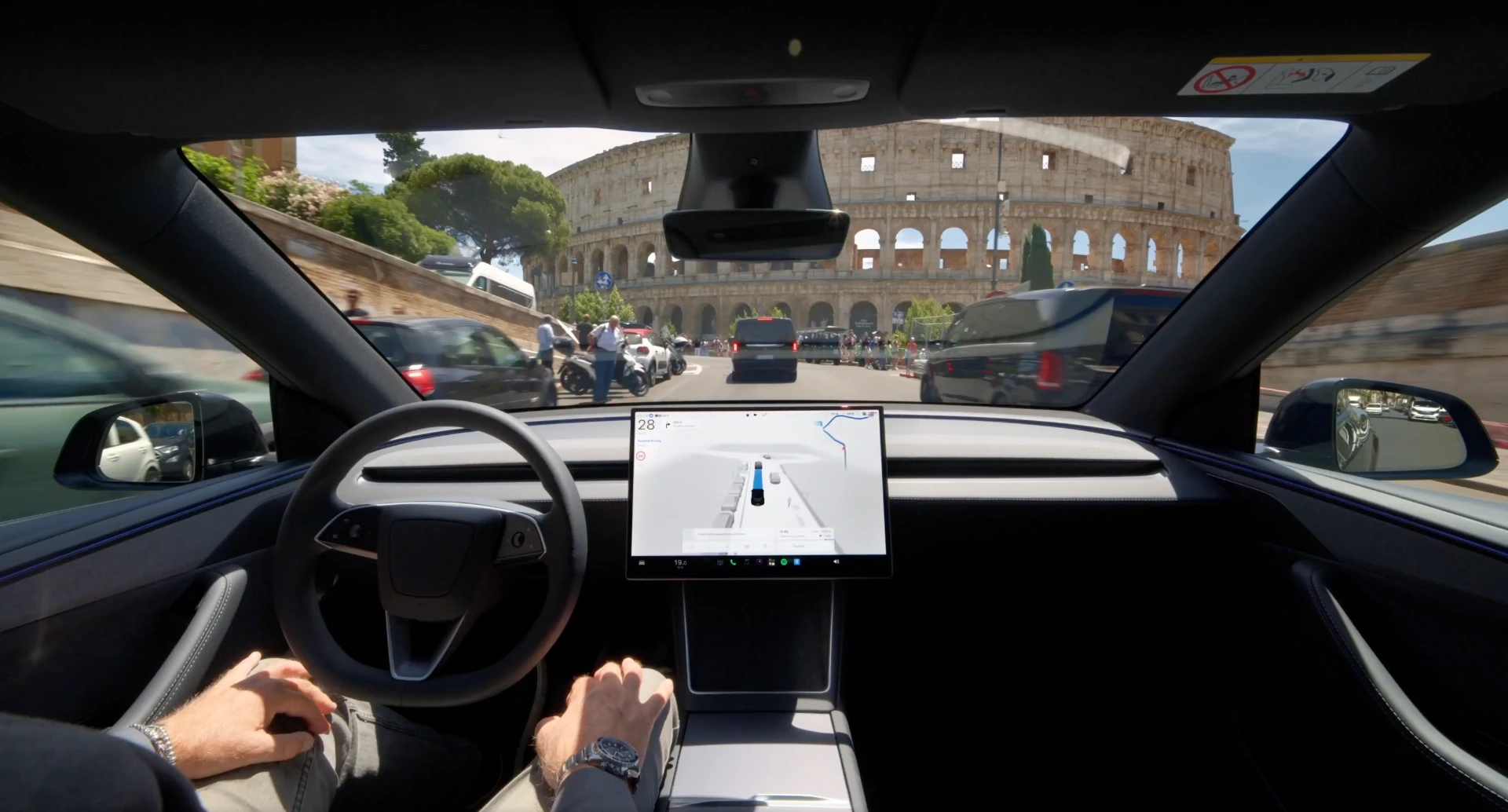
Tesla’s European account followed with “Mamma, butta la pasta,” then added “Now approved in Italy” and “Rollout begins soon” over a video of a car driving itself through Rome. It did not give a launch date.
How the approval works
The permit is temporary and national. EU rules let a member state approve new technologies that common rules do not yet cover, but the approval applies only on that country’s roads and stays under monitoring until Brussels makes a final call.
In practice, Italy’s motor vehicle authority on Nov. 19 recognized the approval the Dutch regulator RDW issued on April 10 under Article 39 of the EU type-approval regulation, and that certificate is valid until April 10, 2029. Belgium, Croatia, Czechia, Denmark, Estonia, Finland, Latvia, Lithuania, Slovakia and Slovenia had already recognized it.
The version Italy cleared carries stricter driver monitoring that the RDW signed off on Nov. 16, with earlier warnings for inattention and a rule that drivers keep their hands on the wheel above 130 km/h (81 mph).
What Italian drivers get
It is still a Level 2 system. The car can steer, brake and accelerate and handle intersections, roundabouts and lane changes, but the driver has to watch the road, stay ready to take over and remains legally responsible. A camera in the cabin tracks attention. Owners will pay 99 euros a month to switch it on through a software update.
Why the December vote is still open
The EU’s Technical Committee on Motor Vehicles is expected to vote in December at the earliest, and a yes needs at least 15 of the 27 member states holding at least 65% of the EU population.
Before Italy, the 11 approving countries had about 70 million people, or roughly 15% of the EU. Italy’s 59 million lift that to close to 30%.
Germany has said it will vote yes after Tesla dropped the “Full Self-Driving” name in Europe, which Berlin had called misleading, and cut the maximum speed margin over the limit from 50% to 10%. Even with Germany on board, backers would cover only about 47% of the population.
France said in July the system was not safe enough, citing speeding and weak attention checks, and it has since started tests on public roads. Sweden wants a no vote unless Tesla removes the option to exceed speed limits, and Spain has not recognized the Dutch approval. Therefore, Tesla still needs France or Spain on its side, plus most of the remaining holdouts.
What is at stake for Tesla
A wider rollout would bring more buyers for software that Tesla sells by subscription. In its third-quarter update the company said more than 75% of new North American deliveries included the system, and active customers rose 67% from a year earlier to 1.74 million. Chief Financial Officer Vaibhav Taneja said more than half of paying users now subscribe.
On the October earnings call, Chief Executive Elon Musk said he hoped for EU approval within a few months and “would be surprised if it takes longer than Q1,” adding that the timing was out of Tesla’s hands.
Politics played a role in Rome. Musk and Salvini spoke by phone in late October, after which the minister backed a swift EU approval and told officials to open the door to innovation within existing rules. Musk thanked him on X after Friday’s announcement.
The decision comes as Tesla’s European sales recover from a long slump. Its September registrations across the EU, EFTA and Britain rose 72.5% to 68,776, according to provisional data from the European Automobile Manufacturers’ Association. Over the first nine months, however, its 260,575 cars trailed China’s BYD at 283,997 and Chery at 260,650.
Praise, criticism and safety claims
Andrea Stroppa, Musk’s representative in Italy, thanked Salvini, Prime Minister Giorgia Meloni and Rome Mayor Roberto Gualtieri, who was the first person to try the system in the capital.
Opposition lawmakers were less impressed. Andrea Casu of the Democratic Party, vice chair of the lower house transport committee, said Salvini backs only the kind of future mobility that helps Musk, and he accused the minister of holding back Italian and European autonomous-driving firms through the new highway code.
Tesla says more than 22,000 people have ridden as passengers in European tests and demos since late 2025, with over 200 million km driven on the continent. It claims its data put the chance of a collision per km up to seven times lower than in manual driving, a figure that has not been independently verified.
Road safety groups such as the European Transport Safety Council had opposed the old setting that allowed speeds up to 50% above the limit. That option is gone in the version Italy approved, and December will decide if Tesla’s changes satisfy the rest of Europe.
Discuss this on Tesla Owners Forum →
We’ve launched an official Tesla Owners Online Forum. Join early and claim your "Founding Fuel" badge.