
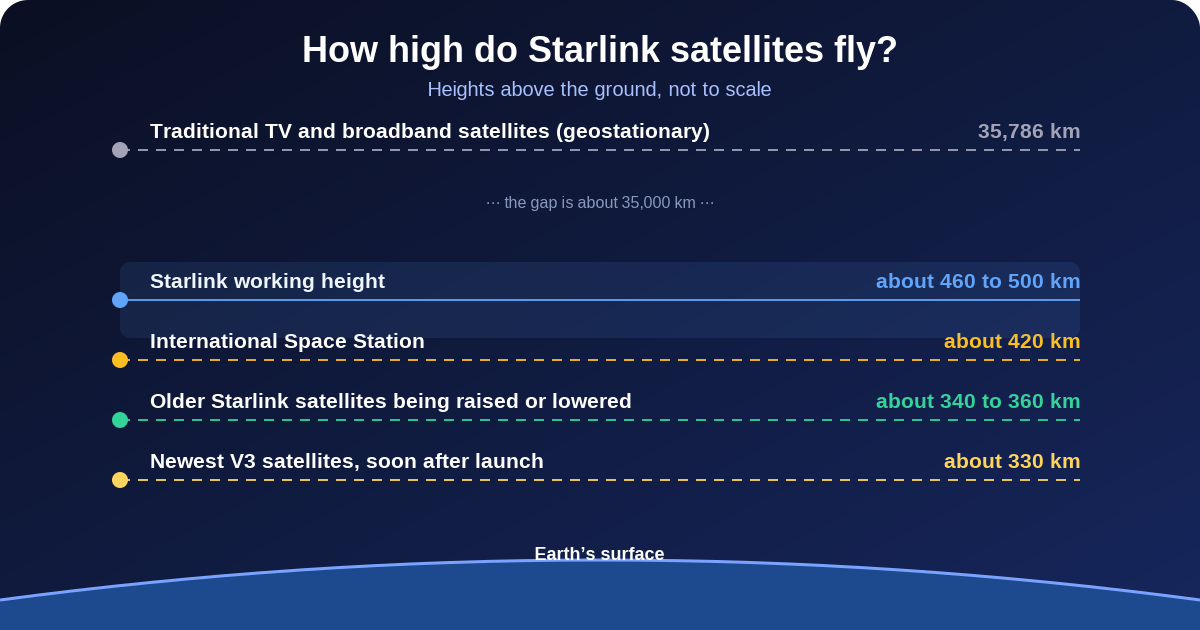
Most Starlink satellites fly between about 460 and 500 kilometres above the ground. That is higher than the International Space Station, which orbits at roughly 420 kilometres, and a tiny fraction of the height of traditional communications satellites, which sit 35,786 kilometres up. The low orbit is the whole trick behind Starlink’s speed, and it is also why you need thousands of satellites to cover the planet.
Why Starlink flies so low
Distance matters because radio signals travel at a fixed speed. A signal that goes up to a geostationary satellite and back down covers more than 70,000 kilometres, so a single web request and its reply take over half a second, which is why older satellite internet felt sluggish for video calls. A signal to a satellite at around 500 kilometres goes up and back in a few milliseconds, so the delay you notice comes mostly from the rest of the internet rather than from space. The trade-off is that a satellite that low sees only a small patch of ground and crosses the sky in a few minutes, so the network hands your dish from one satellite to the next constantly.
The heights in the live data
We can show this from real tracking data rather than quoting a fixed number. The table below is worked out from each satellite’s orbital period and groups the whole fleet by orbit tilt. Different shells fly at slightly different heights, and the newest satellites start lower.
| Orbit tilt | Satellites | Typical height |
|---|---|---|
| 30° (newest) | 51 | 345 km |
| 43° | 3,601 | 483 km |
| 53° | 5,038 | 463 km |
| 70° | 977 | 475 km |
| 97° (near-polar) | 1,516 | 466 km |
Why some satellites are lower than the rest
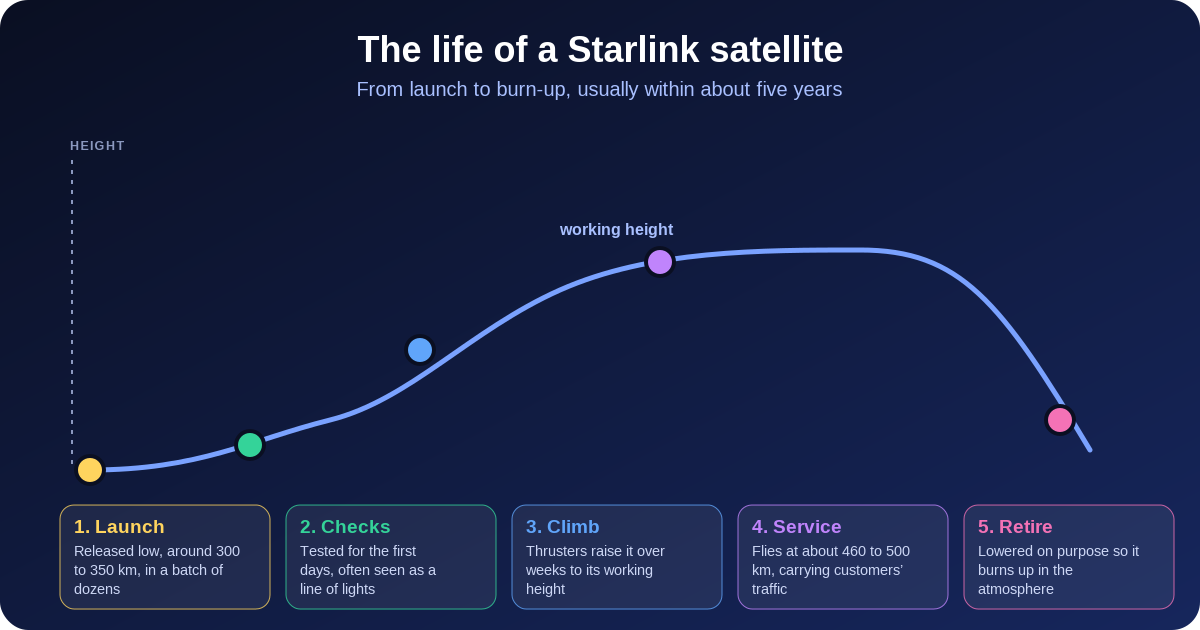
On the live map you will notice a smaller group much lower than the main fleet, around 340 to 360 kilometres, and the newest V3 satellites lower still, near 330. New satellites are released low on purpose. It is the safest place to test them, because if one fails there, atmospheric drag brings it down quickly. Once the checks pass, its thrusters lift it to its working height over a period of weeks. Satellites near the end of their lives take the same path in reverse.
What happens when they get old
Starlink satellites are designed to last around five years. At the end, they are lowered deliberately so they burn up in the atmosphere. Because they already fly low, even a satellite that fails and cannot manoeuvre will fall back within a few years rather than lingering for centuries, which is a big part of how the network limits space junk.
Can you see how high they are right now?
Yes. Open the map, tap any satellite and its card shows the current height in kilometres, its speed and the time it takes to circle the Earth. You can colour the whole fleet by height in the filter panel and switch off the groups you do not care about. If you want to know how many are up there, we explain it in how many Starlink satellites are in orbit.
Height questions
How high is a Starlink satellite?
Most fly at about 460 to 500 km above the Earth. Newly launched satellites start lower, around 330 to 360 km, and are raised over several weeks.
Is Starlink higher than the space station?
Slightly. The International Space Station orbits at roughly 420 km, and Starlink’s main working height is about 460 to 500 km.
Why are Starlink satellites so low?
A low orbit means a much shorter signal path, which gives low delay and fast response, and it means failed satellites fall back to Earth quickly. The cost is that you need thousands of satellites for continuous coverage.
How fast do Starlink satellites travel?
About 7.6 kilometres per second, or roughly 27,000 km/h, which is why each one circles the Earth in about an hour and a half.
How long do Starlink satellites last?
They are designed for around five years, after which Starlink lowers them so that they burn up in the atmosphere.
Affiliate disclosure: this article contains an affiliate (referral) link. If you sign up for Starlink through it, we may earn a reward at no extra cost to you. Read our disclosure.
We’ve launched an official Tesla Owners Online Forum. Join early and claim your "Founding Fuel" badge.