
IMC Logistics is bringing 50 Tesla Semi electric trucks into its California fleet. IMC runs more than 2,700 trucks out of over 50 locations across North America, and it calls itself the largest asset-based marine drayage operator in the country.
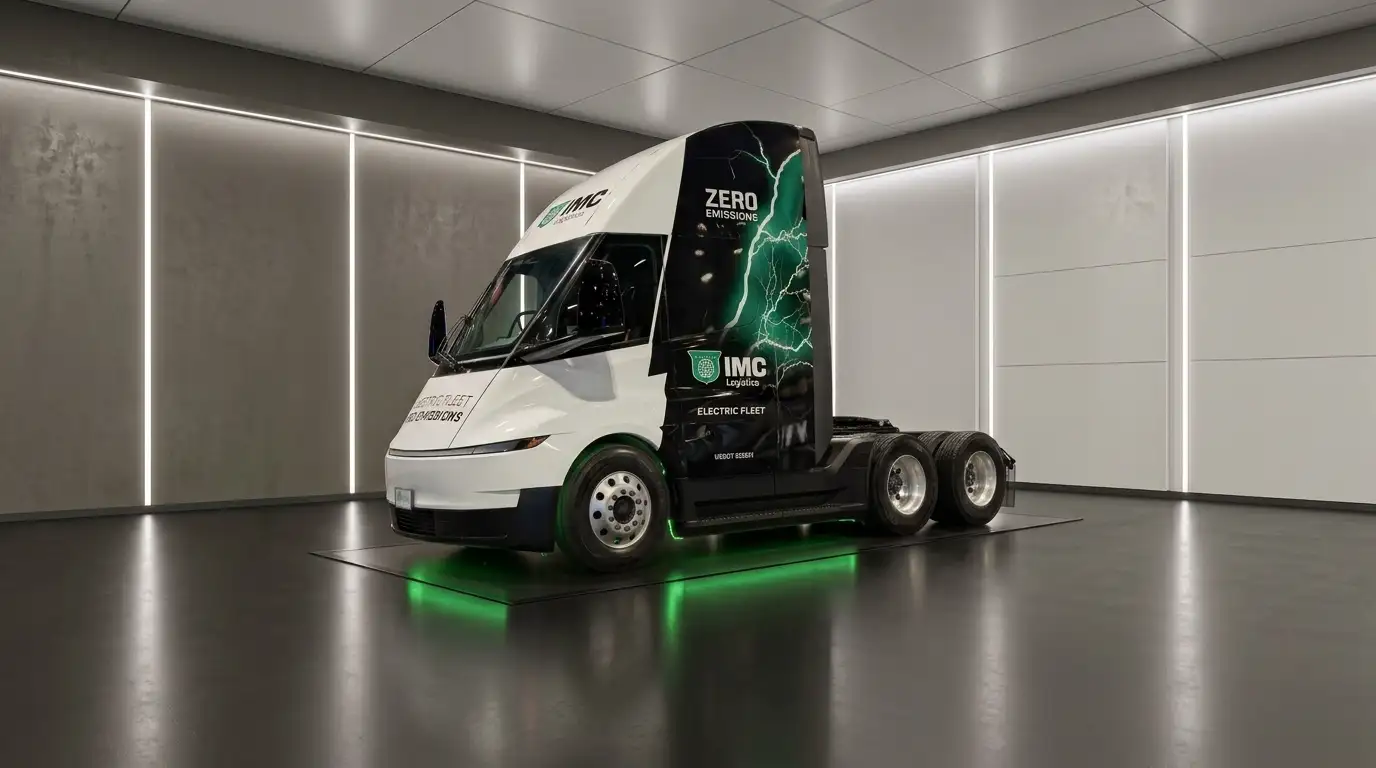
The order came into public view this week at the Intermodal EXPO in Long Beach, where IMC parked one of its new trucks on the show floor for attendees to walk around and look at.
Two truck versions, split by route
The 50 trucks split across two versions of the Semi. Standard Range models, rated at 325 miles, will run drayage routes inside California, and Long Range models, rated up to 500 miles, will cover the stretch between Southern California’s ports and inland destinations farther out. IMC has not said how many of each version it ordered.
This is not IMC’s first electric truck, and it will not be the last kind of truck in its yard either. The company already runs battery-electric and hydrogen fuel-cell trucks alongside renewable-diesel vehicles across California, and the Tesla order adds to that lineup instead of replacing any piece of it.
Jim Gillis, president of IMC’s Pacific Region, put it this way:
“We are focused on making sustainability attainable in day-to-day drayage operations. That means taking a blended approach rather than relying on a single technology. The addition of 50 Tesla Semis strengthens that strategy as well as allows IMC to establish zero-emission service for long haul.”
— Jim Gillis, Pacific Region President, IMC Logistics
IMC’s drivers spent time behind the wheel of the Semi back in March, and that early trial appears to have shaped the bigger order now in motion. Driver Dakota Shearer described taking a wrong turn on a tight bend near Sparks, Nevada, hauling a 40-foot trailer, and finding himself stuck on a curve too narrow to complete. In a standard rig, he would have had to climb out of the cab more than once to check his position from outside. The Semi’s center-seat cab and its surrounding camera screens let him back out without ever leaving his seat.
“That right there showed me that the technology the Tesla has makes a big difference,” Shearer said.
On another run, Shearer moved a 25,000-pound load of dog food over a mountain pass, and he said the truck pulled it as if the load wasn’t there at all. Smooth acceleration stood out to him as one of the truck’s strongest points.
Tesla Semi orders pile up across Southern California
IMC’s order lands in a busy stretch for Tesla’s electric Class 8 truck, and it comes as production ramps up at the company’s Gigafactory in Nevada. Port drayage operators in Southern California have moved fastest of all, and many of them work through Forum Mobility, a charging and leasing company backed by Amazon and CBRE that is building a shared depot in Rancho Dominguez.
Forum Mobility’s list of Tesla Semi customers has grown steadily this year. Big F Transport committed to 40 trucks after running a demo unit, and Nica Container Freight Line followed with an order for 20. QX Logistix and ATC Logistics each added 20 more on top of that. Add it up, and Forum Mobility’s confirmed Tesla Semi commitments reach 100 trucks across four operators, according to an August 28 company update, and MCS charging hardware is now going into the ground at its flagship depot at the Port of Long Beach.
Big F Transport and Nica’s combined 60-truck order stood out on its own as one of the largest drayage-sector commitments to the Tesla Semi so far. WattEV, a company aiming to put 12,000 electric heavy-duty trucks on California roads by 2030, recently ordered 40 Tesla Semis of its own, on top of a charging build-out already underway at several depots. Tesla has begun opening public charging for the truck too, and a 750 kW public Megacharger went live in Ontario, California, not long after an earlier six-stall site opened in Bloomington that can deliver up to 1.2 megawatts per stall.
In California’s Clean Truck and Bus Voucher program, the Tesla Semi accounted for 965 of 1,067 applications between January 2025 and February 2026, and Daimler, PACCAR and Volvo combined for fewer than 100 applications over that same stretch.
A separate electric truck push in Texas
Google is funding its own electric freight effort, separate from the Tesla-heavy activity in California. The company is partnering with logistics firm Nevoya and the nonprofit Center for Green Market Activation to pay for 25 electric trucks and the charging setup that goes with them, on a new route between Houston and Dallas. The trucks are Freightliner eCascadia day cabs, not Tesla Semis, and Google’s 25 trucks are part of a larger 63-truck rollout the companies call the biggest known Class 8 battery-electric deployment in Texas so far. The full fleet is expected to cover around 11 million miles a year, and the group estimates it will cut about 92,000 metric tons of carbon dioxide equivalent compared with diesel trucks over the life of the contracts.
We’ve launched an official Tesla Owners Online Forum. Join early and claim your "Founding Fuel" badge.