
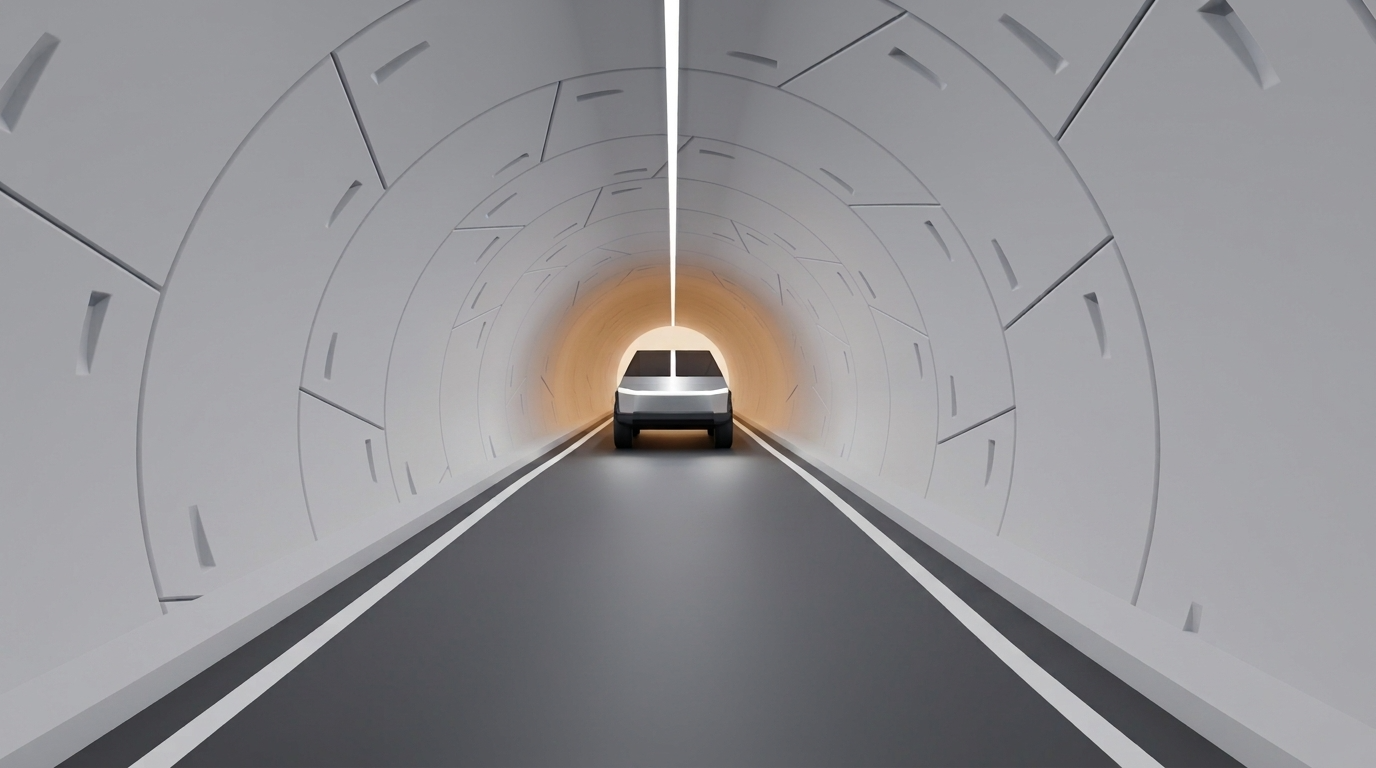

Elon Musk stated that his underground transit company is working on an intercity tunnel between Austin and San Antonio that could cut travel times down to under 30 minutes, yet the plan arrives without public engineering filings, permits, or local government contracts. The billionaire floated the concept over the weekend on X, describing the route as a “simple, precursor Hyperloop” that targets speeds exceeding 200 mph. And his remarks followed fresh corporate filings confirming that The Boring Company secured $3 billion in new capital earlier this month, giving the venture new resources to pursue unbuilt routes.
Online exchange over science fiction video
Musk posted his comment in a reply to an animation depicting space colonies on distant planets, adding his own remark: “This is the future we shall bring into being.”
Video
This is the future we shall bring into being pic.twitter.com/8aD0w8MDVc
— Elon Musk (@elonmusk) September 20, 2026
He argued that highway congestion along Interstate 35 stretches the 80-mile trip between the two Texas cities up to two and a half hours, claiming his underground link would consistently reduce that run to less than half an hour.
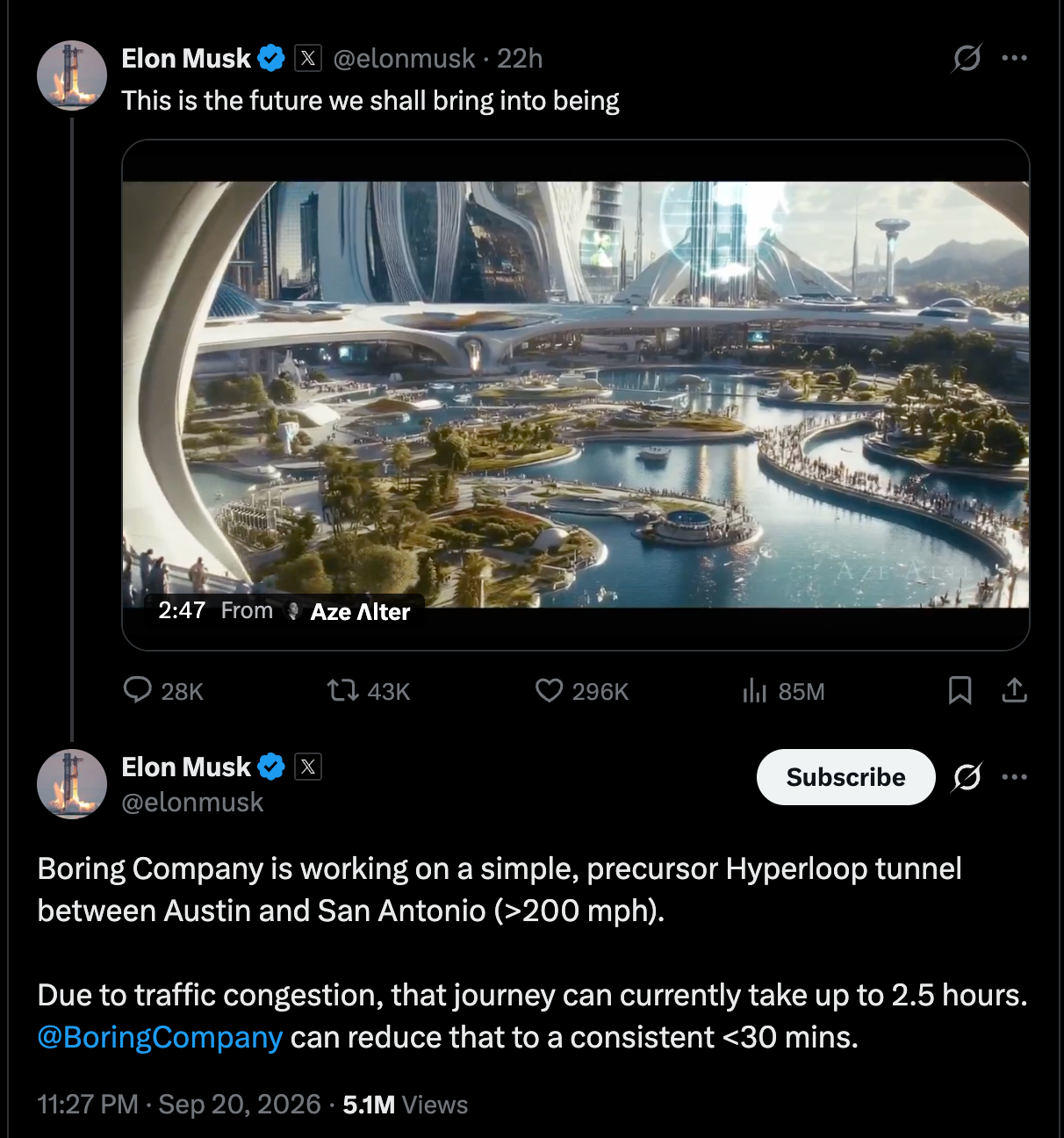
Soon after, The Boring Company’s corporate account verified the plan in the same conversation thread.
The company stated: “Because Loop/Hyperloop is express (i.e. no intermediate stops), one could travel from an Austin parking lot to a favorite San Antonio restaurant in about 30 minutes. As long as they both have Loop stations.”
Garage style station framework
Instead of relying on large central railway terminals, the proposed system would depend on smaller garage stops placed across commercial areas and surface lots. Passengers would board electric passenger cars directly at surface bays, enter tunnels via ramps or lifts, and proceed nonstop to their chosen exit point.
In fact, this setup copies the operational model in Las Vegas, where riders board Tesla passenger vehicles to shuttle between resorts and the local convention center. However, running cars at more than 200 mph over 80 miles would introduce technical hurdles that the firm has never tested in passenger service.
Capital influx from international investors
The venture entered this public push with significantly larger cash reserves than it possessed during earlier infrastructure bids. Earlier this month, The Boring Company raised $3 billion in an equity round led by investors from the United Arab Emirates, lifting the firm’s valuation to $23 billion. Backers in that funding round included Sequoia Capital, Andreessen Horowitz, and Shamal Holding.
At the same time, the company agreed to build over 150 kilometers of tunnels across the Middle East, including a transit network planned in partnership with the Dubai Roads and Transport Authority. Company representatives stated that the capital will finance new equipment production and pay for ongoing tunneling operations in the United States.
Active projects in Tennessee and Nevada
Meanwhile, actual construction work remains focused in Las Vegas and Nashville. In Nevada, the Vegas Loop operates 14 passenger stations, and Clark County commissioners approved plans that allow up to 123 station locations across the resort corridor.
The enterprise recently opened job postings for dozens of drivers and tunnel operators, aiming to double its active Nevada stations before next year. Still, progress in Tennessee marks the firm’s first major airport connection.
Work on the Music City Loop in Nashville began after local officials and the airport board approved station easements and a $34 million agreement. In June, technicians finished commissioning a second tunneling rig named Prufrock-MB2, and recent company video verified that both machines are boring through solid limestone beneath Nashville streets.
Prufrock-MB1 and Prufrock-MB2 mining at the same time in Nashville, constructing Music City Loop.
— Music City Loop (@musiccityloop) August 9, 2026
Tunnels are side-by-side, currently separated by ~20 feet laterally. pic.twitter.com/VhVxpNgQ6j
Yet transit observers note that earlier high-profile announcements from the company failed to advance beyond promotional stages. Earlier bids for express transit links in Chicago, Los Angeles, and the Northeast Corridor between New York and Washington dissolved without any digging.
In Texas, company leaders discussed an Austin to San Antonio tunnel in 2021, and they submitted an application for an airport connection in San Antonio before city leaders paused the review. So far, no Texas regulatory agency has published environmental impact filings or permits for an 80-mile link between the two cities. And until actual engineering documents appear in public records, Musk’s Hyperloop vision remains a concept on a social media feed.
We’ve launched an official Tesla Owners Online Forum. Join early and claim your "Founding Fuel" badge.