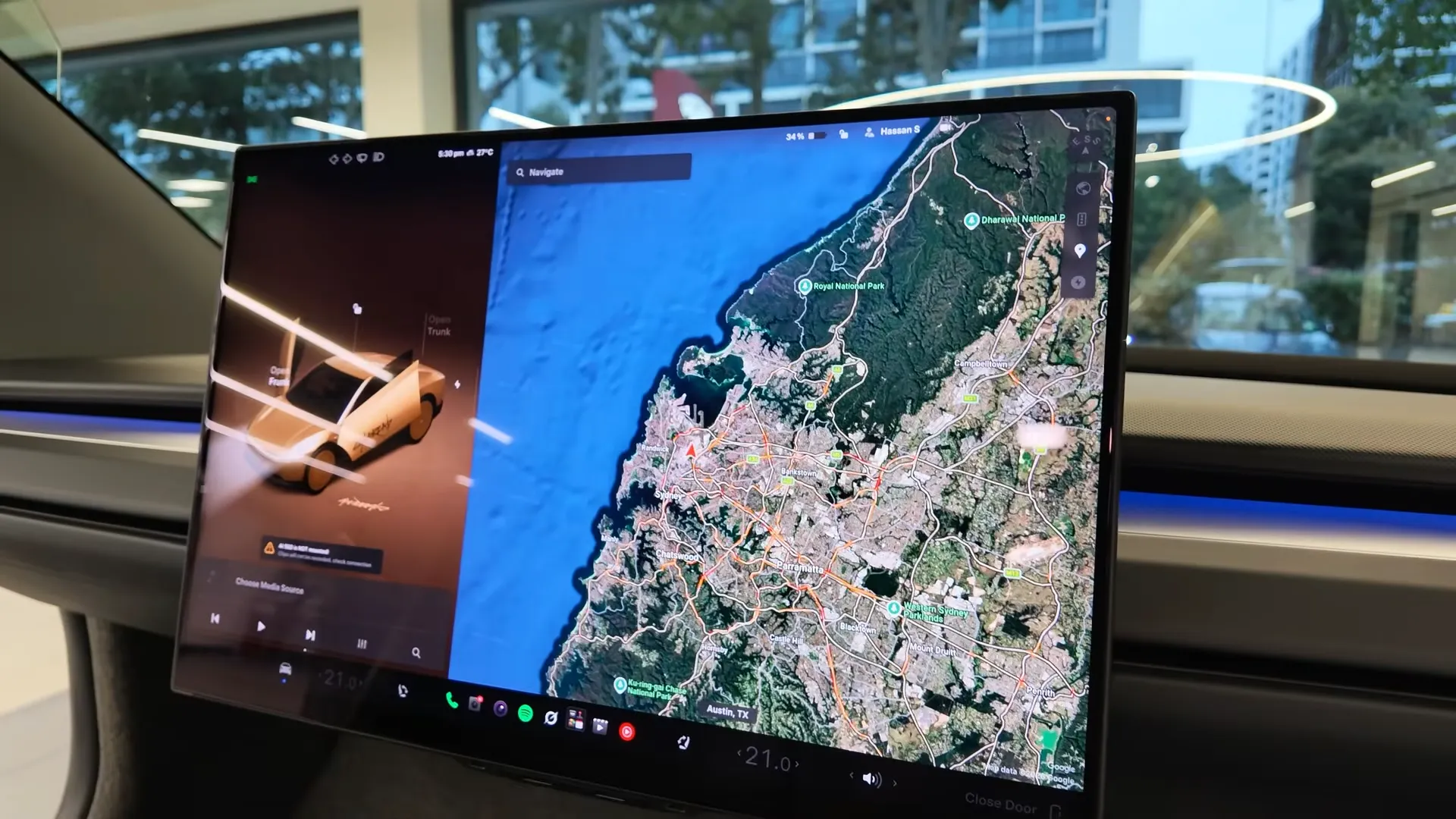

A Tesla Cybercab on display at Tesla Sydney in Alexandria has given the public its first close look at software that could be used in a privately owned version of the vehicle. CarSauce filmed the interior during the Australian tour, and the central screen carries many of the same menus found in a current Model 3 or Model Y.
Tesla has not announced retail orders, final pricing, or a delivery date for private buyers. Yet the interface seen in Sydney goes beyond the passenger display used in Tesla’s robotaxi service.
A familiar Tesla interface
The Cybercab’s wide center display uses Tesla’s standard software layout. It includes the 3D vehicle graphic, maps, navigation, media apps, and the Tesla Theater app suite familiar to owners of newer Tesla models.
CarSauce’s footage includes YouTube playback, Grok access, seat adjustment controls, trunk controls, and cabin settings. At the same time, the car retains its two-seat layout and has no steering wheel or pedals.
The key difference is the vehicle-controls icon at the lower left of the screen. A robotaxi passenger screen is focused on ride status and destination details, yet the Sydney vehicle gives access to settings normally reserved for a vehicle owner.
Controls point to private use
The on-screen menu lets an occupant open the rear trunk and reposition the seats. It appears closer to the standard Tesla owner experience than the restricted interface used by robotaxi riders.
That does not confirm a retail Cybercab program. Still, it gives Tesla a consumer-style software package for the vehicle at a time when its public deployment remains focused on paid autonomous rides and commercial fleets.
Tesla describes the Cybercab as a purpose-built autonomous vehicle, and the Australian display tour runs at Tesla sites from September through December 2026. The Sydney stop is scheduled for September 21 through 27.
Austin rides are underway
Tesla began offering paid public Cybercab rides in Austin earlier this month. The two-seat vehicle joined Tesla’s existing robotaxi service, which had relied mainly on Model Y vehicles.
MotorTrend reported taking five Cybercab trips in Austin, with fares ranging from about $4.73 to $11.44 across trips of 0.6 to 6.2 miles. Meanwhile, early rider reports recorded lower prices than comparable Model Y robotaxi trips, though later recorded larger price swings.
Tesla opened an interest form for companies that may want to buy Cybercab fleets or work on robotaxi infrastructure. The form covers fleet vehicle purchases, mobility hubs, deployment regions, and event partnerships.
Earlier reports said about 73,000 people had submitted the form soon after it went live. Yet those submissions were expressions of interest from potential commercial participants, not paid reservations or signed vehicle contracts.
Built for fleet service
Government certification records list the Cybercab with a 47.6 kWh lithium-ion battery, a front-mounted 163 kW motor rated at 219 hp, and a curb weight of about 3,113 pounds. The documents list an EPA unadjusted combined range of 418.2 miles, which translates to an adjusted figure near 293 miles.
The vehicle uses inductive charging from ground-based pads rather than a conventional plug. That setup fits an automated depot, where vehicles can charge between rides without a person handling a cable.
Yet the lack of a normal charging port could create a problem for private owners who want to charge at home. Tesla has not disclosed how a consumer version would handle home charging or public fast-charging access.
The Cybercab cabin has two seats, hard-wearing interior materials, and a large rear cargo area. CarSauce estimated luggage space at about 572 liters.
Tesla unveiled Cybercab in October 2024, when Elon Musk put its target price at about $25,000. Later, Musk said Tesla planned to sell a consumer version for less than $30,000 before 2027.
We’ve launched an official Tesla Owners Online Forum. Join early and claim your "Founding Fuel" badge.