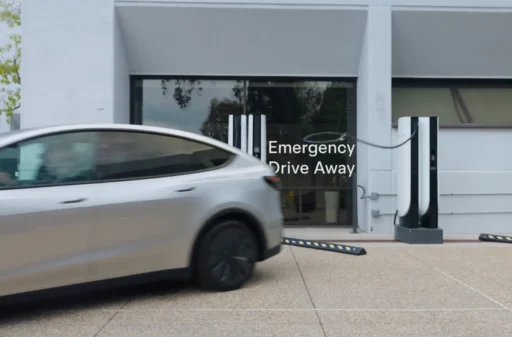
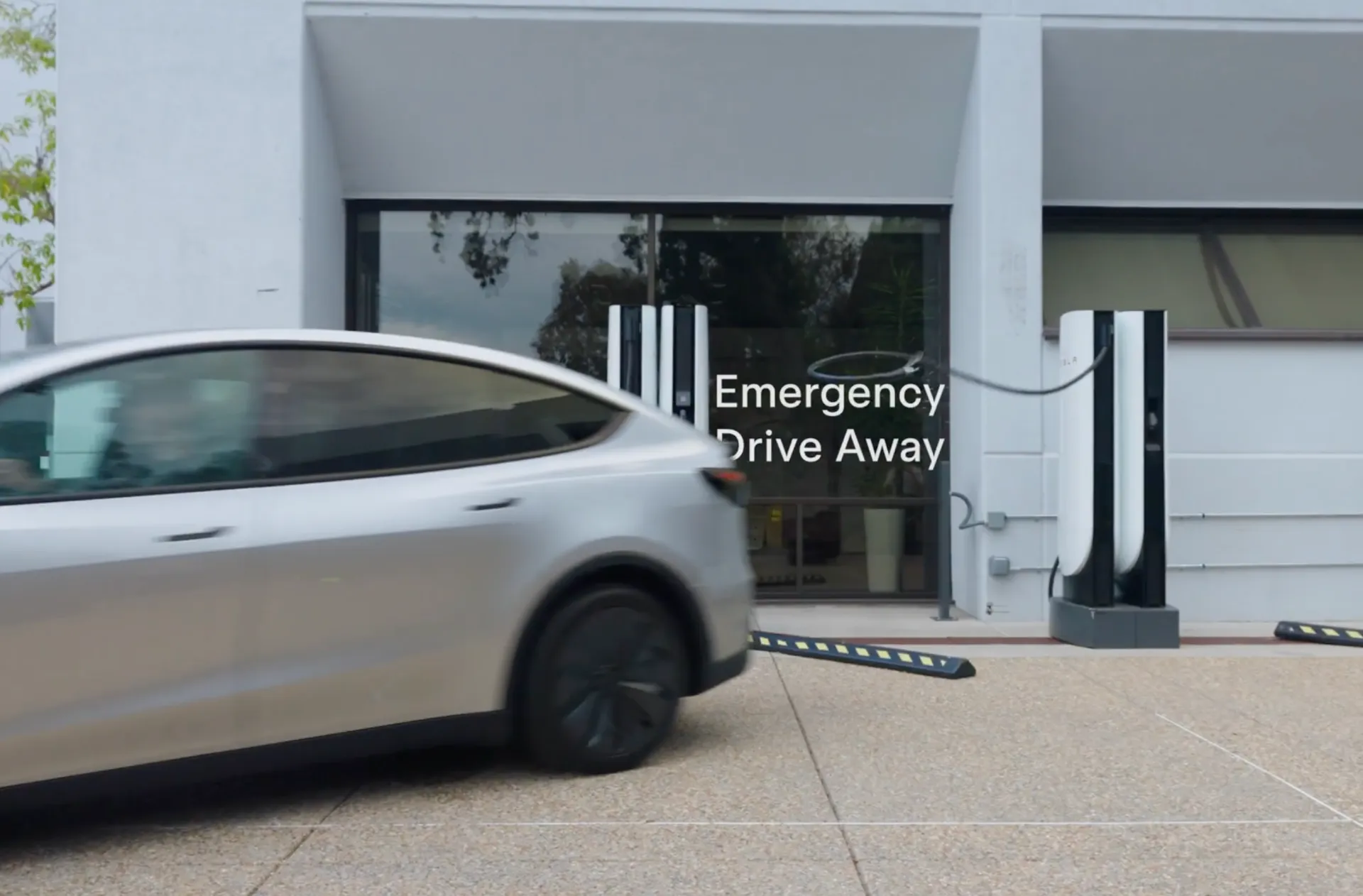

Tesla has introduced an Emergency Drive Away feature that lets drivers leave a U.S. Supercharger during an emergency without first getting out of the vehicle to remove the charging connector.
The feature is being distributed through over-the-air software update 2026.38.3. It works at U.S. Superchargers without new station hardware or a separate adapter, Tesla said. Model S and Model X vehicles built before 2021 are not supported.
Tesla Charging announced the feature on X and posted a video demonstrating how it works. Under normal operation, a Tesla cannot leave Park when a charging connector is attached. Emergency Drive Away lets a driver override that restriction when leaving immediately is necessary.
Emergency Drive Away lets you shift into Drive while still plugged into a Supercharger pic.twitter.com/40GSzyP4lG
— Tesla Charging (@TeslaCharging) October 1, 2026
How the feature works
A driver starts the emergency process by attempting to put the car into Drive with the Supercharger connector still attached. An Emergency Drive Away message then appears on the vehicle’s display, where the driver keeps the brake pedal pressed and selects “Activate.”
The vehicle can then leave the charging stall with the connector attached. Tesla’s demonstration depicts the charging connection separating as the car moves away.
Tesla warns that the procedure will damage the vehicle and Supercharger equipment, so the company says it is intended for emergencies. Deliberate misuse could result in penalties, though Tesla has not publicly detailed what those penalties would be.
Tesla Charging has said the electrical and civil costs tied to damage at some Supercharger locations could reach $25,000. A charge-port service visit is required after the feature is used. A recording of the event is sent to Tesla when Emergency Drive Away is activated.
Tesla debated the feature for years
Max de Zegher, Tesla’s senior charging executive in North America, described Emergency Drive Away as a feature the company hopes customers never need. De Zegher said Tesla considers safety when selecting Supercharger sites and relocates stations it deems unsafe. He said Tesla had debated this type of escape function for years before deciding to release it.
He asked customers not to abuse the feature so Tesla would not have to restrict access to it. Tesla plans to improve the system using feedback after the launch.
The change gives drivers another option during a threat at a charging site. Tesla’s standard charging procedure requires a driver to release the connector latch and pull the handle from the charge port before leaving. During an emergency, those extra steps could keep the vehicle stationary at a time when the driver wants to leave immediately. Emergency Drive Away removes the normal software restriction, accepting possible vehicle and charger damage in the process.
Tesla chose software instead of an adapter
Tesla’s approach does not require customers to buy emergency breakaway hardware. Compatible vehicles receive the function through software 2026.38.3, with no changes required at U.S. Supercharger stalls.
Third-party company EVject has offered an Escape Connector that sits between a charging cable and an EV, allowing the connection to separate when a driver leaves during an emergency. Tesla sued EVject in 2024 over alleged overheating risks involving an earlier version of its connector, and the original connectors were later recalled.
Tesla’s own feature takes a different route. The car permits an emergency departure using its existing charging connection, removing the need for another device between the Supercharger handle and vehicle. But the connection is not intended to separate without damage. Tesla explicitly warns owners that using Emergency Drive Away will damage the car and Supercharger.
Older Model S and Model X vehicles excluded
Emergency Drive Away requires software version 2026.38.3, and Tesla has excluded Model S and Model X vehicles produced before 2021.
Tesla has not announced a retrofit that would bring the function to those older vehicles. Its first-responder documentation treats 2021 and later Model S and Model X vehicles separately from earlier generations, though Tesla’s public material on Emergency Drive Away has not given a technical explanation for the cutoff.
Availability is limited to U.S. Superchargers at launch. Tesla has said the U.S.-only restriction applies at present, but it has not published a schedule for other countries.
Tesla has yet to explain several parts of the policy surrounding Emergency Drive Away, including the exact penalties that could apply when the company determines that a driver deliberately misused it. The company has not given a date for international availability, and no retrofit plan has been announced for unsupported older Model S or Model X vehicles.
For supported Tesla owners in the United States, the feature changes a long-standing charging restriction. A connected Tesla normally stays in Park until the charging cable is released. With software 2026.38.3, a driver facing an emergency can override that restriction and leave, accepting the resulting damage to the vehicle and charging equipment.
We’ve launched an official Tesla Owners Online Forum. Join early and claim your "Founding Fuel" badge.