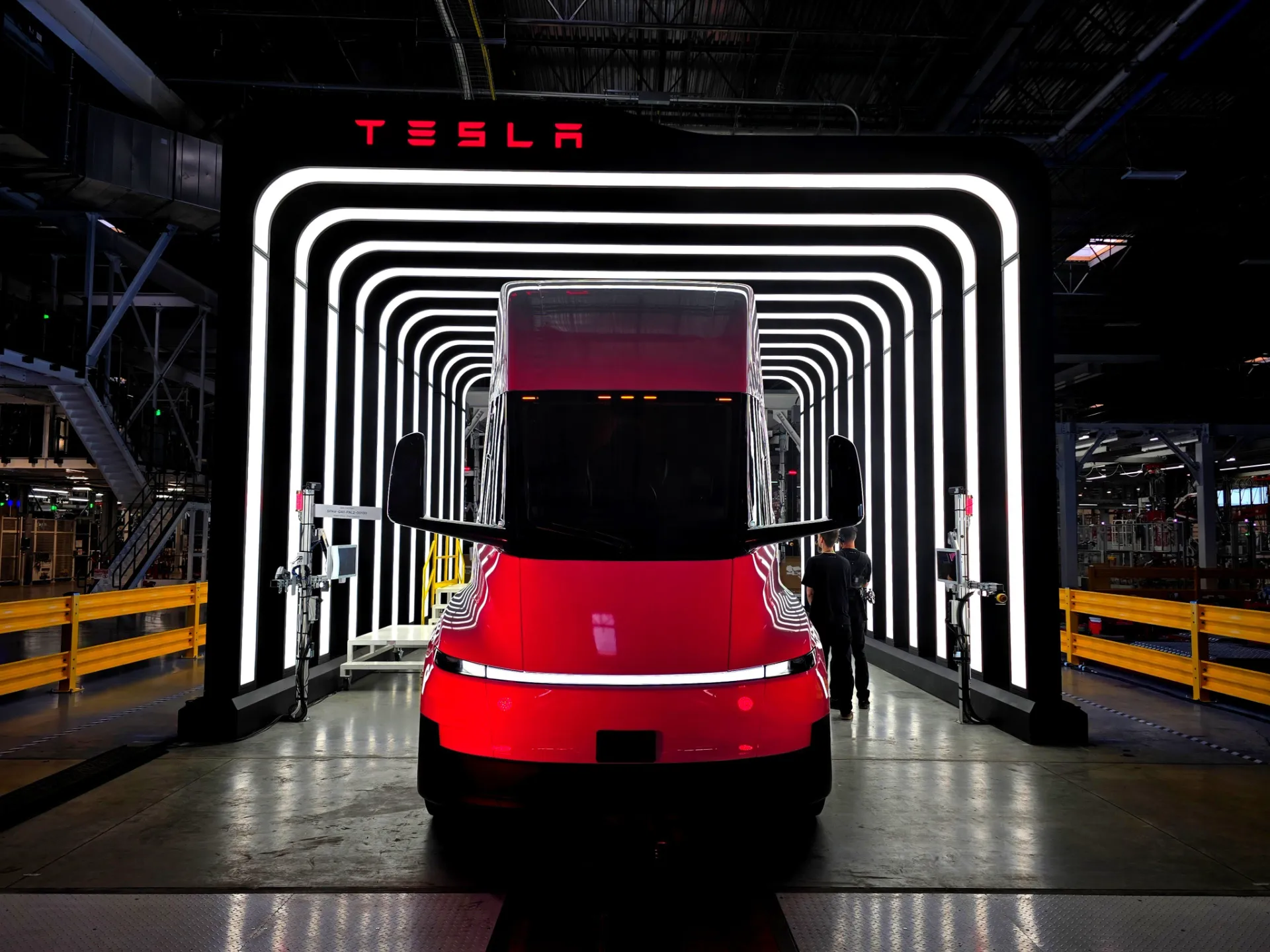

Tesla has started customer deliveries from its dedicated Semi factory in Nevada, putting the electric Class 8 truck into a new stage nearly nine years after Elon Musk introduced it in 2017.
Executives confirmed the latest deliveries during a September 24 event at Tesla’s plant in Sparks, Nevada. The company is moving beyond the limited production program that supplied early trucks to PepsiCo and other fleet operators, with a dedicated factory now supporting larger-scale output.
Semi is here
— Tesla Semi (@tesla_semi) September 25, 2026
Today, we're launching high volume production pic.twitter.com/QQjYDmcPsf
Tesla has set annual capacity at 50,000 Semis once the plant reaches its planned production rate. That figure describes factory capacity rather than current output, since Tesla has yet to publish a present annualized production rate for the new line.
Tesla delivered its first limited-production trucks in late 2022 after years of delays, then spent several more years preparing a dedicated production system in Nevada. The first truck from the new high-volume line rolled out in April 2026.
Tesla’s dedicated Semi plant covers about 1.7 million square feet near its existing Nevada operations. The company has planned the facility for annual capacity of 50,000 trucks, which would put output near 1,000 units per week at full production.
The factory takes more manufacturing work inside Tesla rather than relying on outside suppliers for every major assembly. Production includes battery-related work, drive axles, stampings, cooling hardware, seats and other truck components.
The line is intended to support several versions of the truck. Tesla currently lists Standard Range and Long Range configurations for the U.S. market, plus a separate European specification prepared around regional weight, charging and operating requirements.
Two U.S. versions cover different freight routes
Tesla currently lists its Standard Range Semi at an estimated 325 miles per charge. The Long Range truck carries an estimated 500-mile rating. Both figures use an 82,000-pound gross combination weight under Tesla’s stated test conditions.
Energy consumption is listed at 1.7 kWh per mile for both configurations. Tesla states that its estimates use a speed of 55 mph on flat ground at 20 degrees Celsius with specified aerodynamic equipment and a CARB-compliant dry van trailer. Tires, trailer setup and roof fairings can change real operating results.
The Standard Range truck has a listed curb weight below 20,000 pounds. The Long Range version comes in at 23,000 pounds, with each rated for an 82,000-pound gross combination weight. Tesla lists drive output at up to 800 kW for both trucks, along with an electric take-off system rated at up to 25 kW.
Those figures give fleet operators two different options. Shorter regional routes can use the smaller-range truck, whereas operations requiring longer daily distances can use the 500-mile version.
New 4680 battery packs cut the required capacity
Battery size has been one of the biggest questions surrounding the Semi since Tesla introduced the truck. Regulatory information reported from a California Air Resources Board filing put usable battery capacity at 548 kWh for the Standard Range Semi and 822 kWh for the Long Range version. Both were identified as using Tesla’s 4680-format cells with NCMA lithium-ion chemistry.
The Long Range figure is lower than earlier estimates surrounding the Semi. Elon Musk had referred to a battery near 900 kWh in 2022, yet the production specification reported through the regulatory filing came in at 822 kWh. Tesla still lists the Long Range truck at 500 miles under its stated test conditions.
A smaller battery can reduce vehicle mass and material use, two major issues for an electric heavy truck. Battery weight affects available payload, so reducing pack capacity without cutting the rated driving distance can help the truck remain useful for commercial freight.
Cost is another factor. Fewer cells can reduce the amount of battery material required for each vehicle, though Tesla has not released enough Semi-specific cost data.
Weight reduction became a major engineering target
Tesla changed the Semi during the years between the first prototype and the production truck. One goal was lower vehicle weight. Reports from the production program put the reduction at about 1,000 pounds compared with earlier versions.
That work carries extra importance in trucking. A tractor that weighs more can leave less capacity for revenue-producing cargo when operating under legal gross-weight limits.
Tesla has paired the weight work with changes across the drivetrain, battery system, cab and supporting hardware. Some components use manufacturing methods related to technology already found elsewhere in Tesla’s vehicle lineup, including Cybertruck.
The production drivetrain includes changes to motor construction aimed at lowering manufacturing cost and meeting the long service requirements of commercial trucking. Tesla has discussed features such as a steel-caged rotor and a bar-wound stator architecture linked to manufacturing work used on Cybertruck.
Reliability will need to be judged through longer fleet service. Heavy trucks can accumulate far more annual mileage than passenger vehicles, so durability data will become clearer as customer fleets put more production Semis into daily use.
Electric steering changes the driving hardware
The Semi uses electric steering assistance rather than the conventional hydraulic assistance found on many heavy trucks. Tesla says the system cuts weight and noise while giving the driver more precise steering response. The truck retains a mechanical steering connection rather than using Cybertruck’s full steer-by-wire arrangement.
Electric assistance can remove some hydraulic components from the vehicle, which fits Tesla’s broader effort to reduce mechanical parts across the Semi. The company has paired the steering system with independent front suspension, regenerative braking and an electric drivetrain that provides torque without a conventional diesel transmission.
Charging can restore 60% of range in 30 minutes
Charging is one of the central questions for long-distance electric trucking, and Tesla is building its Semi program around high-output Megachargers. The company states that the U.S. Semi can recover up to 60% of its driving range in about 30 minutes. Tesla’s current U.S. specifications list the truck with up to 1.2 MW charging capability.
For the Long Range model, 60% of the 500-mile rating is about 300 miles under the stated test conditions. Tesla has been deploying Megacharging equipment at fleet sites and along freight corridors. Public infrastructure remains part of the challenge since megawatt-class truck charging places far greater demands on electrical connections than ordinary passenger-car charging.
Real fleet data puts consumption near Tesla’s target
DHL has supplied one of the clearer independent fleet data sets for the Semi. During an earlier two-week trial in California, DHL operated the truck for more than 3,000 miles on normal routes. One long-distance run covered 390 miles with a gross combined weight of about 75,000 pounds.
DHL reported average consumption of 1.72 kWh per mile during testing, close to Tesla’s current 1.7 kWh-per-mile specification. The truck spent more than half of its operating time above 50 mph during the test.
DHL later took delivery of its first Tesla Semi in December 2025. At that time, the company said its North American Class 8 electric fleet had grown beyond 150 vehicles across several manufacturers.
Electricity changes the operating-cost calculation
At 1.7 kWh per mile, a Semi traveling 100,000 miles in a year would consume about 170,000 kWh under the same consumption assumption.
A diesel tractor averaging 7 mpg would burn about 14,286 gallons across the same distance. From there, the calculation depends on local energy prices. For example, multiplying 170,000 kWh by a fleet’s effective electricity rate gives its annual charging energy expense. Multiplying 14,286 gallons by the local diesel price gives the comparable diesel fuel expense.
Tesla says electricity can cost less than diesel and electric trucks have fewer components requiring regular maintenance.
PepsiCo became the best-known early Semi customer when Tesla began limited deliveries in December 2022. Those early vehicles gave Tesla operating data before the dedicated Nevada production line was ready. DHL later ran its own trial, then accepted its first Semi in December 2025. So, the Semi has already demonstrated that it can move commercial loads over long routes.
Europe gets a different Semi specification
Tesla is preparing a Semi for Europe, where truck dimensions, weight limits, charging standards and freight routes differ from those in North America.
Tesla’s European site lists an estimated 550-kilometer range at a 40-ton gross combination weight. Energy use is estimated at 1.0 kWh per kilometer, with curb weight below 9,100 kilograms. Charging differs from the U.S. specification. Tesla lists the European truck with up to 800 kW charging and says it can recover as much as 60% of its estimated range in 30 minutes.
The European specification includes an electric take-off system rated at up to 25 kW, which can support equipment that would otherwise need a separate energy source.
Tesla says European customer deliveries are scheduled to start in 2027. That market will give Tesla a different test. European freight routes often involve different road layouts and vehicle rules from U.S. interstate trucking, so the regional truck cannot be treated as a direct copy of the American version.
The Semi took nearly nine years to reach this stage
Musk introduced the Tesla Semi in November 2017, with production initially planned much earlier than what followed. The schedule slipped several times. Tesla eventually delivered a small number of trucks to PepsiCo in late 2022, using a limited production setup rather than the dedicated high-volume plant now operating in Nevada.
Tesla then spent the following years refining the vehicle and building its Semi factory near the Nevada Gigafactory. In April 2025, Semi program head Dan Priestley said the facility was being prepared for high-volume production and carried planned capacity of 50,000 units per year.
The first Semi from the new high-volume line appeared in April 2026. Customer deliveries from the new production program are now starting.
The 50,000-unit figure is the plant’s planned annual capacity, not evidence that Tesla is already building 50,000 Semis a year. Reaching that level would require a production ramp from the factory’s current output, which Tesla has yet to quantify.
We’ve launched an official Tesla Owners Online Forum. Join early and claim your "Founding Fuel" badge.