
Elon Musk sees a future where your car talks to satellites, and he says the rest of the auto industry will follow. Terrestrial cell networks won’t be enough to handle the data needs of the future vehicle fleet.
The billionaire CEO presented his argument succinctly in a post on X. Responding to a user about connectivity, Musk wrote, “All cars will have Starlink in the future. It’s the only way to get super high bandwidth to billions of vehicles.”
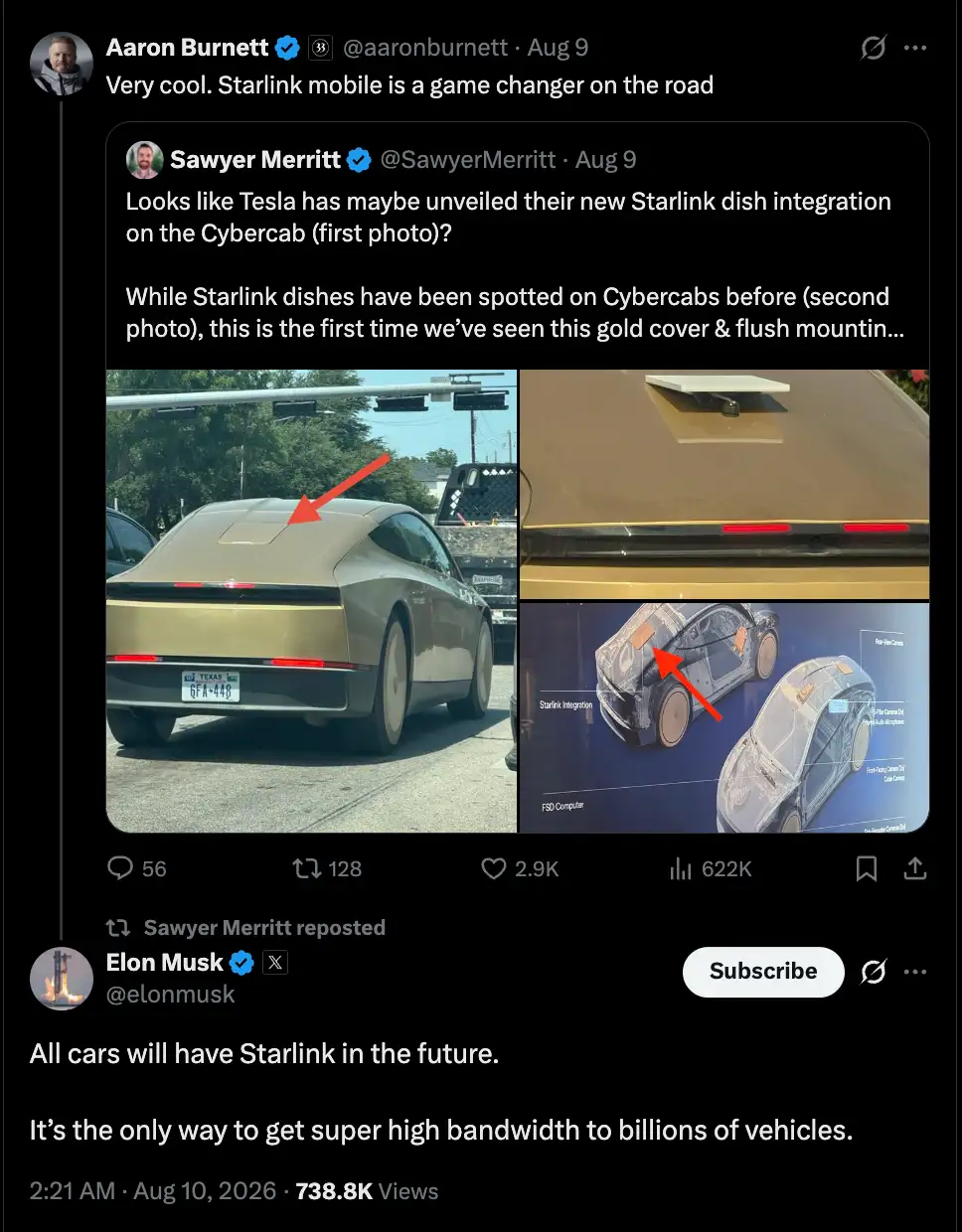
His statement sets up satellite internet as a universal standard for the auto industry. Right now, most modern cars rely on 4G and 5G cellular networks for navigation, over-the-air updates, and entertainment. But Musk believes that as cars become fully autonomous and billions of them hit the road, those ground-based networks will face bandwidth limits and coverage gaps.
Starting With the Cybercab
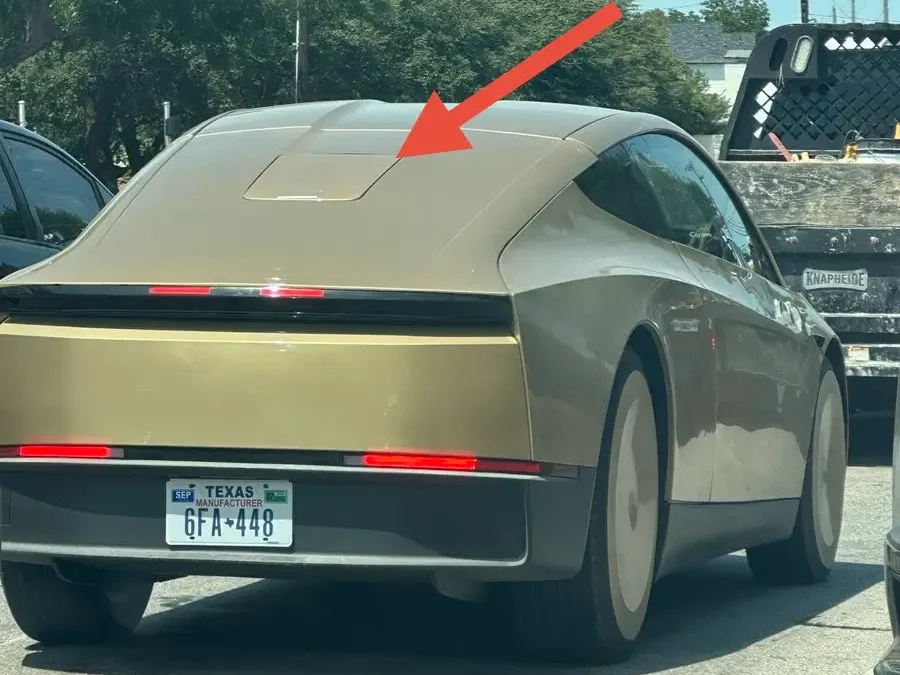
While Musk talks about all cars getting the hardware eventually, the actual rollout is starting much smaller. Tesla and SpaceX officially confirmed in late July 2026 that the upcoming Cybercab will be the first vehicle to feature built-in Starlink connectivity.
The company shared diagrams showing a compact Starlink V5 antenna integrated directly into the roof structure of the robotaxi.

The V5 hardware is smaller than previous generation dishes, and it sits near the vehicle’s standard GPS and 5G LTE antennas. This is a clean, factory-installed design, far different from the bulky external dishes sometimes strapped to prototype vehicles.
Musk noted in July that “Starlink will be integrated into all our vehicles,” pointing to a fleet-wide strategy for future production lines. However, Tesla has not announced any retrofit programs for current owners of the Model 3, Model Y, or Cybertruck. And, it seems the hardware will be added to vehicles as they are built, with the Cybercab acting as the launch platform.
You might wonder why a car needs an internet connection from space. Tesla executives say it’s about fleet management and the passenger experience, rather than core safety.
Ashok Elluswamy, Tesla’s Vice President of AI Software, clarified how the system works. He explained that a connection to Starlink is not required for the vehicle’s autonomous driving systems to function safely. The car’s onboard computers handle the driving decisions. Instead, the satellite link handles background tasks.
“Connectivity is primarily meant for navigation, customer service and, in general, fleet management,” Elluswamy wrote on X.
A persistent connection helps Tesla operators keep track of the robotaxi fleet, push immediate software updates, and fix issues remotely. When a cybercab drives into a rural area or a crowded event where local cell towers are jammed, the Starlink connection keeps the data flowing.
There is also a strong consumer pitch. Musk highlighted the entertainment value, noting that riders will be able to “watch 4K streaming video while Cybercab takes you anywhere you want.” The V5 antenna can handle download speeds over 375 Mbps, which easily supports high-definition video and gaming for passengers who no longer need to watch the road.
The Road Ahead for the Auto Industry
If Musk’s vision plays out, the entire auto industry will need to rethink vehicle connectivity. Legacy automakers currently partner with telecom companies like AT&T and Verizon to keep their cars online. Moving to a satellite-first approach would require new hardware, new partnerships, and navigating a complex web of international regulations, since satellite frequencies are tightly controlled by local governments.
Tesla is creating a unique advantage here. By combining SpaceX’s massive satellite constellation with Tesla’s vehicle manufacturing, Musk’s companies are building a closed-loop system that rivals will struggle to match quickly. It creates a seamless data pipeline for Tesla’s Full Self-Driving development while turning the car into a mobile hotspot.
We don’t know yet how much this will cost the average buyer. Tesla has not announced pricing structures or detailed whether Starlink data will be part of the standard Premium Connectivity package or a separate subscription tier.
Musk’s weekend post clearly outlines his long-term goal. He views satellite bandwidth not as a luxury add-on, but as a hard requirement for the next generation of transportation. Now, the rest of the market has to decide if they agree.
We’ve launched an official Tesla Owners Online Forum. Join early and claim your "Founding Fuel" badge.