


Tesla is preparing an update to steer around potholes in its Full Self-Driving software. The upcoming feature builds on recent neural network improvements and fulfills a long-standing request from vehicle owners.
Musk confirms incoming update
Tesla CEO Elon Musk confirmed that pothole avoidance will arrive soon for drivers on Full Self-Driving Supervised.
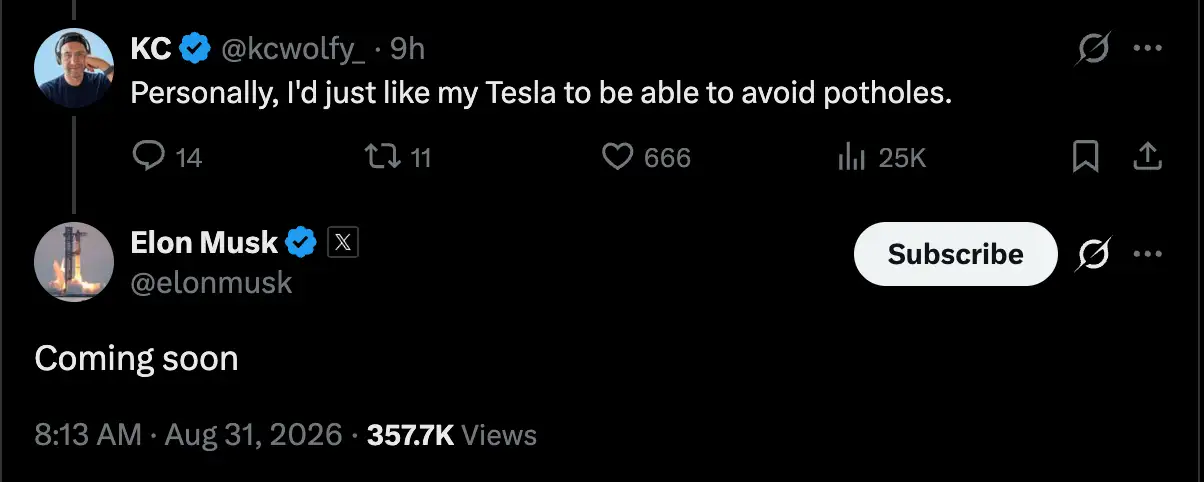
His comment on social platform X answers a feature request that drivers have raised for years. In August 2020, Musk stated Tesla engineers started labeling road bumps and deep holes so vehicles could slow down or move around road hazards when traffic allowed. Later, he tied automated pothole handling to larger neural network training models that run inside recent software updates.
Release notes list feature additions
Official documentation for recent firmware releases lists pothole avoidance under upcoming improvements. For instance, release notes for version 2026.26.6.5 identify pothole avoidance alongside broader machine reasoning and sensitive driver monitoring systems. Earlier builds like version 14.3 introduced rewritten AI compilers with faster vehicle reactions. But Tesla engineers continue testing these road surface detection tools across internal test cars before wider deployment.
Drivers noticed the vehicle steering around road divots in real traffic tests without dedicated menu settings. During testing on version 14.2.2.5, a vehicle adjusted its position to place a pothole between its wheels rather than striking the edge. In fact, engineers credit the end-to-end neural architecture for learning these avoidance moves from millions of human video clips. The system uses an occupancy network of three-dimensional voxels to detect changes in pavement elevation.
Technical limits and road conditions
Camera vision faces real physical hurdles when dealing with wet streets, rain puddles, and tree shadows. Standing water can hide hole depth from external sensors, and dark shadows sometimes cause false steering adjustments. In dense city traffic, the software keeps lane discipline first instead of risking contact with other cars or painted lines. So drivers must stay attentive to avoid cracked wheels or suspension damage on severe roads.
Tesla maintains that the software operates as a Level 2 driver assistance program. And the company requires owners to keep their hands ready to steer at any second. Future builds like version 15 will extend these tools, but human oversight remains mandatory across all consumer vehicles. Therefore, drivers should treat incoming road surface tools as assistance rather than full automation.
We’ve launched an official Tesla Owners Online Forum. Join early and claim your "Founding Fuel" badge.