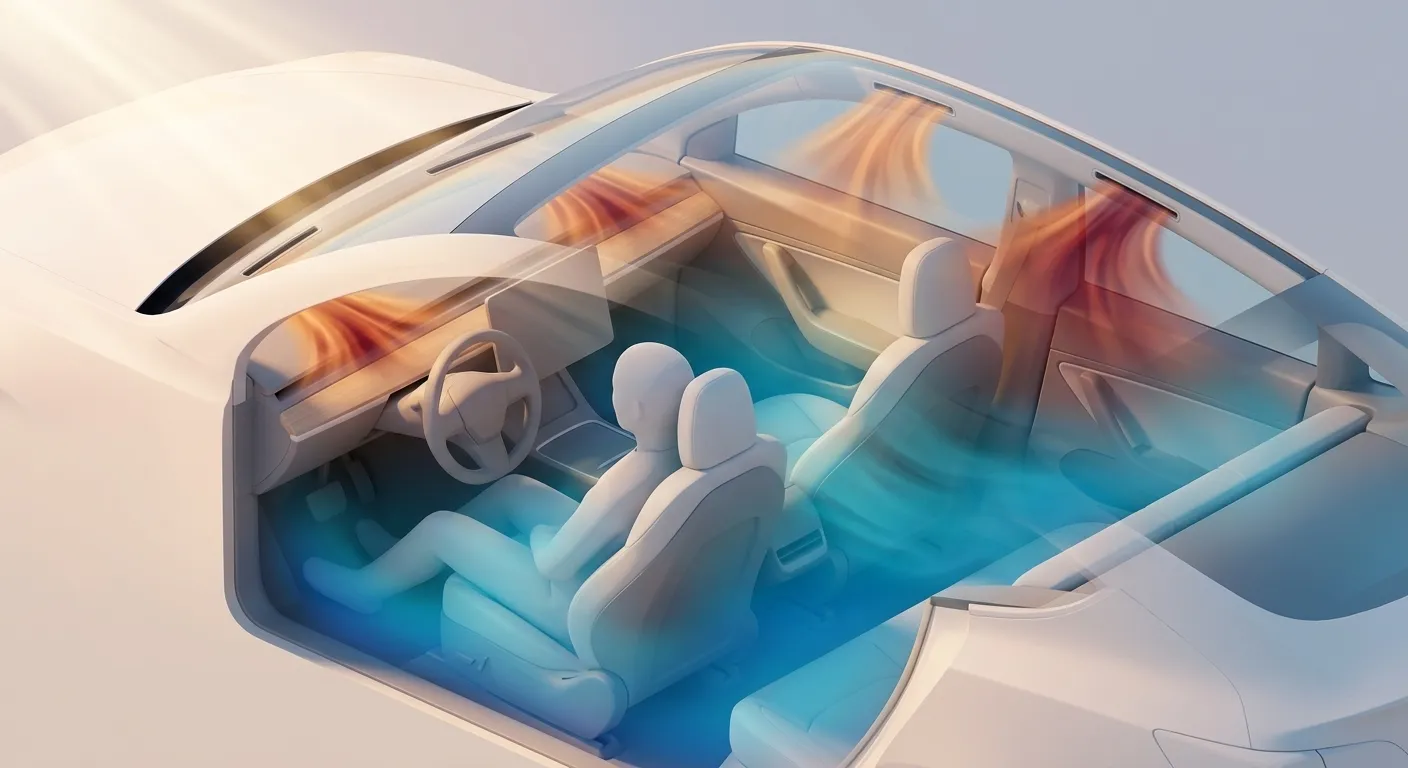

More driving range does not always start with a larger battery. Sometimes it starts with cabin heat, which can push air conditioning load higher after a vehicle sits in the sun. In an April 2026 patent filing, US20260091643A1, titled “Airflow Optimization for Cabin Comfort,” Tesla lays out a climate system that pulls hot air away from the windshield and roof glass before that heat spreads through the interior.
Traditional cooling pushes cold air into a cabin where hot air sits near the ceiling and cooler air stays lower down. And that layered condition can leave passengers cold in one spot and hot in another. For vehicles with large glass areas, including the Cybertruck, the issue gets worse when solar heat builds under the windshield and roof glass.
Why standard cooling falls short
Tesla says this common setup creates entrainment, a fluid effect in which a fast jet of cold air drags stagnant hot air down into the passenger space. The cabin never settles, the compressor stays under heavy load, and range falls as the system keeps running at full tilt. So the car uses more energy, and the cabin can still feel uneven.
That is the core problem Tesla is trying to fix. Instead of forcing more cold air into the cabin, the company wants to remove the hottest air before it mixes with the rest of the interior. And that changes the airflow path at the source, near the glass where the heat is strongest.
How the system works
Tesla’s answer is a set of hidden suction intakes in the dashboard and roof lining, and those inlets pull the hottest air into an extraction duct before it can spread across the cabin. The duct carries that air back into the climate system, so cooling starts closer to the heat source. That layout can lower the need for high blower speed, and it can cut the load on the compressor at the same time.
The patent says Tesla can reuse the windshield defroster path by reversing airflow with actuators and directional valves. In summer, the same vents inhale hot air from the glass area. In winter, the airflow direction flips and the vents push warm air onto the windshield for defrosting.
A control system manages the setup with data from cabin temperature sensors, outside weather inputs, and sunlight intensity readings. It can open or close the suction intakes and adjust blower speed without driver input. So the system is not running at one fixed setting, and it can react as cabin conditions change.
Tesla included test data that compares the new layout with a standard setup. In the filing, engineers report about 500 watts less continuous energy draw, which would save about 2.5 kilowatt-hours over a five-hour summer drive and add about 8 to 10 miles of range. The same data says head-level temperature in a conventional setup reached 46 degrees Celsius, chest-level temperature sat near 25 degrees Celsius, and the new system improved upper-body temperature uniformity by 12 degrees Celsius.
Cabin comfort and future use
Tesla says the result is a tighter “comfort bubble” across the face and upper body, with temperatures kept between 21 and 33 degrees Celsius instead of the usual “frozen nose and sweaty neck” feeling. That gain comes from more even air distribution, and from removing heat before it drops into the seating area.
The approach addresses a long-running cabin issue tied to large glass roofs, yet it avoids adding a separate visible vent network across the dashboard.
The filing says the ducting can be scaled for larger cabins such as the Cybertruck, and it even discusses suction points near the rear parcel shelf or around the driver seat to clear local heat pockets. For Tesla’s future robotaxi service, a quieter climate system and steadier cabin temperature could help keep passengers comfortable during long daily use. And from Tesla’s view, that same setup could preserve range without adding a larger battery.
You can view the full patent below:
You may also like to read:
- Tesla files patent for new interior clip to stop cabin rattles »
- Tesla files patent for Optimus V3 hand with 22 degrees of freedom »
- Tesla files patent for software-controlled 6-DOF hypercar seat frame »
- Tesla patent maps out occupant-based control for HOV and carpool access »
- Tesla patent offers new life for HW3 FSD computers »
We’ve launched an official Tesla Owners Online Forum. Join early and claim your "Founding Fuel" badge.