Tesla has filed a new U.S. patent application titled “Vehicle Suspension Control System,” published on May 14, 2026 under pre‑grant number US2026/0131614 A1. The utility application, filed January 9, 2026 as Application No. 19/444,705, lists Tesla, Inc. as the applicant and names Blane Frye as the first inventor alongside five co‑inventors.
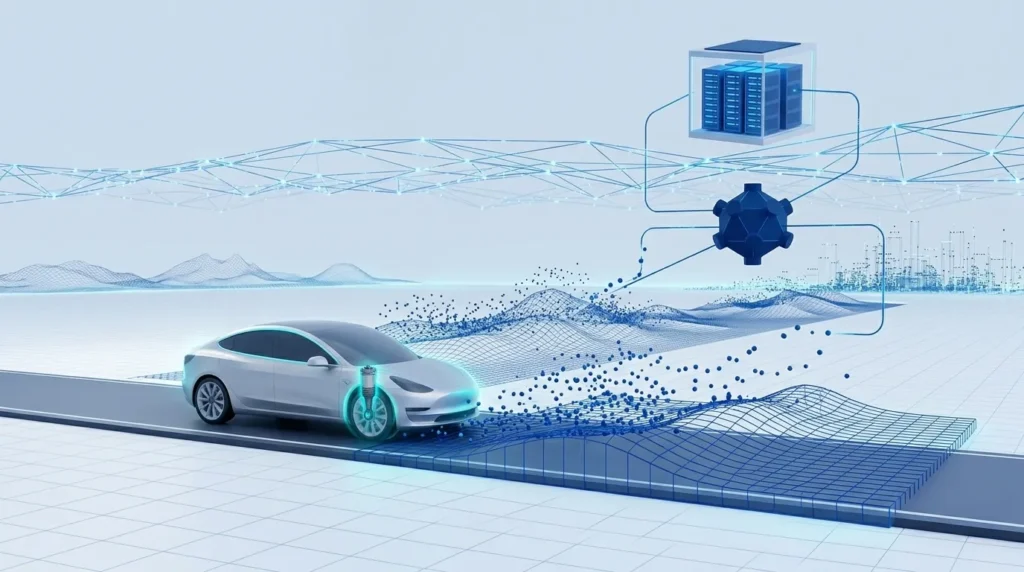
According to the filing, the system links a vehicle’s suspension to a cloud‑hosted “road roughness map” built from sensor data shared across the Tesla fleet, then adjusts ride height and stiffness in advance of potholes and broken pavement.
Breaking the range‑versus‑comfort tradeoff
Traditional suspensions react only after a wheel hits a bump, so the initial impact is still transmitted into the cabin even with fast adaptive dampers.
EVs face an extra penalty. To get enough suspension travel for comfort, automakers usually raise ride height, which increases aerodynamic drag and cuts highway range. Tesla’s patent tackles this by keeping the car in a low, aero‑efficient stance for most of a drive, then briefly pre‑adjusting the suspension only where the road is known to be rough.
By timing lift events to specific hazards instead of entire routes, the system aims to preserve energy savings from a “slammed” highway posture while smoothing out the worst impacts.
How the predictive suspension works
At the heart of the invention is a cloud‑based road roughness map generated from millions of data points collected by Tesla vehicles acting as telemetry probes. Each car uploads GPS‑tagged acceleration and suspension‑movement data whenever it encounters significant bumps, allowing Tesla’s servers to build a highly granular profile of road conditions worldwide.
To distinguish normal rolling undulations from serious defects, the system applies band‑pass filters that focus on vertical vibration frequencies associated with harsh impacts rather than slow body motions like pitch and roll.
The patent describes using time‑decay weighting so that recent sensor reports count more than older ones, ensuring that repaired sections quickly “disappear” from the roughness map as new, smoother data comes in. The backend also requires a consensus from multiple vehicles before a hazard is formally added, preventing a single noisy sensor or erratic maneuver from polluting the database.
Once the map flags a segment as rough, upcoming vehicles download that information over the network and pre‑configure their air suspension as they approach, instead of waiting for an onboard sensor to feel the impact. When a car enters a region where a high fraction of route segments exceed a roughness threshold, the control system raises the suspension and may adjust damping across that entire stretch.
If the rough segments are dense and continuous, the car stays elevated through the zone; if they are isolated, the system can lift only briefly and then return to a low‑drag stance.
Lane‑level precision and vision integration
Because hazards often sit in just one lane or on one side of the road, Tesla’s patent pushes accuracy down to the lane level instead of treating an entire road segment as uniformly rough.
Onboard cameras and a machine‑learning model detect lane markings and determine which virtual “data lane” of the roughness map the car currently occupies. If only the right lane is cratered while the left remains smooth, the car can stay low and stiff while in the clean lane and only raise itself if the driver or FSD system initiates a lane change into the damaged path.
The same trajectory‑aware logic allows the system to anticipate upcoming exits or turns: it will pre‑lift when navigation indicates the vehicle must cross a rough patch, even if it is currently traveling in a smooth lane.
This fusion of cloud data, GPS, and real‑time computer vision effectively turns Tesla’s fleet into a shared “nervous system” for road quality, with each car benefiting from what every other car has previously felt.
Energy‑aware comfort and robotaxi implications
The patent goes beyond comfort by tying suspension decisions directly to battery state of charge and trip length, effectively assigning an efficiency “budget” to how soft the ride can be.
When the battery is high relative to the remaining distance, the system can raise the vehicle more often and smooth even moderate imperfections; when energy is tight, it stays low and only lifts for severe, vehicle‑threatening impacts. Prior studies and industry tests have shown that lower ride heights can improve EV efficiency by several percent at highway speeds, which in practice can translate into dozens of extra miles of range.
By combining aero‑optimized stance control with predictive rough‑road avoidance, Tesla’s approach is designed to extend real‑world range without forcing drivers to choose between comfort and efficiency.
Tesla already offers map‑based rough‑road raising on current Model S and X with Adaptive Air Suspension, where the car automatically lifts over known bumps and then lowers again.
The newly detailed system dramatically scales this idea, using global fleet data and more advanced algorithms that could be particularly valuable for future robotaxi services, where a consistently smooth ride will be central to customer experience. With over nine million Teslas on the road globally, the company is uniquely positioned to continuously refresh this roughness map and feed its predictive suspension engine at a scale no rival can yet match.
Patent – Vehicle Suspension Control System

You may also like to read:
- Tesla patent hints at unbreakable aerospace-grade vents for silent cabins »
- Tesla gets patent for 2D-to-3D labeling system to speed up Full Self-Driving »
- Tesla files new patent to remove cabin heat and save battery life »
- Tesla files patent for new interior clip to stop cabin rattles »
We’ve launched an official Tesla Owners Online Forum. Join early and claim your "Founding Fuel" badge.