
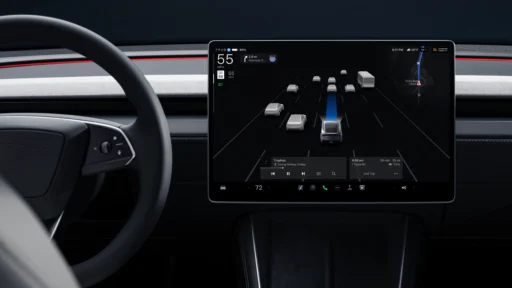
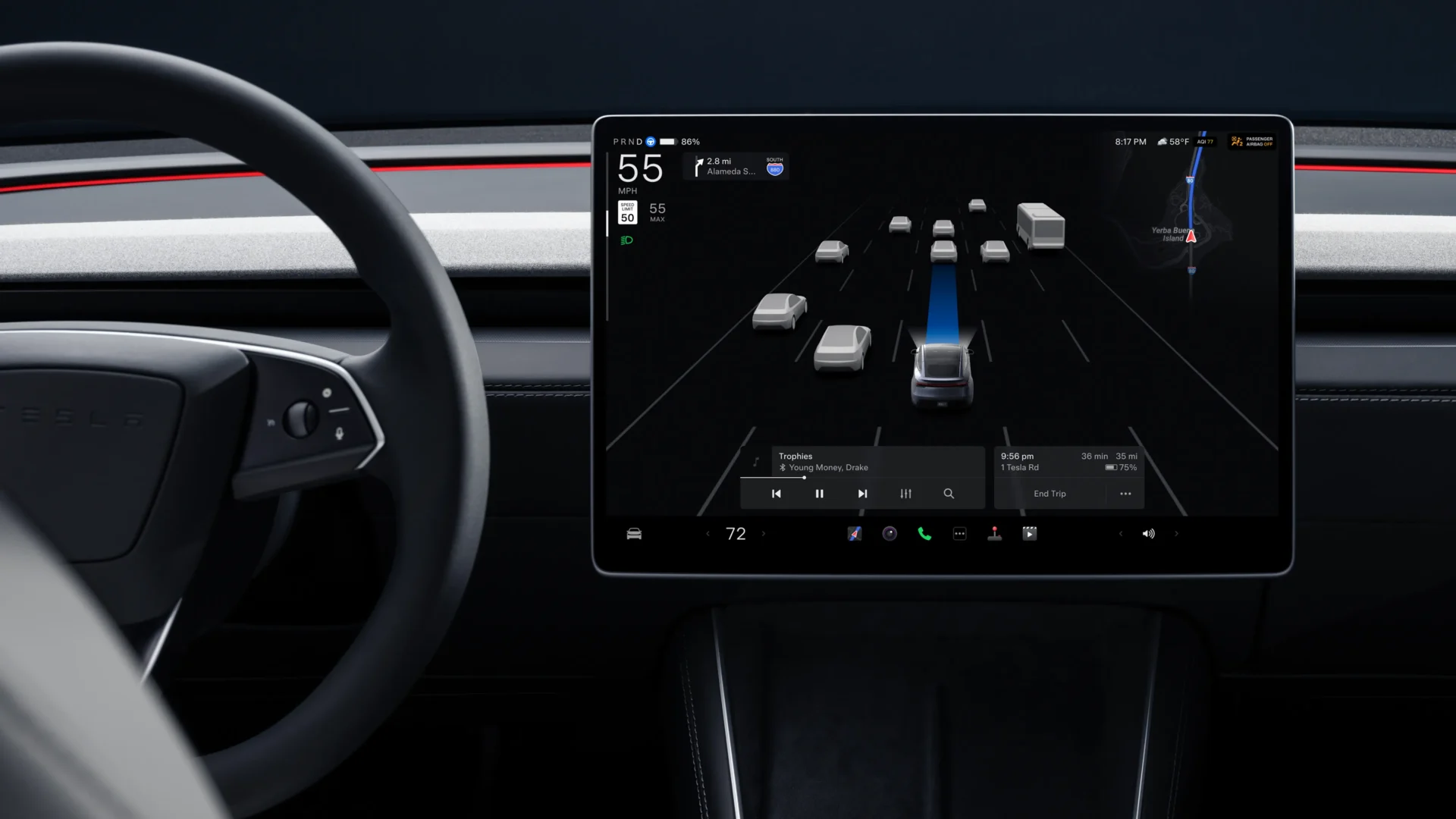

Tesla has started sending Full Self‑Driving (Supervised) version 14.2.2.5 to a small group of cars with AI4 (HW4) hardware. The update comes as part of software build 2025.45.10 and is rolling out in a slow, controlled wave.
Early fleet data points to February 15, 2026, as the first sighting of this build, with only a few cars receiving it and overall adoption still close to zero. Earlier version 14.2.2.4 under build 2025.45.9 had reached a few percent of the FSD fleet by late January, while a related build, 2025.45.9.1, moved toward 10 percent of tracked cars.
Core focus of v14.2.2.5
The release notes for FSD v14.2.2.5 match those from v14.2.2.4, so this update appears aimed at neural network refinements and bug fixes instead of new headline features. Still, the v14.2.2 line already carries a sizeable list of changes, including a higher‑resolution vision encoder, new speed profiles, and more flexible arrival and parking behavior.
The updated vision encoder improves how the system reads camera feeds, helping it detect emergency vehicles, hand gestures, and small obstacles more precisely. Testers of earlier v14.2.2 builds have reported steadier lane centering and fewer late reactions to hazards, especially on curving roads at higher speeds. This build continues to train on that base.
Driving behavior and edge cases
Tesla has added “Arrival Options,” giving drivers choices such as parking lot, street, driveway, parking garage, or curbside when approaching a destination. The car saves these settings per location, and the reasoning model selects a default that fits the address.
The update also leans on new speed profiles, from very cautious “SLOTH” up through more assertive “MAD MAX,” with the right scroll wheel now adjusting profile instead of fine speed offset. More assertive profiles allow higher speeds and quicker moves, while calmer modes keep a larger buffer.
Tesla has also improved responses to emergency vehicles, gates, debris, school buses, and unprotected turns, and tied routing more closely to the vision network to avoid odd detours and missed exits.
Cameras, safety, and interface
On the safety side, the car can warn drivers about residue on the interior windshield that might interfere with the front camera and can trigger a narrow‑field wash on some 2026‑and‑newer Model Y vehicles. Attention monitoring can become stricter when camera confidence drops, prompting more frequent driver checks.
The interface gains a Self‑Driving stats section under Controls > Autopilot, letting owners see how they use FSD over time. Drivers can now start FSD with a tap on the screen from Park or while moving, and the Brake Confirm step for that button is off by default, though normal supervision rules remain.
Beyond FSD, the 2025.45.10 update brings a dashcam viewer upgrade that overlays speed, steering angle, and self‑driving state on clips when owners have Premium Connectivity and an up‑to‑date app. Navigation adds automatic HOV routing based on local rules and user settings, plus a toggle for express lanes in supported regions. Some Superchargers now display 3D site maps with stall status and vehicle types at each stall, while Model S and X drivers get quicker access to air suspension controls from the main menu.
For now, FSD v14.2.2.5 remains a limited rollout focused on AI4 hardware. Owners with FSD active can check Controls > Software over Wi‑Fi to see if build 2025.45.10 is available on their car.
You may also like to read:
- Tesla FSD v14.2.2.4 brings quiet but clear refinements »
- Tesla relaxes FSD transfer timing, tightens rules for Luxe buyers »
- Tesla FSD helps get Georgia man to ER during 4 a.m. heart attack »
We’ve launched an official Tesla Owners Online Forum. Join early and claim your "Founding Fuel" badge.
When will they add functionality to choose the correct garage door at my house to arrive at. It never does.
When will FSD start to detect pot holes and avoid them?