Elon Musk has again said that owners of Tesla vehicles with Hardware 3 who paid for Full Self-Driving will receive a free computer upgrade if that system falls short for unsupervised FSD. He gave that assurance on a quarterly earnings call, and he called the task “painful and difficult” but said the company will carry it out.
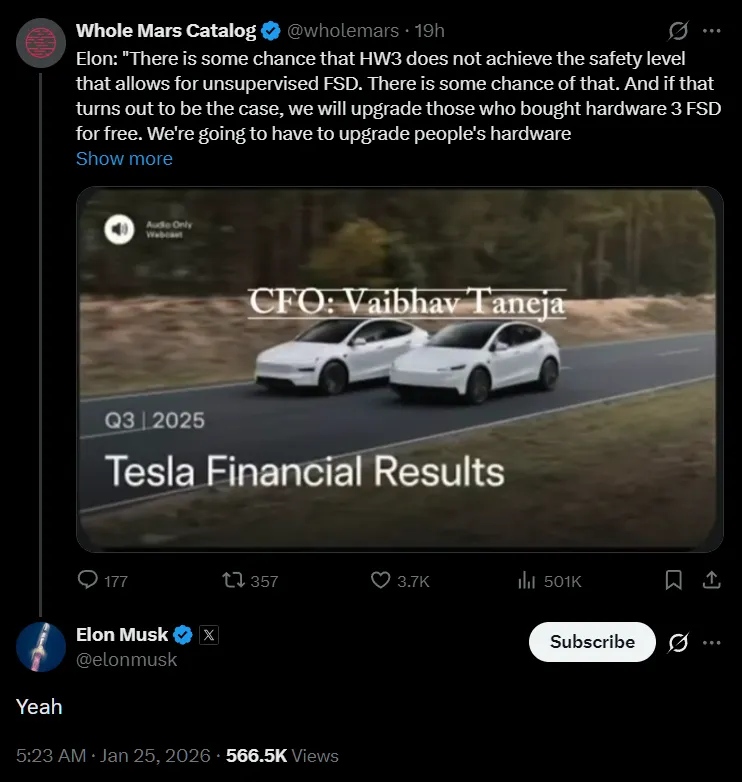
He added that he was “kind of glad that not that many people bought the FSD package,” a remark read as an acknowledgment of the cost risk for Tesla. The pledge only covers drivers who bought FSD outright, so people on the monthly subscription do not have the same guarantee today. Those subscribers may face a paid path to newer hardware later.
V14 lite planned for HW3 in 2026
Tesla is also preparing a software path for HW3 owners while work on unsupervised FSD continues. On the third quarter 2025 earnings call, Tesla AI chief Ashok Elluswamy said the company plans a “V14 Lite” version of Full Self-Driving for Hardware 3 cars once the main V14 series is finished. He said the team “probably” expects that release in the second quarter of 2026, which points to an April-June window. Chief Financial Officer Vaibhav Taneja backed that plan in a personal way, noting that his own daily car still runs Hardware 3.
V14 Lite is expected to bring several behaviors already seen on Hardware 4 vehicles down to the older platform. Owners can expect better handling of construction zones, emergency vehicles and security gates, plus automatic parking at a destination and the current set of speed profiles from Chill through Mad Max.
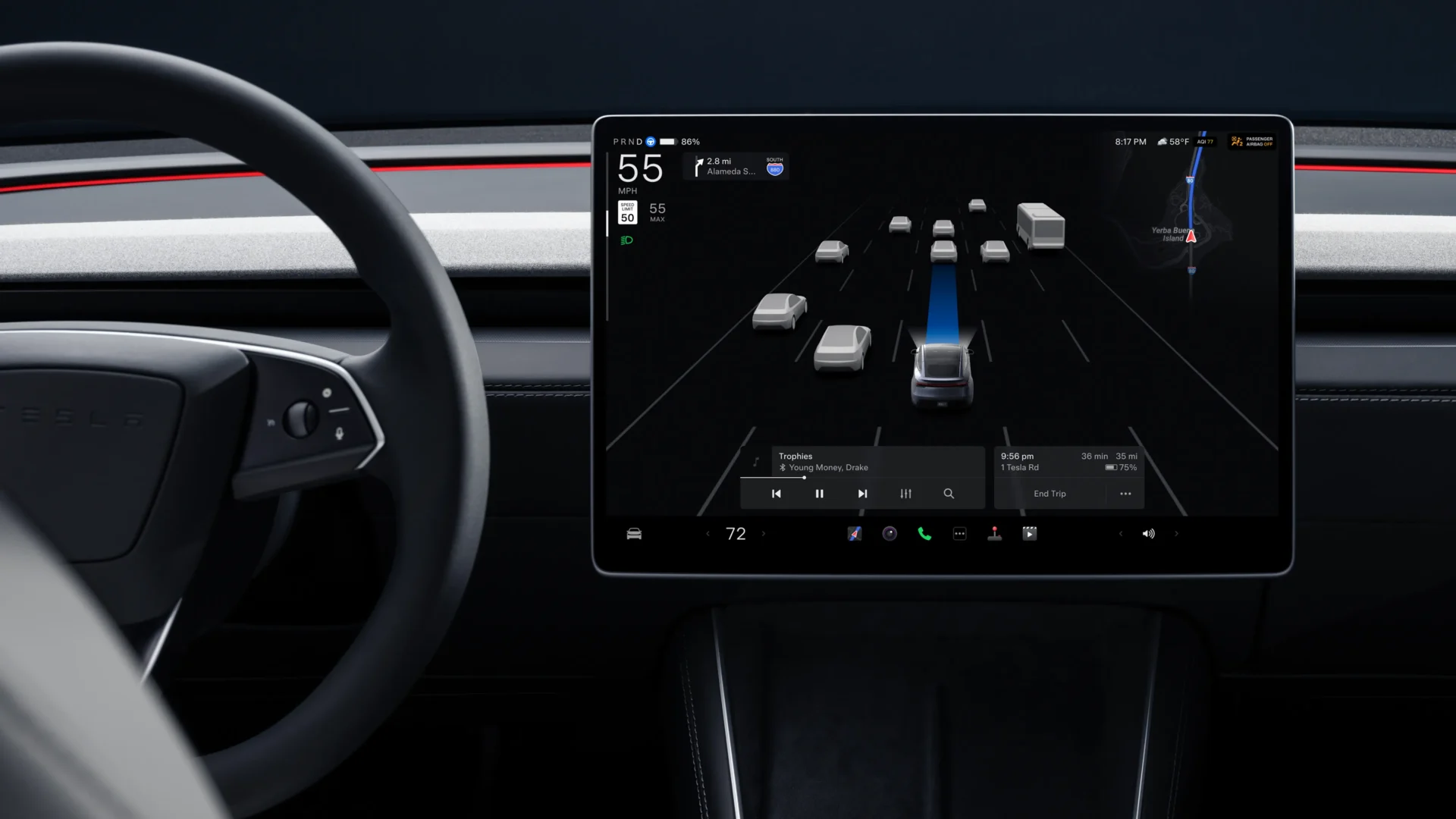
The update is also likely to adjust the user interface to match newer cars, including removal of older Autopilot icons. Still, engineers say V14 Lite will not match the full V14 feature set, since Hardware 3 cannot support the same neural network size or the same video bandwidth.
The tension behind these promises sits in the technical gap between Tesla’s two hardware generations. Hardware 3 carries 8 GB of RAM, 64 GB of storage and camera units around 1.2 megapixels. Hardware 4 doubles the memory, quadruples storage, adds more CPU cores and reaches 5‑megapixel cameras, with performance estimates that run three to five times higher.
Engineers point out that FSD V14 makes use of a neural network around ten times larger than earlier builds, and it relies on higher resolution video with less compression. This is why Hardware 4 cars already run V14, while Hardware 3 vehicles stay on the V12.6 branch.
Why the HW3 retrofit is hard
Upgrading millions of cars from Hardware 3 to a newer system will not be a simple swap. Hardware 4 draws more peak power than Hardware 3, uses a different physical layout and needs stronger cooling. Service centers cannot just slide an HW4 board into the old slot and call it done. Internal planning leaks and supplier chatter point toward a custom retrofit module, potentially built around Tesla’s next AI5 chip but tuned for lower power use.
Also, Tesla does not plan to replace cameras as part of this upgrade. That choice keeps costs down but leaves HW3 cars with their lower resolution sensors, even after the computer swap. So, up to four million vehicles on the road today may fall into the HW3 category, and some research notes warn that the total retrofit bill could reach into the billions of dollars over several years.
Musk has tried to soften that picture by saying that a smaller share of buyers paid the upfront FSD price, and by stressing that a large part of FSD revenue remains deferred on Tesla’s balance sheet until the company delivers the promised capability.
Subscription shift and pricing outlook
The hardware and software plans sit alongside a shift in Tesla’s business model for FSD. In early 2026, Tesla removed the option to buy FSD outright, which had been priced around $8,000. New customers now access FSD only through a monthly subscription, currently set at $99 for the supervised version that still requires active driver oversight.
Musk has already warned that this fee will rise as performance improves, saying “the massive value jump is when you can be on your phone or sleeping for the entire ride (unsupervised FSD).”
Musk has also laid out a new data target after missing his goal of unsupervised FSD by the end of 2025. He now says Tesla needs about 10 billion miles of FSD driving data to validate the system at scale. Current projections place that milestone around mid‑2026.
Because AI5 is still some distance away, many industry watchers see a window in which Tesla must support HW3 owners with both V14 Lite and a bridge hardware upgrade based on current technology. The scale of that task, together with the shift to subscription pricing and the push toward unsupervised robotaxis, will remain a key test of Tesla’s promises to early FSD buyers over the next two years.
You may also like to read:
- Tesla patent offers new life for HW3 FSD computers »
- HW3 Tesla reacts quicker than humans in box truck close call »
- Lemonade offers 50% insurance cut for Tesla owners using FSD »
We’ve launched an official Tesla Owners Online Forum. Join early and claim your "Founding Fuel" badge.