


Elon Musk has set a new public marker for Tesla’s push to unsupervised self‑driving. He now says the company needs around 10 billion miles of training data before its system can drive safely without human supervision.
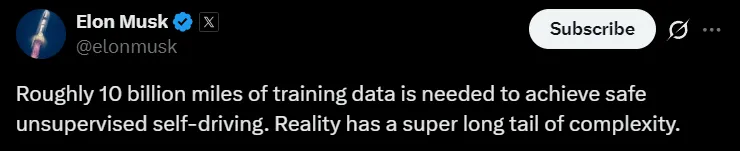
In a post on X, Musk wrote that “roughly 10 billion miles of training data is needed to achieve safe unsupervised self‑driving” and added that “reality has a super long tail of complexity.”
That message resets expectations, since for years he had pointed to a lower threshold of about 6 billion FSD miles as the hurdle for broad regulatory approval.
Tesla’s Full Self‑Driving (FSD) fleet has already logged more than 7 billion+ miles with FSD Supervised enabled.
For context, data trackers estimate Tesla added over 2 billion FSD miles in 2024 alone as the installed base of FSD‑capable vehicles grew and the company ran free trial campaigns. Given that trend, analysts say Tesla could reach 10 billion FSD miles sometime in 2026 if growth in miles driven holds near recent levels.
The long tail and edge cases
In earlier comments, Musk noted that only a tiny fraction of distance driven is actually useful for training, since the system learns the most from unusual and risky situations.
Engineers and safety experts say those edge cases include events such as unusual pedestrian behavior, odd vehicle maneuvers, complex work zones, or poor weather that confuses sensors. So, companies building self‑driving systems try to collect targeted clips of rare events that can stress‑test and refine their neural networks.
Tesla leans heavily on its global customer fleet to gather that training data at scale. Every car with FSD Supervised and the company’s latest camera‑based hardware can record and send snippets of driving back to Tesla when the system detects something unusual. They say those clips feed a large “data engine,” where engineers and automated tools label scenarios and fold them into new training runs for Tesla’s driving models.
However, rivals are moving on different paths. Waymo reports tens of millions of supervised autonomous miles and widespread use of simulation, and has already removed safety drivers in multiple U.S. cities under local permits. Other players, including traditional automakers and tech suppliers, are focusing on more limited driver‑assistance systems or geofenced services while they collect data and work with regulators.
The question is whether 10 billion miles of mostly customer‑driven data, plus targeted test runs and simulation, can convince regulators and the public that unsupervised self‑driving is safe enough, though Musk remains confident that it will.
You may also like to read:
- Tesla expands FSD (Supervised) rollout with v14.2.2.2 release »
- NVIDIA Robotics Chief says Tesla FSD v14 passes “Physical Turing Test” »
- Tesla speeds out FSD v14.2.2.1 in holiday weekend rollout »
- Tesla FSD v14.2.2 rolls out with smarter vision and parking control »
We’ve launched an official Tesla Owners Online Forum. Join early and claim your "Founding Fuel" badge.
FSD is already safer than WAYMO. FSD gas an accident rate of 0.15 accidents per million miles. Waymo’s rate is 1.6. Almost 11X as many accidents per million miles as Robotaxi. This must be more an internal safety goal for Tesla, rather than one set by regulators, since Waymo is already approved with a much worse safety record. Not to mention WayLess training date. Only 100 million mi driven by Waymo vs FSD’s 7.1 billion.