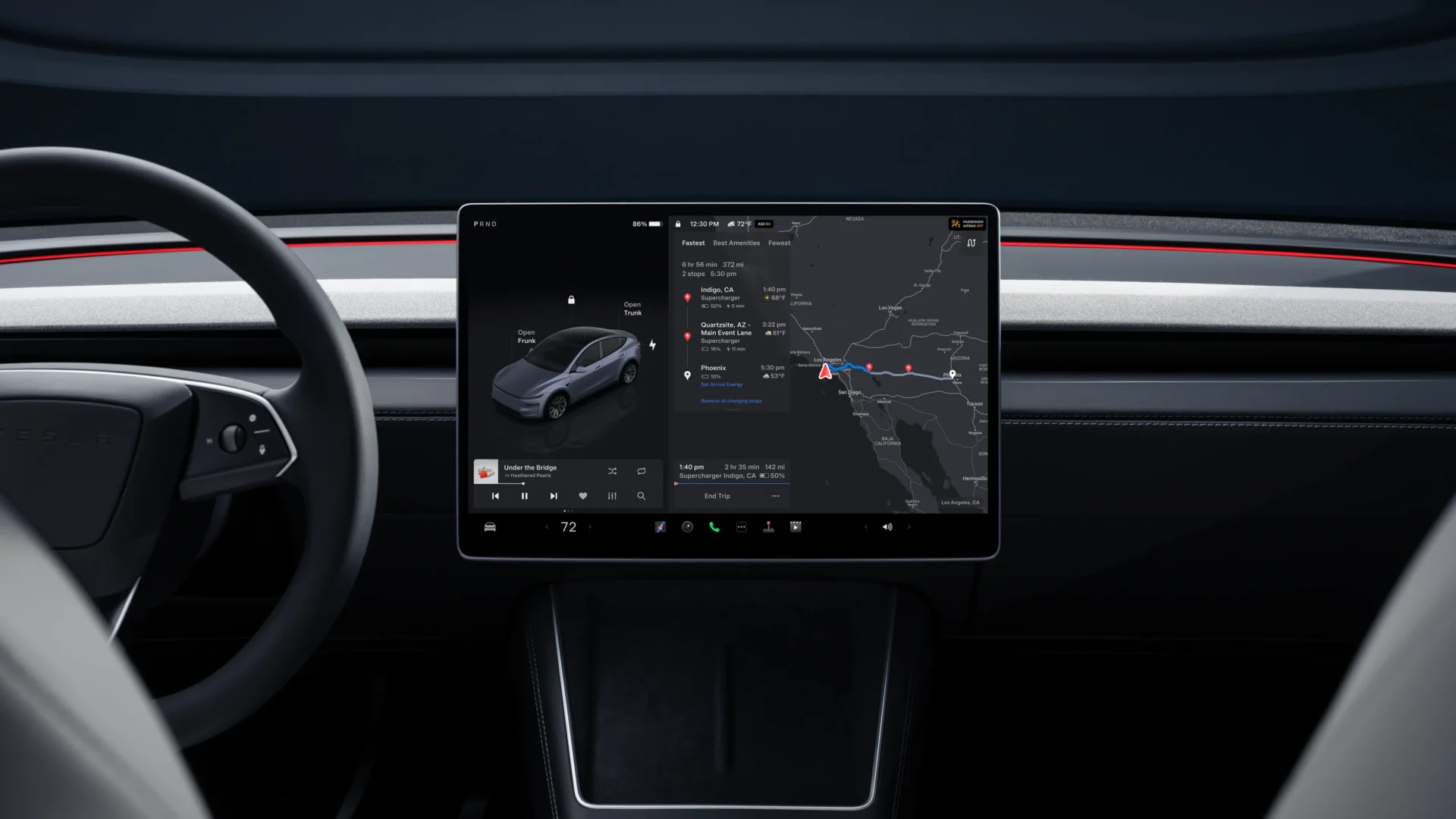

Tesla has started rolling out a new in-car Automations app that lets owners set up “If This, Then That” style rules for their vehicles. The feature is live in China as part of software update 2025.45.32.1 and is expected to reach other markets later this year.
The update arrived around the Lunar New Year, and it sits inside the car’s main touchscreen. Drivers can open an Automation, decide what should trigger it, add conditions, and then pick what the car should do.
Video:
In China, Tesla introduced a new automation app called “If This Then That” inside Tesla UI.
— Nic Cruz Patane (@niccruzpatane) February 11, 2026
It allows owners to create custom rules for the vehicle to automatically perform actions based on triggers, events, and conditions. pic.twitter.com/nvtCE21FxN
How the Automations app works
At its core, the app follows a simple three-part flow: event, condition, and action. An event could be the driver’s door opening, a gear change, or the car reaching a set speed. A condition might be that the driver is detected in the seat or that it is after a certain time in the evening.
The action is what happens next. For example, an owner can make the car play a reminder such as “Please don’t forget your belongings” when the driver’s door opens and the seat sensor confirms someone is still in the seat. The app offers some ready-made examples, yet it also lets users build their own rules from a list of triggers and actions.
Range of triggers and conditions
The system draws on several data points from the vehicle and its surroundings. Car-related triggers include:
- Gear selection changes
- Specific speed thresholds
- Seat-occupancy sensor status
- Seat-belt status
In addition, the app can use environmental inputs. Owners can base rules on time of day, ambient light level, cabin temperature, outside temperature, or local Air Quality Index (AQI). This helps drivers link comfort or safety settings to changing conditions, and it reduces the need to make the same adjustments by hand.
Some rules can start from voice as well. Tesla allows certain custom voice commands to act as the trigger, so a spoken phrase can start a routine that adjusts several settings at once.
What the car can do in response
Once a rule is triggered and any conditions are met, the car can carry out a range of actions. According to feature breakdowns, these actions include changing HVAC settings, adjusting interior lighting, altering some driving-related modes, or using text-to-speech to read out a custom message.
For instance, a driver can set a rule such as: if the outdoor AQI level rises above 150, then enable Bioweapon Defence Mode. This type of automation can help protect air quality inside the cabin, and it saves the driver from watching air readings or toggling the feature manually.
Categories in the interface for areas like seat heating and cooling, doors and windows, charging, HVAC, and media controls, giving owners multiple ways to combine actions into a single rule.
Safety limits and guardrails
Tesla has added some clear boundaries around the feature. Automations do not run when Autopilot or Full Self-Driving (FSD) is active, and they cannot be triggered during those modes. Engineers appear to have taken this step to reduce the risk that user-created rules might conflict with driver-assistance behavior at higher speeds or in complex traffic.
In addition, Tesla is exposing only a curated set of triggers and actions rather than every possible control inside the car. This approach keeps some areas off limits to user scripts, and it may help the company manage safety and liability as the system expands.
Access and rollout
The Automations app currently appears in the vehicle’s touchscreen under the “App Launcher > Automation” menu in Chinese builds of software version 2025.45.32.1. So far, there is no confirmed link to the Tesla mobile app, and owners seem to configure rules directly inside the car.
For now, the feature is limited to China. However, Tesla has a track record of releasing software features in that market first, then moving them to North America and Europe in later updates. This pattern is likely to hold again, so many expect the Automations app to reach a broader fleet during 2026.
For years, more technical Tesla owners have turned to third-party tools, unofficial APIs, or hardware add-ons to get similar automation. Those methods often required extra setup, and they sat outside Tesla’s own interface. Now, the core idea is built into the car, and it is available to any owner who installs the update.
The feature also marks a shift in how Tesla handles feature requests. The company has tended to push out software that it decides will suit most drivers, and it has left edge cases unaddressed for long periods. With the Automations app, Tesla is giving owners a way to solve many of those small, personal wishes on their own by composing rules that fit their habits.
You may also like:
- Tesla FSD v14.2.2.4 brings quiet but clear refinements »
- Tesla relaxes FSD transfer timing, tightens rules for Luxe buyers »
- Tesla FSD helps get Georgia man to ER during 4 a.m. heart attack »
We’ve launched an official Tesla Owners Online Forum. Join early and claim your "Founding Fuel" badge.