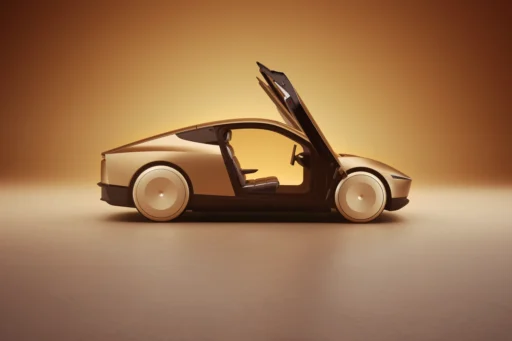


Tesla brought its production-ready Cybercab to the U.S. Department of Transportation headquarters in Washington, D.C. on March 10, for the first-ever National Autonomous Vehicle Safety Forum hosted by NHTSA. The public display allowed attendees to sit inside the cabin and experience the vehicle firsthand, and the details that emerged confirm Tesla is serious about turning its robotaxi vision into reality.
A cabin designed for riders, not drivers
With no steering wheel, no pedals, and no traditional dashboard, the Cybercab’s interior is built entirely around the passenger experience. The most striking element is a massive ~21-inch center display, the largest ever fitted in a Tesla, serving as the primary hub for entertainment, trip management, and ride-hailing controls.

The two-seat cabin offers what observers described as impressive legroom, made possible by floor-track adjustable seats that can slide further back than any fixed-mount design. Without a steering column or footwell eating into space, Tesla has reclaimed the entire floor plan for passengers. Two USB-C charging ports sit in the center console.

The Cybercab has only one manual input, an emergency stop button mounted on the overhead panel. When pressed, the vehicle autonomously navigates to the side of the road, activates hazard lights, and comes to a safe stop. In a vehicle with no human driver, this button is the only direct intervention available to passengers.

What sets this detail apart is the Braille lettering engraved on the button, along with the interior door releases, ensuring that all riders, including those with visual impairments, can use the vehicle comfortably.
There’s currently no federal mandate requiring Braille on robotaxi controls, so Tesla appears to be getting ahead of accessibility requirements voluntarily.
Cameras everywhere, for good reason
The production Cybercab features a significantly larger interior camera compared to Tesla’s existing fleet. In a driverless vehicle, this camera takes on a critical role, monitoring passenger safety, detecting unauthorized activity, and providing incident evidence around the clock.

On the exterior, a trunk camera, a first for Tesla, appears designed to detect belongings left behind by passengers. For a high-turnover ride-hailing vehicle, this could prevent one of the most common headaches in the taxi industry. The Cybercab also features a high-pressure washer system for every external camera, powered by a dedicated tank.
Video:
Tesla Cybercab on display at the USDOT in Washington, DC pic.twitter.com/BceYXr5P3b
— Moe (@moemoe889) March 10, 2026
This wasn’t a flashy consumer auto show. The forum brought together Transportation Secretary Sean Duffy, NHTSA Administrator Jonathan Morrison, and executives from Waymo, Zoox, and Aurora to discuss the future of AV regulation. Secretary Duffy announced proposed updates to Federal Motor Vehicle Safety Standards to formally account for vehicles without human drivers, the regulatory foundation Tesla needs for commercial Cybercab deployment.
With the first production unit rolling off the line at Gigafactory Texas in February and mass production targeted for April 2026, Tesla showed up to the table with a finished product.
You may also like to read:
- FCC clears Tesla to use UWB for Cybercab wireless charging »
- Tesla Cybercab production nears launch with new factory method »
- Tesla Cybercab mass production to start in April 2026 »
We’ve launched an official Tesla Owners Online Forum. Join early and claim your "Founding Fuel" badge.