Tesla has started rolling out software version 2026.14.6.7, a new Spring Update that carries Full Self-Driving (Supervised) v14.3.3 and a revised driver monitoring item that is now listed as part of the live release. The build has been detected on Model 3, Model Y, refreshed Model S, and Cybertruck vehicles equipped with Tesla’s AI4 computer in North America, based on fleet data. And most of the FSD package matches the earlier 2026.14.6.6 rollout, with the driver monitoring entry standing out as the clearest change in the 2026.14.6.7 notes.
Driver monitoring update goes live
Earlier 2026 Spring builds, including FSD v14.3 and early FSD v14.3.3 releases, placed the driver monitoring item under “Upcoming Improvements” and grouped it with future work such as pothole avoidance. That line said Tesla planned to improve driver monitoring sensitivity with better eye gaze tracking, better handling of eyewear, and higher accuracy in variable lighting conditions. Now the same language appears inside the active FSD v14.3.3 list for 2026.14.6.7, which indicates Tesla has begun pushing that cabin-camera revision to drivers on this branch.
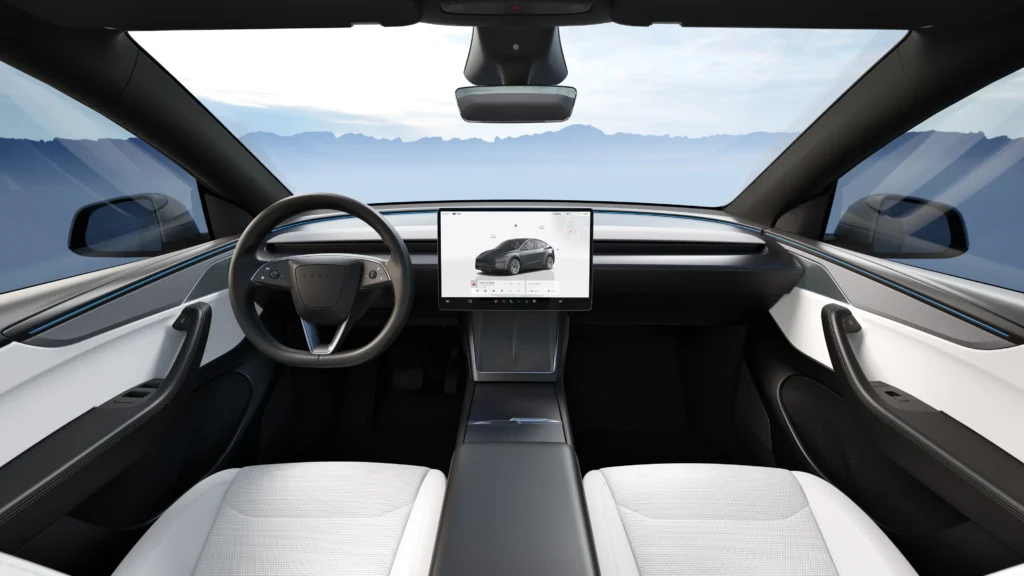
The system relies on the interior camera above the rear-view mirror to check that the driver is watching the road when FSD (Supervised) is active. And the new tuning is aimed at harder real-world cases, including glasses, sunglasses, bright daylight, low sun, dusk, and darker scenes that can make eye tracking less consistent. For drivers who use FSD every day, that can translate into fewer false alerts when their eyes are still on the road but the cabin camera has a harder read than usual.
Independent testing published after the first v14.3.3 builds said the monitoring system had already become less aggressive in some situations, with fewer quick look-forward warnings and longer grace periods before a prompt appears. Early reviews indicated drivers managed to look away for close to a minute in lower-stress conditions, yet the system still becomes stricter in heavier traffic or other cases where confidence drops. But Tesla has not described the change as a relaxation of responsibility, and FSD remains a supervised system that keeps the driver fully accountable.
Also, the wider 2026.14.6.6 Spring Update notes include an item called “Increased Attention Monitoring Alert,” which indicates Tesla is still tuning how attention warnings work across different Autopilot and FSD use cases. That leaves 2026.14.6.7 looking less like a rewrite of the safety model and more like a calibration pass aimed at making the camera read the driver’s eyes with better accuracy.
Other FSD changes
The driver monitoring revision arrives with a larger set of FSD v14.3.3 upgrades that Tesla first introduced in earlier Spring builds, including a rewritten AI compiler and runtime with MLIR that the company says cuts reaction time by about 20%. And the release notes say Tesla upgraded the reinforcement learning stage used to train the FSD neural network, then updated the vision encoder to handle rare and low-visibility scenes better, improve 3D geometry understanding, and expand traffic sign recognition. So the package reads as a broad refinement pass across perception, decision-making, and low-speed maneuvering rather than a one-item release.
On the road, Tesla says the software reduces unnecessary lane biasing and minor tailgating, picks parking spots with more confidence, and improves the parking pin prediction that now appears with a “P” icon on the map. The update package covers harder edge cases too, including emergency vehicles, school buses, right-of-way violators, small animals, and objects that extend, hang, or lean into the car’s path. Yet another part of the notes says the system is better at staying in control during temporary degradations and can recover in some cases without forcing a driver takeover.
Tesla has kept building one common model across FSD, Robotaxi work, and Actually Smart Summon, and the notes raise Summon’s top speed to 8 mph, or 13 km/h, where that feature is available. Drivers on this branch can now track distance traveled between interventions, and the Self-Driving app can list a user’s longest intervention-free streak along with subscription and feature information.
Spring update extras
The wider Spring Update carries more than FSD items, including the new Self-Driving app, Hey Grok voice controls, pet mode changes, an immersive sound upgrade, Apple Music and Spotify queue viewing, overnight automatic installs, interface updates, and Service Mode changes. Still, for drivers focused on FSD, the part they may notice first in 2026.14.6.7 is a cabin camera that reads eye direction more accurately through eyewear and in uneven lighting, with fewer incorrect warnings and the same supervised setup that keeps the driver responsible at all times.
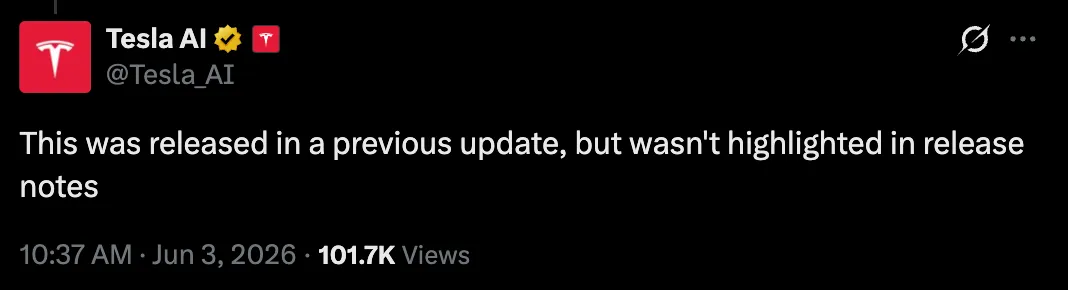
Update: A recent post on X by the official Tesla AI account clarified that this specific camera behavior actually shipped to cars in a previous software version. The company noted that the improvement was “released in a previous update, but wasn’t highlighted in release notes.” Tesla just waited until version 2026.14.6.7 to officially move the text from upcoming improvements to the main list.
We’ve launched an official Tesla Owners Online Forum. Join early and claim your "Founding Fuel" badge.