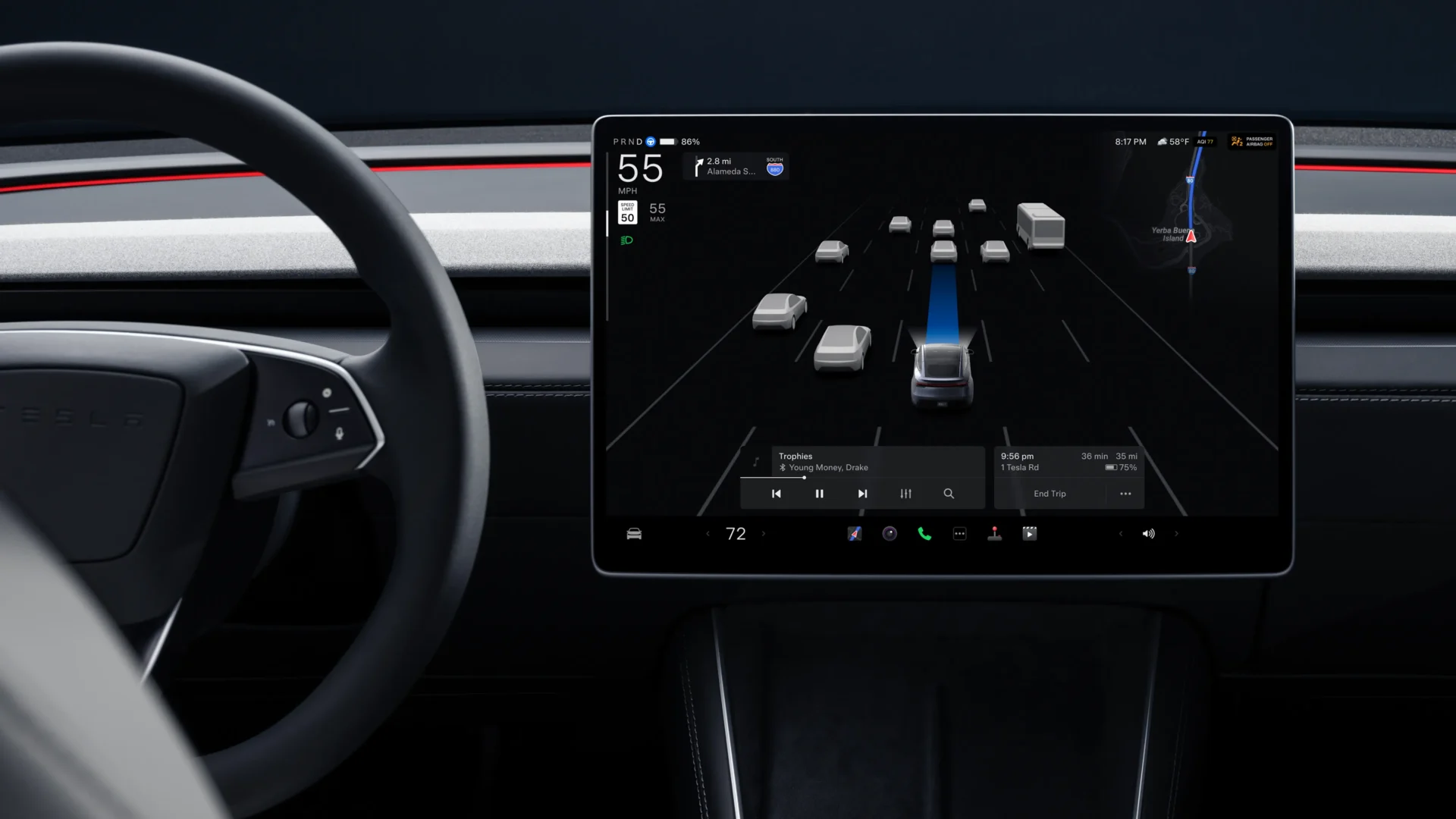
Tesla is rolling out Full Self-Driving (Supervised) v14.2.2, focusing on better vision, more natural driving, and more accurate parking behavior. This update targets real‑world driving comfort and reliability instead of headline features.
Smarter vision and neural network upgrade
Tesla has upgraded the vision encoder so it can process higher‑resolution information from the cameras. Now, the car detect emergency vehicles, road debris, and human gestures more clearly. The encoder feeds into a larger end‑to‑end neural network, which replaces older hand‑written planning logic with learned behavior.
The stack uses multiple neural networks that turn camera images into a bird’s‑eye view, track objects over time, and then choose steering, braking, and acceleration. As a result, FSD v14.2.2 reacts more smoothly at complex intersections, during merges, and near vulnerable road users.
Arrival Options and end‑of‑trip precision
A key change in v14.2.2 is how the car finishes trips. Drivers can now pick Arrival Options such as Parking Lot, Street, Driveway, Parking Garage, or Curbside. The system then adjusts the navigation pin and final path so the car targets the right entrance or area, instead of stopping at a vague map point.
Video:
First look at the new Arrival option changes for FSD v14.2.2.
— Zack (@BLKMDL3) December 23, 2025
The pin now adjusts for navigation based on your selected arrival option. pic.twitter.com/A3HRYFLW8K
The car remembers choices for specific destinations, so if a driver always prefers a garage entrance or a driveway, future routes adapt to that preference.
New Speed Profiles and driving behavior
Tesla has expanded Speed Profiles so drivers can adjust how assertive FSD should be. Profiles now span from very conservative to very assertive styles, affecting how closely the car follows speed limits, how quickly it passes slower traffic, and how often it changes lanes.
Emergency vehicle handling and real‑time detours
FSD v14.2.2 adds clearer rules for emergency vehicles. When the system detects sirens or flashing lights from police cars, fire trucks, or ambulances, it can slow, move aside, or pull over when safe. This behavior builds on earlier audio detection work that listened for sirens and horns.
Routing is now integrated into the same vision‑based network that handles perception and control. So if the car sees blocked roads, cones, or closures, it can re‑route in real time based on what it sees.
The update also improves how the car deals with gates, both static and moving. Timing is better when approaching automatic gates, which cuts down on awkward starts and stops at entrances. The system also offsets more confidently around debris such as tires, branches, or boxes in the lane.
In traffic, Tesla has tuned behavior around unprotected turns, lane changes, vehicle cut‑ins, and stopped school buses. Testers report fewer aborted lane changes and fewer abrupt responses when another driver moves aggressively into the lane.
Fault recovery, attention checks, and camera maintenance
Tesla has improved fault handling so the system can recover more gracefully from degraded states. When sensors or cameras are partially blocked, FSD aims to keep control with added safety margins instead of handing over abruptly, as long as it can still operate safely.
The update can now warn about residue on the inside of the windshield if it detects a pattern that may affect camera visibility. For recent Model Y builds, there is automatic narrow‑field washing for the front camera.
The update also adds a Self‑Driving Stats section under Controls > Autopilot. There, drivers can see how many miles they drive with FSD active and what share of their total driving uses the system.
FSD v14.2.2 does not solve every problem. Some users still see occasional harsh braking, inconsistent stop‑sign behavior, or speed‑limit errors in edge cases. But the update continues the trend of smoother behavior, better perception, and more control over how the car arrives and parks.
Tesla FSD (Supervised) v14.2.2 official release notes
Full Self-Driving (Supervised) v14.2.2 includes:
- Upgraded the neural network vision encoder, leveraging higher resolution features to further improve scenarios like handling emergency vehicles, obstacles on the road, and human gestures.
- Added Arrival Options for you to select where FSD should park: in a Parking Lot, on the Street, in a Driveway, in a Parking Garage, or at the Curbside.
- Added handling to pull over or yield for emergency vehicles (e.g. police cars, fire trucks, ambulances).
- Added navigation and routing into the vision-based neural network for real-time handling of blocked roads and detours.
- Added additional Speed Profile to further customize driving style preference.
- Improved handling for static and dynamic gates.
- Improved offsetting for road debris (e.g. tires, tree branches, boxes).
- Improve handling of several scenarios, including unprotected turns, lane changes, vehicle cut-ins, and school buses.
- Improved FSD’s ability to manage system faults and recover smoothly from degraded operation for enhanced reliability.
- Added alerting for residue build-up on interior windshield that may impact front camera visibility. If affected, visit Service for cleaning!
- Added automatic narrow field washing to provide rapid and efficient front camera self-cleaning, and optimize aerodynamics wash at higher vehicle speed.
- Camera visibility can lead to increased attention monitoring sensitivity.
Upcoming Improvements:
- Overall smoothness and sentience.
- Parking spot selection and parking quality.
We’ve launched an official Tesla Owners Online Forum. Join early and claim your "Founding Fuel" badge.