Tesla now lets its unsupervised Robotaxi operate across the entire Austin metro area. The company widened the geofenced zone where its vehicles drive without an in-car safety monitor.
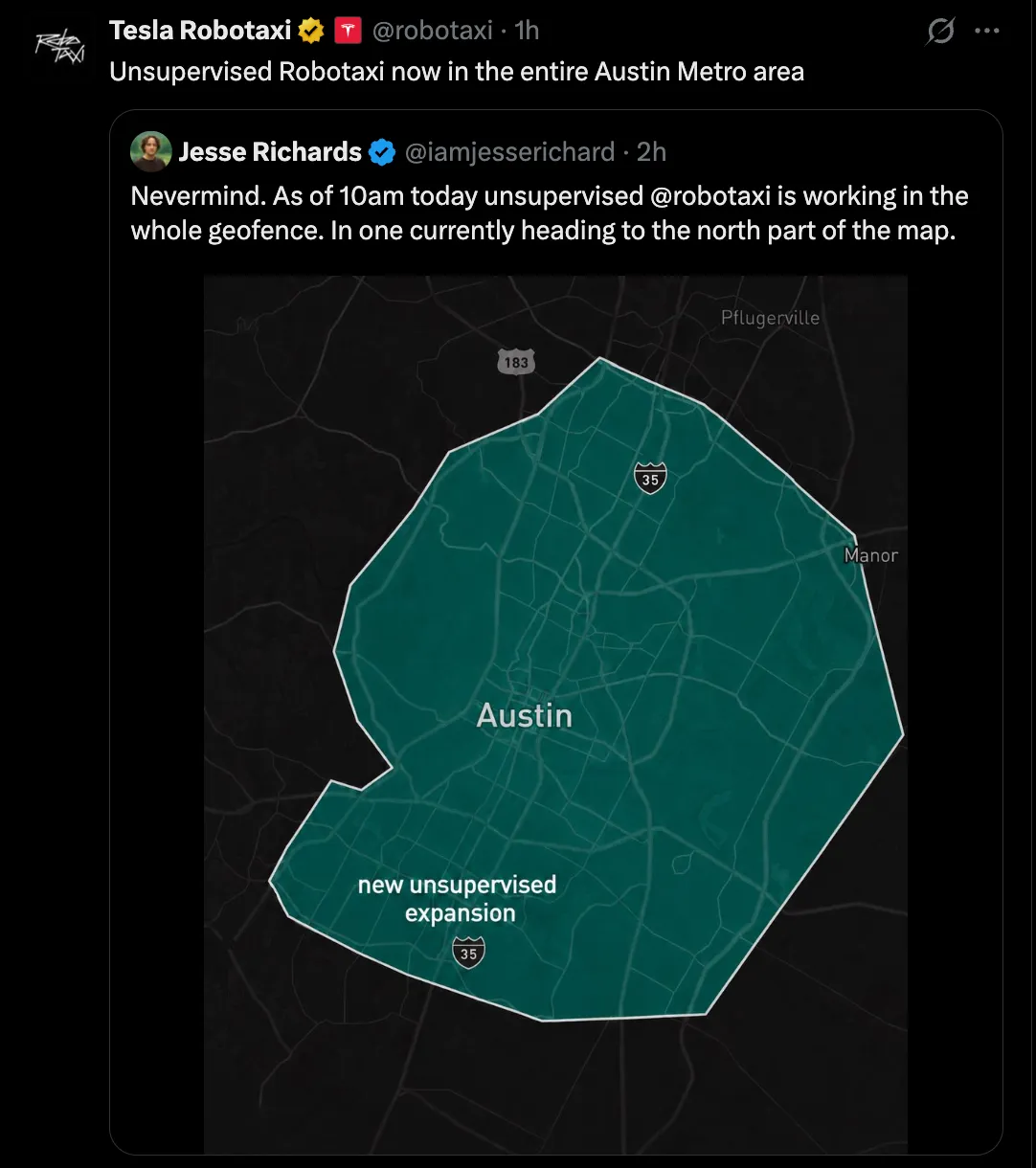
The official Tesla Robotaxi account on X posted a short update: “Unsupervised Robotaxi now in the entire Austin Metro area.” So, fully driverless service is no longer limited to a small part of South Austin. It covers the full metro zone now.
Unsupervised Robotaxi rides began quietly in Austin in January. At that time, CEO Elon Musk and Tesla’s vice president of AI, Ashok Elluswamy, said a small number of vehicles started carrying members of the public with no safety monitor inside. Still, not every car in the fleet was fully driverless then.
Elluswamy said Tesla would “start with a few unsupervised vehicles mixed in with the broader robotaxi fleet with safety monitors” and increase the share of fully driverless cars over time. And that plan is what the company followed.
What the expansion covers
The new geofence now spans the entire Austin metro area. Before this, unsupervised rides were limited to sections of South Austin. Also, the service area grew in steps over the past year. First, Tesla expanded supervised Robotaxi coverage to roughly 177 square miles. Then it pushed to about 243 square miles, or nearly 80% of Austin’s land area. Now, the unsupervised zone removes the remaining geographic limits inside Tesla’s Austin metro geofence.
The scale of the deployment remains modest compared with rivals. A recent presentation by Austin officials indicated Tesla has around 50 Robotaxi-capable vehicles operating in the city. Waymo, by contrast, runs more than 250 robotaxis in the same area.
Within Tesla’s broader fleet, the number of cars actually running unsupervised is smaller still. Tracking data cited shows the active unsupervised fleet peaked at 25 cumulative vehicles in late April. After that, it slipped back to about 20 active driverless cars as of the latest expansion. So, just a few dozen fully driverless Teslas now cover the entire metro geofence. As a result, some riders report wait times that can exceed 30 minutes.
Tesla launched its Robotaxi program in Austin in June 2025 with human safety operators onboard. At launch, rides were limited to a relatively small slice of South Austin. Since then, the company repeatedly expanded the supervised geofence. Then, in January 2026, it began offering unsupervised rides to the general public.
FSD Supervised vs. FSD Unsupervised
The Robotaxi service runs on a dedicated version of Tesla’s Full Self-Driving software stack. Tesla brands this FSD “Unsupervised.” By contrast, retail customers buy FSD “Supervised,” a driver-assist system.
Elluswamy has said the difference between supervised and unsupervised modes is “primarily legal, not technical.” Millions of Teslas with FSD v14 run variants of the same codebase as the Robotaxi fleet. Regulatory approvals, not software capability, limit where the system can operate without human oversight.
Tesla uses a vision-only sensor suite and in-house AI models to pilot its Robotaxis. Still, the company also runs a separate fleet of validation vehicles. These cars carry additional rooftop sensor rigs, including LiDAR, to generate high-fidelity ground-truth data for training and validation.
In Austin, those validation cars have been spotted running routes through downtown and over the South Congress Bridge. Tesla used these runs to prepare the service for more complex urban environments.
Musk has pivoted Tesla’s strategy from being primarily an electric-vehicle manufacturer to positioning the company as an AI and robotics leader. Robotaxis and broader FSD deployment are framed as key profit drivers. And analysts say a large-scale Robotaxi network could lift Tesla’s valuation.
Still, Tesla faces regulatory scrutiny and competition from established robotaxi operators. Waymo and Amazon-backed Zoox are active in the space.
Tesla has signaled that Austin is only the first step in a broader Robotaxi rollout. Musk has indicated that, subject to regulatory approvals, the company plans to expand unsupervised Robotaxi operations to additional U.S. cities. These include parts of California and several Sun Belt markets later this year.
We’ve launched an official Tesla Owners Online Forum. Join early and claim your "Founding Fuel" badge.