

A Polish Tesla enthusiast has managed to run Full Self-Driving (FSD) Supervised on public roads in Japan and EU, and he did it on older HW3 hardware too, months before Tesla’s planned 2026 launch window.
The developer is Michał Gapiński, a software engineer and founder of the TeslaAndroid project. He shared the result late on March 20, in a new post on X.
Gapiński opened his post with a clear message about what he achieved in Japan. He wrote:
“There is much more coming but let’s start with a banger…
Full Self Driving in Japan, didn’t activate so easily like in the EU but I got that sorted already
Digging into what else I can do for this market!”
He confirms FSD Supervised is running in Japan and EU, and notes that the activation process in that market was harder than in the European Union. He also hints that he is still exploring other changes that might help Japanese owners.
Visual proof from Japan
His post included several media items that help you see what he did.
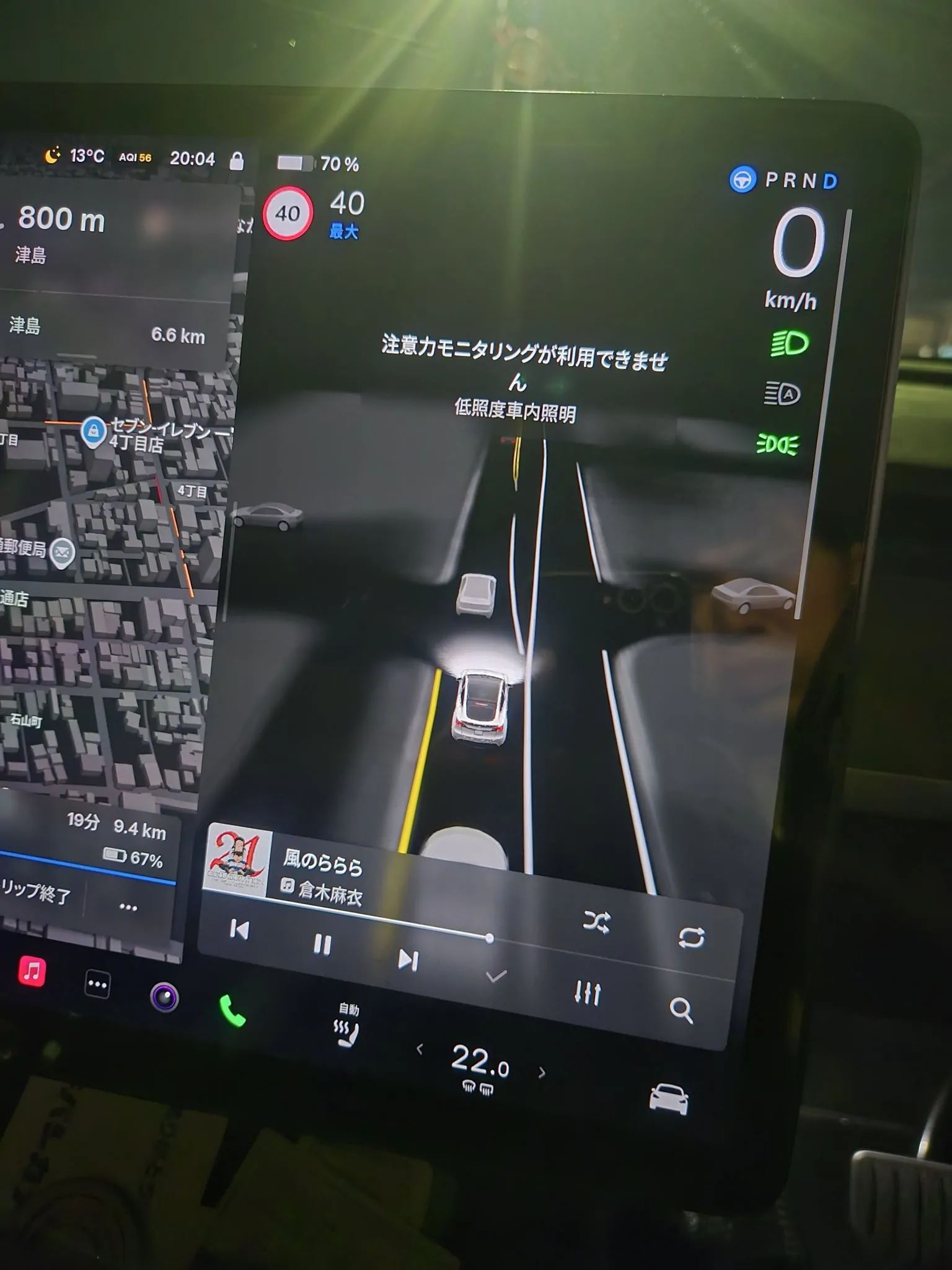
As you can see, in this frame, the Tesla center screen is in full Japanese language. FSD Supervised is active with the car in Park. The navigation map includes local place names such as 津島, and there is an attention-monitoring warning in Japanese. The familiar FSD 3D road visualization is also visible, with surrounding vehicles highlighted.
Video – Nighttime dashcam footage (55 seconds) – HW3 Tesla
There is much more coming but let’s start with a banger…
— Michał Gapiński (@mikegapinski) March 20, 2026
Full Self Driving in Japan, didn’t activate so easily like in the EU but I got that sorted already
Digging into what else I can do for this market! https://t.co/Sk2xDu2HzV pic.twitter.com/Oy1pB9Fq64
This clip captures the car driving at night with FSD Supervised engaged. The vehicle keeps its lane, moderates speed, and handles Japanese urban streets after dark. Neural network visualizations track lane lines, traffic lights, and nearby traffic. So, this is the key proof that the stack is already operating in real conditions in Japan.
Video 2 – Highway/Urban intersection clip (20 seconds) – HW3
The second video segment covers a mix of highway and complex intersections during the day. FSD handles dense traffic, multiple signal-controlled junctions, and right-hand-drive lane layout. It also manages turns and stop lines with precision.
Later the same afternoon, Gapiński kept the momentum going with a new post that directly quotes his Japan FSD video.
“OK. You liked Japan so it’s time for some working ASS (Actually Smart Summon) in the EU in my car.
Not edited, full video!”
Video 3 – Actually Smart Summon demo in EU (97 seconds, unedited)
OK. You liked Japan so it's time for some working ASS (Actually Smart Summon) in the EU in my car.
— Michał Gapiński (@mikegapinski) March 20, 2026
Not edited, full video! https://t.co/41llCkFLLI pic.twitter.com/getQCUJR0u
FSD v14.2 running without EU regulatory restrictions
The Japan activation is not the only recent highlight from Gapiński. Later on the same day, he posted another update that focused on Europe. In that post, he presented FSD v14.2 running without EU regulatory restrictions.
“Ok, bomb number 3. V14.2 without EU regulatory crap. This was on my radar last week and got me jailed from FSD for a week but I came back stronger
That is how it works in the US and that is how it can work in Europe.
It looks like I cracked it, it’s awesome and I can’t wait for my fellow testers to try it as well!
LFG!!!! ”
Video 4 – FSD v14.2 unrestricted EU demo (~48 seconds)
Ok, bomb number 3. V14.2 without EU regulatory crap. This was on my radar last week and got me jailed from FSD for a week but I came back stronger
— Michał Gapiński (@mikegapinski) March 20, 2026
That is how it works in the US and that is how it can work in Europe.
It looks like I cracked it, it’s awesome and I can’t wait… https://t.co/8xD03fRflT pic.twitter.com/0GuX3FRjQz
Hardware and software details: HW3 with FSD v12
Under the same post, Gapiński replied to questions about the hardware and software in use. He clarified that the car in the Japan is running on HW3 and on FSD v12.
He wrote:
“The car on the picture… it’s hw3 so v12. V14 will work, but that won’t be fully RHD until Australia gets the update.”
This short reply carries several important details. The Japanese Tesla is equipped with the first-generation FSD Computer, often referred to as HW3, which Tesla began shipping around 2019. It is not a newer HW4 or AI4 setup. The software branch is FSD v12, which continues to support HW3 cars.
He also notes that FSD v14 is expected to operate on this hardware, but he adds that full right-hand-drive behavior is still pending. He ties that milestone to a future update for Australia, another right-hand-drive market. The comment gives a sense of Tesla’s likely rollout plan for RHD support across regions.
His test shows that even an HW3 car with the right configuration can run FSD Supervised locally, so the system is not limited to the latest hardware.
Why Japan is a hard test case
Japan has developed a reputation as one of the most demanding environments for driver-assistance and FSD-style systems. Streets can be narrow, and many neighborhoods have tight clearances and blind corners. Pedestrian and cyclist traffic is heavy in busy areas, and crosswalk rules are strict.
Road markings and signs differ from those in North America and most of Europe. The system has to interpret unfamiliar visual cues and respond correctly to local norms. That alone is a challenge for any vision-based neural network trained mainly on other regions.
Japan also drives on the left with right-hand-drive vehicles. This adds another layer on top of Tesla’s region locks and regulatory checks. Gapiński’s note that activation was harder than in the EU matches this context. In Europe, many unofficial efforts have focused on left-hand-drive cars that more closely match U.S. layout and data.
Official timeline for FSD Supervised in Japan
Tesla is working on a formal rollout of FSD Supervised in Japan, and that path runs through local regulators. Tesla Japan has been testing the system with employees since at least August 2025. During that phase, cars ran FSD on public roads under internal programs, helping the company gather data and refine behavior.
On March 5, 2026, Tesla Japan President Riichi Hashimoto said the company is “aiming for implementation in 2026” and “doing everything in our power” to meet that goal. That timeline points to late 2026 as the target window for a full commercial launch.
Japan’s rules for advanced driver assistance at Level 2 and beyond are strict, so localization has taken more time than in some other major markets.
At the same time, his warning about FSD v14 and full right-hand-drive support indicates that not every feature will be ready at the same pace. Owners may see differences between versions as Tesla adjusts its neural networks and rule sets for each region.
Tesla and Tesla Japan have not issued public comments on his specific activations. FSD Supervised remains a driver-assist system that requires constant attention, and the driver is still legally responsible for the vehicle at all times.
Now, the focus turns back to Tesla and Japanese, EU authorities. If testing continues to perform well and regulatory reviews proceed on schedule, FSD Supervised could move from isolated enthusiast activations to a supported feature for thousands of drivers. Until then, Gapiński’s post stands as the clearest public example of what that future might look like.
You may also like to read:
- Tesla patent offers new life for HW3 FSD computers »
- Tesla to launch lighter FSD V14 for hardware 3 by Mid-2026 »
- Tesla FSD (Supervised) nears European approval »
- Tesla FSD v14.3 enters testing phase, wide rollout only weeks away »
We’ve launched an official Tesla Owners Online Forum. Join early and claim your "Founding Fuel" badge.