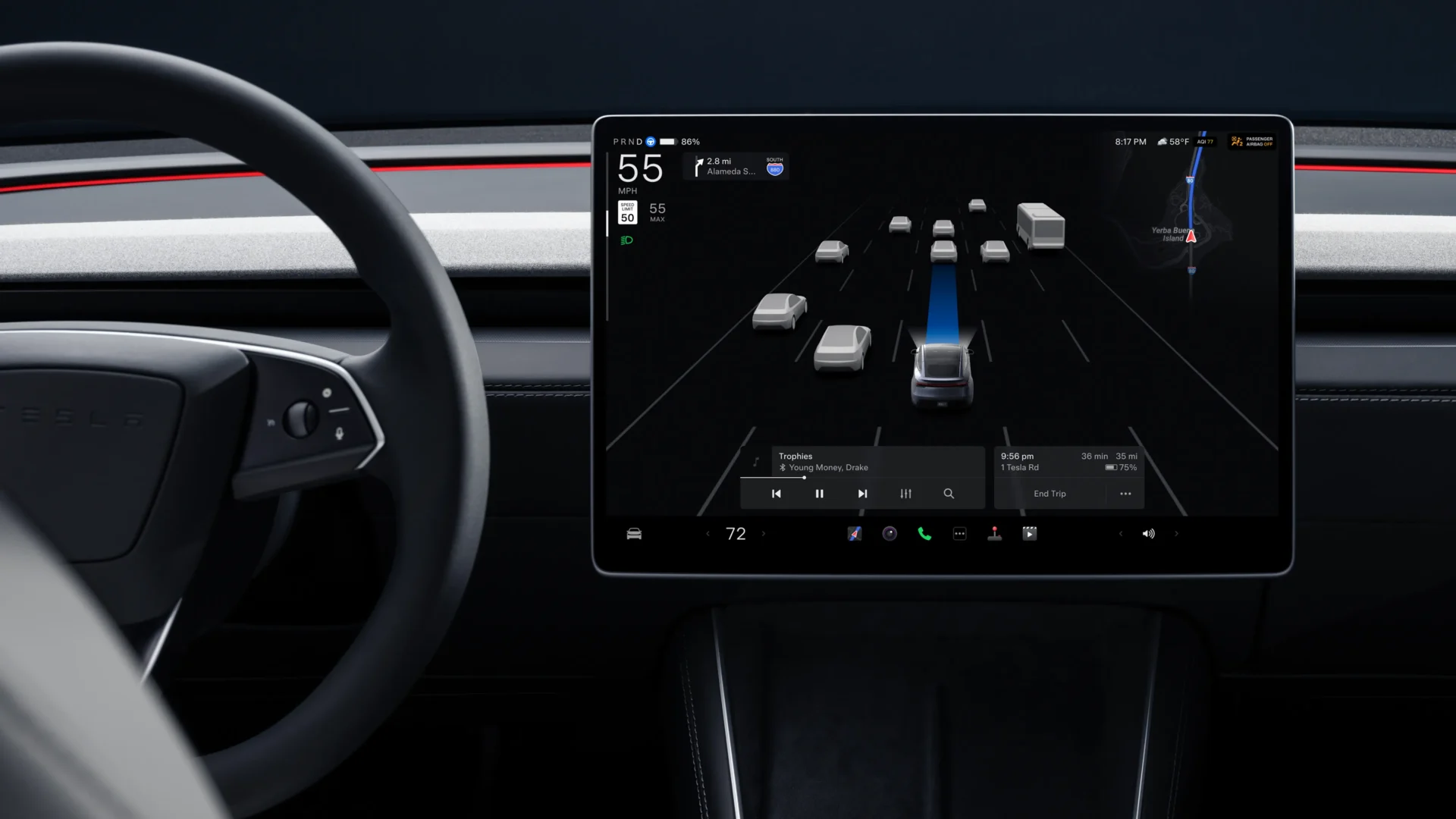

Tesla’s Head of AI, Ashok Elluswamy, says a key Full Self-Driving feature once tied to version 14.3 has already started to reach cars through the current 14.2 software line. This early rollout centers on “reasoning,” an upgrade that aims to make the system act more like a driver that can think through choices.
Elluswamy said on Thursday that parts of the new reasoning system are already active in two areas: route changes around road construction and smarter choices for parking. He added that “more and more reasoning will ship in Q1.”

Musk’s “sentient” FSD goal
Musk has been framing reasoning as a turning point for the system. On the Q3 2025 earnings call in October, he said: “With reasoning, it’s literally going to think about which parking spot to pick. It’ll drop you off at the entrance of the store, then go find a parking spot. It’s going to spot empty spots much better than a human. It’s going to use reasoning to solve things.”
That same month, he raised expectations further, saying: “By v14.3, your car will feel like it is sentient.”
How FSD V14.2 is performing now
Version 14 introduced a new network with around ten times more parameters than the earlier stack, which gives the system more capacity to handle complex driving scenes, according to technical write‑ups and owner documentation. The latest public build, labeled FSD v14.2.2.2, runs on this architecture and aims for smoother turns, more natural lane changes, and better handling of busy city streets.
Early users report that the current build already feels much closer to human driving than older software, with more confident maneuvers and fewer abrupt moves. Even so, many drivers still complain about routing and odd navigation choices, and Tesla acknowledges that path planning and comfort need more work before any unsupervised release is possible.
Tesla’s push on reasoning sits on top of a large data pipeline. Company updates late last year said FSD vehicles had logged close to 7 billion miles, including about 2.5 billion miles in urban environments, which are usually harder for autonomous systems. Engineers rely on that scale of real‑world data to train networks to deal with rare and messy road situations that are hard to script in a lab.
Even with that data, Musk now says Tesla will target about 10 billion FSD miles before calling the system safe for unsupervised use, a milestone he recently tied to a timeline around mid‑2026.
For the moment, FSD v14 is limited to vehicles running Tesla’s Hardware 4 platform, which has more compute capacity than older Hardware 3 cars. Company roadmaps indicate a lighter “v14 Lite” branch is planned for those earlier vehicles later in 2026, though details on feature parity remain uncertain.
As reasoning logic spreads beyond construction rerouting and parking, owners should see more consistent navigation choices, and smoother overall operation on familiar routes.
You may also like to read:
- Elon Musk sets new data target for Tesla unsupervised self‑driving »
- Tesla introduces 5-year unlimited kilometre warranty for Model 3 and Model Y »
- Tesla prepares Model Y “Mid Range” with new 8L battery pack »
- Tesla extends battery and drive unit warranty by two years »
We’ve launched an official Tesla Owners Online Forum. Join early and claim your "Founding Fuel" badge.