Tesla’s upcoming FSD (Supervised) v14.3.9 release adds Automatic Collision Evasion, a safety feature that can briefly take control of the vehicle during a serious emergency.
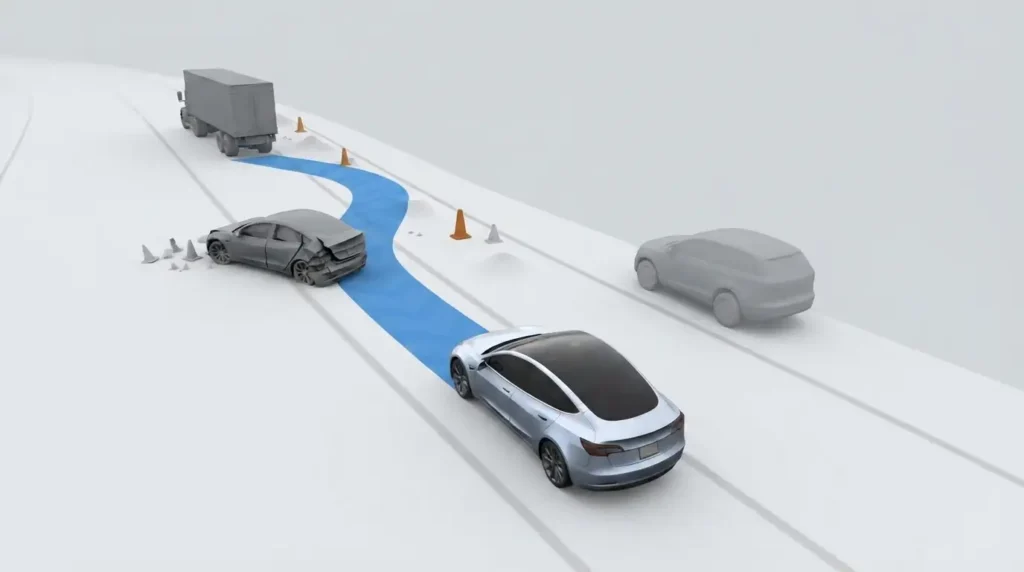
The software can activate when a frontal collision is imminent and Automatic Emergency Braking, or AEB, may be unable to prevent impact. Instead of relying only on braking, the vehicle can use steering, braking and acceleration to move away from the threat if it detects a safe route.
Tesla already offers AEB, Forward Collision Warning and other driver-assistance tools across its lineup. AEB applies the brakes when the vehicle detects a likely crash, yet braking in a straight line may not stop every collision.
The new feature gives FSD Supervised a role during those rare situations. It can look for space in an adjacent lane or along the shoulder and then make an evasive move if the car determines that path is safer than continuing straight.
When the feature can intervene
The first activation case involves an imminent frontal crash on a controlled-access highway. FSD Supervised can take control if braking alone is unlikely to avoid the impact and the vehicle identifies a safe escape path.
Reports on the new feature describe several operating limits. The vehicle must be traveling below about 85 mph, the road must be dry and the steering system must be operating normally. The system must also detect no pedestrians, cyclists or other vulnerable road users in its intended path.
Then the car can steer around the danger by changing lanes or moving toward the road shoulder. It can brake or accelerate during the maneuver, depending on what the system calculates is needed to avoid the collision.
Tesla has described the feature as an emergency response system, not a regular lane-change or obstacle-avoidance tool. Drivers remain responsible for the vehicle at all times, and FSD Supervised remains a supervised driver-assistance feature rather than an autonomous driving system.
Intervention for distracted drivers
Automatic Collision Evasion has a second use case. It can activate if Tesla detects that the driver is heavily distracted, no longer in control of the car or may have accidentally disengaged FSD Supervised.
The intervention can operate at speeds from about 22.5 mph to 85 mph across different road types, according to reports on the rollout. For example, the system may react after detecting that a driver is looking away from the road for an extended period or reaching into the rear seats.
Tesla has already changed how FSD Supervised handles repeated driver-monitoring warnings. In earlier versions, the system could slow and stop in its lane after a driver failed to respond. FSD v14.3 introduced a behavior where the car searches for a place to pull over and park after ignored warnings.
The v14.3.9 feature goes further in an immediate-risk scenario. It can take control at the point where the car detects a serious safety concern, then prompt the driver to resume control after the danger has passed.
Driver control remains available
Tesla appears to have added safeguards intended to prevent accidental driver inputs from interrupting an emergency maneuver. During an Automatic Collision Evasion event, the accelerator pedal may be ignored and light brake use may slow the vehicle without immediately canceling FSD Supervised. But the driver can still take back control. A firm and deliberate steering input can override the system during the maneuver.
After the immediate risk ends, the car alerts the driver with a chime and asks them to take over. That handoff keeps the driver responsible for the vehicle after the emergency intervention is complete.
Availability and limits
Automatic Collision Evasion appears to require an active FSD Supervised purchase or subscription, with FSD enabled through Controls > Self-Driving. Early reports place availability in North America, and Tesla has not publicly detailed a broader international release schedule.
Tesla says its vehicles include features such as AEB, Forward Collision Warning, Lane Departure Avoidance and Obstacle-Aware Acceleration, though the company warns that these systems do not replace attentive driving.
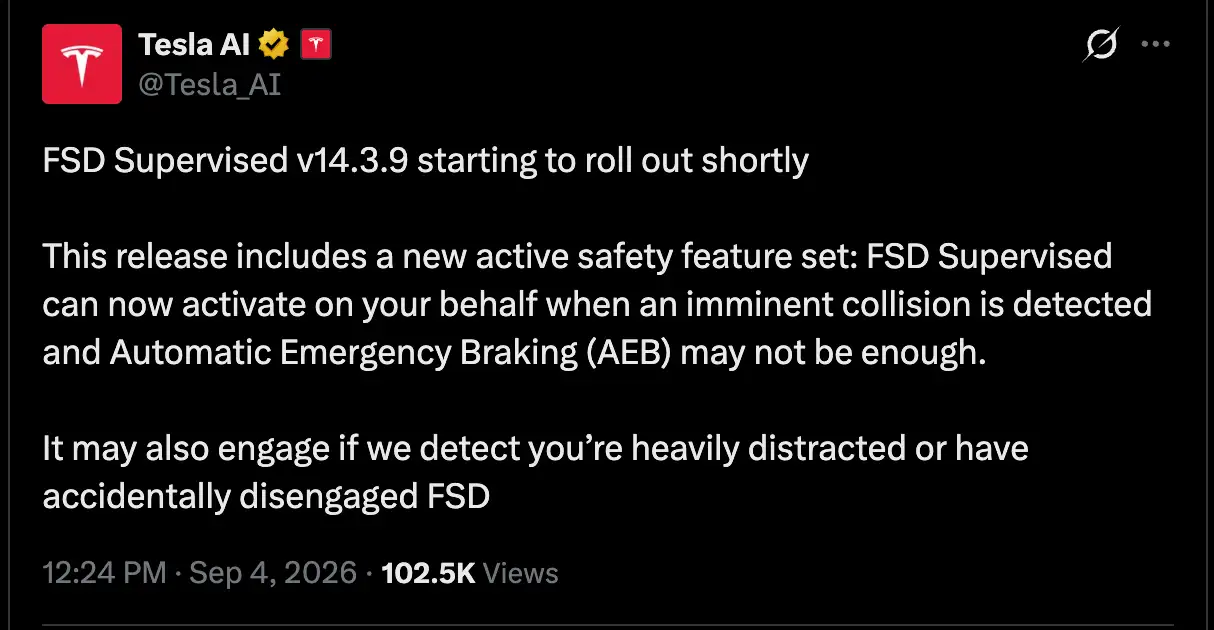
Still, Automatic Collision Evasion marks a different use of the FSD stack. It lets the system intervene during manual driving when a crash may be seconds away or when the driver may no longer be able to respond safely.
We’ve launched an official Tesla Owners Online Forum. Join early and claim your "Founding Fuel" badge.