Nvidia chief executive Jensen Huang has given rare public credit to Tesla’s Full Self-Driving system at a time when his own company is pushing a rival technology for carmakers. He said in a recent Bloomberg interview that he thinks “the Tesla stack is the most advanced autonomous vehicle stack in the world,” adding that he is “fairly certain they were already using end-to-end AI.”
He also remarked that the debate about “reasoning” models is secondary once a company commits to end-to-end AI, even as Nvidia courts Tesla’s competitors with its Alpamayo platform. The comments came around the CES 2026 news cycle, where autonomy and so‑called physical AI are a central theme for chipmakers and automakers.
Video:
Nvidia CEO Jensen Huang in new interview today on @Tesla’s FSD:
— Sawyer Merritt (@SawyerMerritt) January 6, 2026
“I think the Tesla stack is the most advanced autonomous vehicle stack in the world. I’m fairly certain they were already using end-to-end AI. Whether their AI did reasoning or not in somewhat secondary to that… pic.twitter.com/pYuPYdwW3h
How Tesla’s FSD stack works
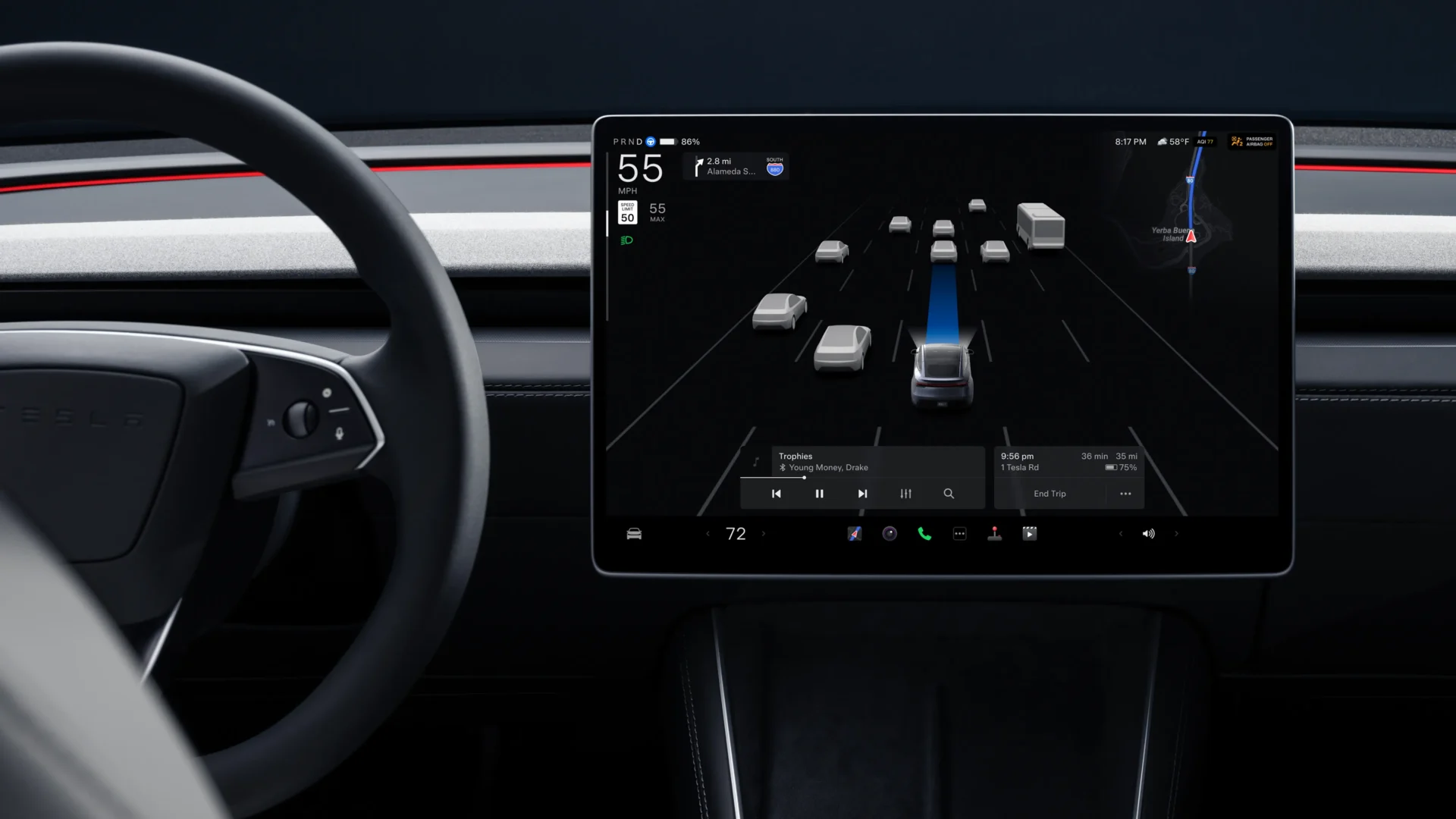
Tesla’s recent FSD releases are built around end-to-end neural networks that take in camera video and output driving controls without relying on large blocks of hand-written C++ code. Company engineers have said that earlier releases used roughly 300,000 lines of control logic, but newer versions replaced that logic with learned behavior from fleet data.
Tesla trains its models on millions of hours of human driving collected from a fleet of several million vehicles worldwide. The stack uses multiple camera feeds to form a 3D understanding of the scene, and then a single large model chooses steering, acceleration, and braking in one step instead of passing decisions through many separate modules.
Nvidia’s Alpamayo and the sensor debate
Huang’s remarks landed as Nvidia rolled out Alpamayo, a family of open AI models for autonomous driving that the company positions as a reasoning system for cars. Alpamayo is being released with open weights on platforms such as Hugging Face, along with simulation tools and data sets meant to help automakers and startups build their own autonomy stacks.
Unlike Tesla’s camera‑only strategy, Nvidia’s reference designs pair Alpamayo with cameras, radar and LiDAR, aiming to give cars redundancy in bad weather or low‑visibility conditions. Huang told interviewers that Tesla’s vision-led method is “state-of-the-art” but said Nvidia will pursue a multi‑sensor path with partners such as Mercedes‑Benz, which plans to ship Nvidia-based Level 2+ systems on the new CLA starting in 2026. Mercedes executives say they are moving carefully because safety expectations for 4,000‑pound vehicles at speed are high and legal liability is significant.
Reasoning models and the “long tail” problem
Nvidia pitches Alpamayo as a “thinking” model, capable of chain‑of‑thought style reasoning about driving scenes rather than simple pattern copying. Company material describes a vision-language-action design where the model can break a situation into steps, reason about possible outcomes, then pick a path and explain that logic in language form. Researchers say this kind of trace could help engineers and regulators review how an autonomous system decided to act in rare or risky scenarios.
Elon Musk has said in recent comments that competitors will find the long tail of rare events “super hard” to solve, even if they can get to “99%” performance.
Huang has previously said Tesla was one of Nvidia’s earliest big customers in automotive, and that Nvidia helped build Tesla’s first in‑car computers for Autopilot. Nvidia hardware powered earlier FSD computers before Tesla started rolling out its own AI chips. At the same time, Musk has spoken about ongoing purchases of Nvidia data center hardware for AI training, even as Tesla develops its own Dojo system.
So Huang’s praise for Tesla’s current FSD stack comes against a backdrop where the two companies are partners in AI compute and rivals in autonomous software.
You may also like to read:
- NVIDIA Robotics Chief says Tesla FSD v14 passes “Physical Turing Test” »
- Saudi supercluster gives xAI first access to 600,000 Nvidia GPUs »
- Tesla prepares Model Y “Mid Range” with new 8L battery pack »
We’ve launched an official Tesla Owners Online Forum. Join early and claim your "Founding Fuel" badge.