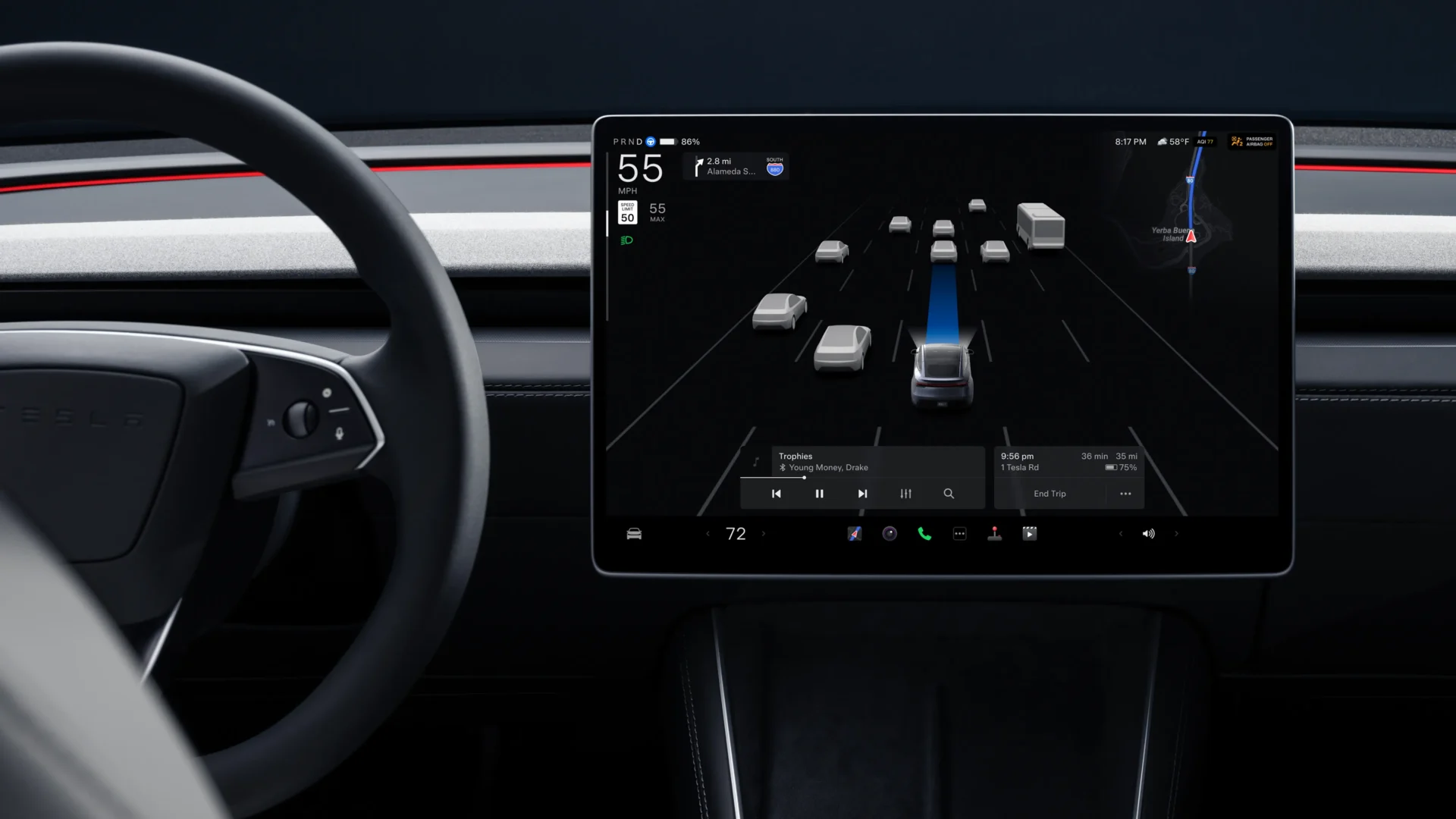
Elon Musk now says Tesla has “pretty much solved” unsupervised Full Self-Driving from a technical side and is focused on validation. He made these comments during an xAI Hackathon question-and-answer session, where he outlined the next steps for Robotaxis and FSD.
Musk stated that Tesla plans to remove safety monitors from Robotaxis in Austin in about three weeks, which points to fully driverless rides in that city around late December 2025 or early January 2026 if timelines hold and he framed this as a major step toward large-scale unsupervised use.
Video
NEWS: Elon Musk says FSD Unsupervised is "pretty much solved at this point" and that @Tesla will be launching Robotaxis with no safety monitors in about 3 weeks in Austin, Texas. He also teased a new FSD model is coming in about 1-2 months.
— Sawyer Merritt (@SawyerMerritt) December 10, 2025
"We're just going through validation… https://t.co/Msne72cgMB pic.twitter.com/i3wfKX3Z0r
A much larger FSD model
Musk also flagged a new Full Self-Driving model that he says is “an order of magnitude larger” than the current system. He said this model is planned for January or February 2026 and will add more “reasoning” along with heavier use of reinforcement learning.
The current unsupervised effort will start on a relatively small model, yet the 10x larger version is expected to support more complex decisions and harder driving scenarios. Musk links this jump in capacity to Tesla’s long-term goal of scaling Robotaxis to many cities, though he did not share exact parameter counts or training data volumes.
“Last big piece” and FSD v14
In late November, Musk said that FSD v14.3 is “where the last big piece of the puzzle finally lands,” and earlier v14 builds, such as v14.1 and v14.2, already aimed at smoother driving and better lane handling.
FSD v14.2 and v14.2.1 reached more drivers during the fall and brought noticeable behavior changes on public roads. Testers and reviewers report that the car takes more natural turns, handles merges with less hesitation, and brakes less aggressively in many situations, though some awkward actions still appear in dense traffic or complex intersections.
Driver monitoring and eyes-off plans
With v14.2.1, Musk and owners report that driver monitoring has become less strict. Looking at a phone or glancing away from the road triggers fewer alerts than earlier versions, which Musk cites as evidence that Tesla is closer to allowing drivers to fully look away.
To support larger FSD models, Musk says Tesla might need its own semiconductor plant. He talked about the need for “a few hundred gigawatts of AI chips per year” and said he does not see outside chip suppliers adding that capacity fast enough, so Tesla will “probably have to build a fab.”
However, regulators in the United States and abroad have not yet approved Tesla’s FSD as a fully autonomous system for general use.
Musk’s claim that unsupervised FSD is “pretty much solved” from a technical angle still has to be tested against long-term accident data, court cases, and responses from transportation and safety agencies.
You may also like to read:
- Tesla rolls out 2025 holiday software update »
- Tesla’s 2025 Holiday update quietly upgrades Sentry Mode viewer »
- Tesla’s 2025.44.25.1 update introduces Unreal Engine visuals »
We’ve launched an official Tesla Owners Online Forum. Join early and claim your "Founding Fuel" badge.