Elon Musk now says Tesla vehicles with the AI4 / Hardware 4 computer have enough capability to run Full Self-Driving in unsupervised mode without new hardware in the car. This statement answers a debate among owners who asked if their recent cars would be left behind once Tesla moved from supervised FSD to driverless service.
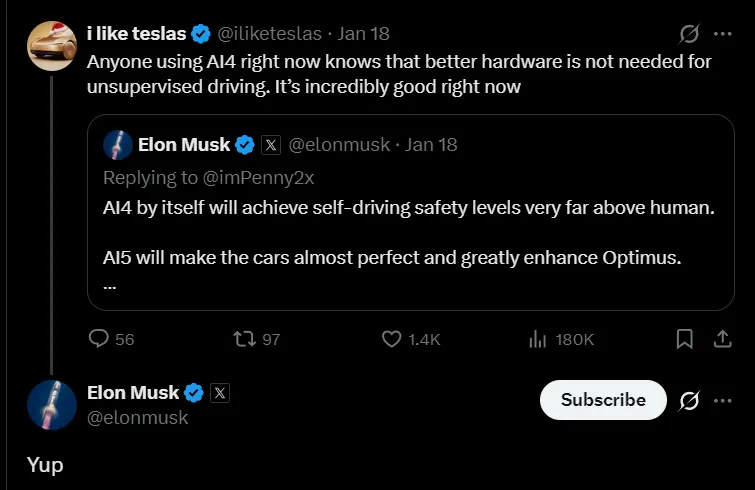
In a comment shared widely by Tesla watchers in mid‑January 2026, Musk said AI4 can reach safety levels “very far above human,” making clear that the current in‑car platform is, in his view, sufficient for unsupervised use once the software is ready.
What AI4 / HW4 actually delivers
AI4, often called Hardware 4, is Tesla’s latest in‑vehicle self‑driving computer and offers far more compute than the previous HW3 platform. Its neural network performance at about 50 TOPS (trillion operations per second), roughly two to four times the effective capacity of HW3 when running Tesla’s larger vision models.
The system uses upgraded CPU cores and faster memory. HW4 carries 20 CPU cores at up to 2.35 GHz and moves from LPDDR4 to GDDR6, giving memory bandwidth in the range of 384 GB/s, which helps handle high‑resolution video from multiple cameras at once. These changes give Tesla more headroom to run big end‑to‑end neural networks in real time, which engineers and outside researchers say is key for driverless operation.
The hardware shift is not just in chips. Tesla’s HW4 camera suite has higher resolution and longer range than the older HW3 setup. Front cameras now use 5‑megapixel sensors at 2896 × 1876 resolution instead of the 1.2‑megapixel units that shipped on many HW3 cars, which helps the system detect objects and read signs further down the road.
FSD version 13, which is tuned for newer cars, processes this video at about 36 frames per second and can handle around 1.3 gigapixels of image data each second with low latency from sensor to neural network output. This gives smoother behavior at intersections, better lane selection, and more confident turns than earlier builds that were limited by HW3’s lower‑resolution pipeline.
Early unsupervised trials in Austin
Tesla has already begun running driverless robotaxi tests in Austin, Texas, using Model Y vehicles that operate with no one behind the wheel during specific test runs. These cars run on a special build of FSD often described as a branch of v14 that is tuned for a geofenced zone of mapped streets and known traffic patterns in the city.
Musk told attendees at an xAI event in late 2025 that “unsupervised is pretty much solved at this point” in controlled settings and that robotaxis without a human in any seat would appear in Austin “within weeks”.
HW3 owners face a different path
Musk has been more cautious when speaking about older Hardware 3 cars. In early 2025, he said Tesla will have to replace HW3 computers for people who paid for the FSD package if they want unsupervised capability, after earlier remarks that implied HW3 would be enough on its own. He described this upgrade effort as “painful and difficult,” but still a commitment for those who bought FSD outright.
HW3 has both compute and memory limits that hold back the largest current FSD neural nets, even with tricks like quantization and model pruning meant to squeeze more performance from the chip. For that reason, AI4’s headroom gives Tesla a cleaner path to unsupervised driving on newer cars, while HW3 owners may wait longer and rely on service‑center retrofits whose timeline is still not fully set out in public documents.
You may also like: Tesla to launch lighter FSD V14 for hardware 3 by Mid-2026 »
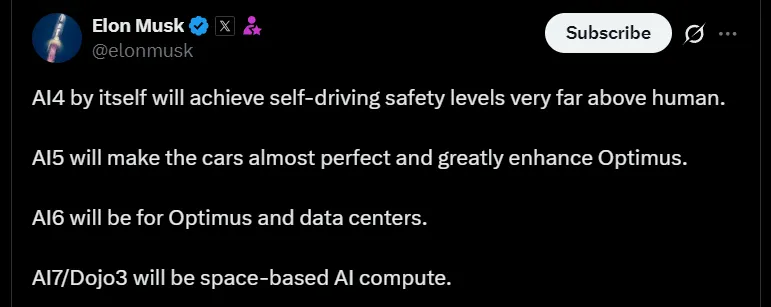
Musk is already talking about Tesla’s next in‑car platform, labeled AI5, even as he calls AI4 sufficient for unsupervised FSD. Company briefings indicate Tesla is “almost done” with AI5 design and targets about eight times the compute, nine times the memory, and roughly five times the bandwidth of HW4, along with improved efficiency.
Production at scale is not expected until around 2027. Musk has said AI5 will support both next‑generation FSD and the Optimus robot program, while a planned AI6 chip would focus more on robots and data centers than on passenger cars. So, AI4 may remain the main platform for Tesla vehicles sold through much of this decade, even after AI5 arrives for premium or specialized models.
FSD v13 and its successors use end‑to‑end neural networks that take raw camera video and output driving decisions directly, and they add features such as better parking, reversing behavior, and audio inputs to detect emergency vehicles more reliably. Yet regulators still classify Tesla’s system as SAE Level 2, which means drivers must stay attentive at all times and remain responsible for the vehicle. Any move to broad “unsupervised” deployment would require sign‑off from regulators, and that may differ city by city or state by state.
According to Musk, if you own a Tesla with HW4 / AI4, he says your car has the hardware needed for unsupervised FSD once the software, data, and regulators catch up.
You may also like to read:
- Tesla to launch lighter FSD V14 for hardware 3 by Mid-2026 »
- Tesla patent offers new life for HW3 FSD computers »
- Tesla launches seven‑seat Model Y with 16‑inch display in U.S. »
We’ve launched an official Tesla Owners Online Forum. Join early and claim your "Founding Fuel" badge.