A Tesla Cybertruck owner says his electric pickup helped save his life after he blacked out on a California freeway during a medical emergency. The case is drawing attention to how advanced driver-assistance systems may help in rare but serious situations.
The owner, Rishi Vohra, shared his account on X. He said a normal drive turned serious in minutes. He had unintentionally gone about 17 hours without food, then took some medicine and suffered a severe allergic reaction.
According to his post, his body started to shut down while he was on the freeway and talking to his wife on the phone. He wrote that he passed out mid-conversation, with the vehicle still moving at highway speed. His wife suddenly heard silence on the line and realized something was wrong.
How the Tesla responded on the freeway
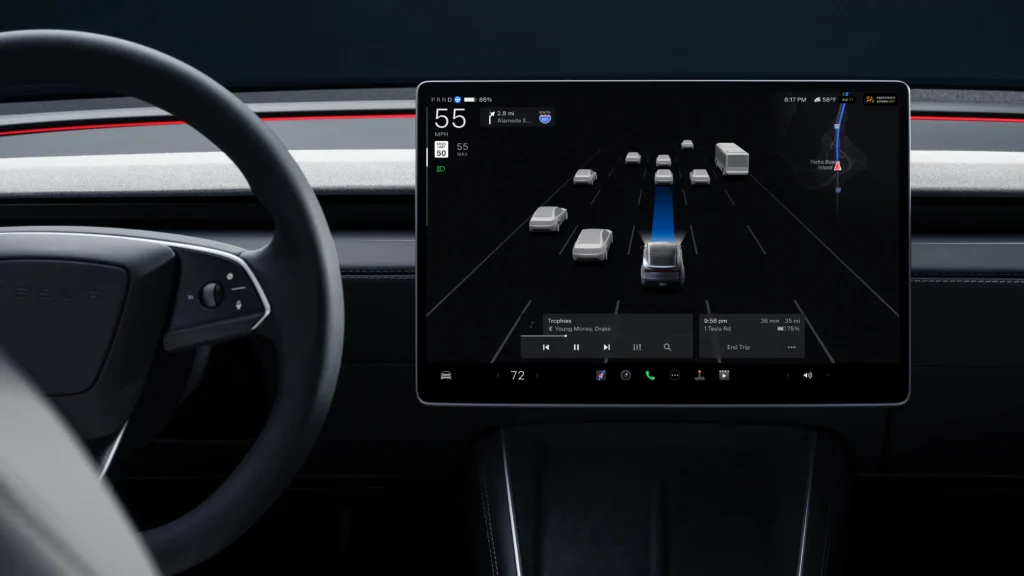
Vohra had Full Self-Driving (Supervised) engaged in his Cybertruck at the time. He says the system’s driver monitoring detected that he was no longer responsive in the driver’s seat. The cabin camera monitors driver attention and is placed above the rearview mirror in newer Tesla vehicles.
He wrote that the truck slowed down, turned on the hazard lights, and guided itself to the freeway shoulder. He added that there was no crash and no risk to other drivers on the road. Tesla’s system is designed to issue warnings when a driver appears inattentive for a period of time, and, if there is no response, it can bring the vehicle to a controlled stop.
Wife’s actions and emergency response
On the phone, Vohra’s wife heard him go quiet. She did not hang up. Instead, she used the location-sharing app Life360 to find his exact position and contacted emergency services. She passed on his location so that first responders could reach him quickly.
He says paramedics arrived in about five minutes. They treated him at the roadside and stabilized him enough for him to speak. At that point, he recalls telling them that he did not want to leave his Cybertruck unattended on the freeway shoulder.
After that, the story took another turn. Vohra says the Cybertruck, with FSD engaged, then took him the rest of the way to the hospital. He rode in the driver’s seat while the system handled the driving.
He walked into the emergency room on arrival. Doctors admitted him and kept him overnight. Medical staff were able to bring his levels back to normal, and he says he was discharged the next day. He described himself as grateful to be alive and recovering.
Response from Elon Musk and Tesla

Vohra tagged Elon Musk, Tesla, and the company’s official account in his X thread. Musk replied with a short message, saying he was glad Vohra was okay. Tesla’s official account reposted the story, which drew more attention to the incident on social media.
The company says owners have driven more than 8 billion miles with FSD (Supervised) engaged and millions of miles each day.
The company has often highlighted safety data for its driver-assistance systems. At the same time, U.S. regulators and safety advocates have said drivers must stay alert and ready to take control at all times, and Tesla itself states that FSD (Supervised) requires active supervision.
This is not the first time an owner has linked a medical emergency outcome to Tesla’s software. In a separate case reported, a driver in a Tesla Model Y suffered a major heart attack on an interstate near Atlanta while FSD was active. His son used the Tesla app to direct the vehicle to a hospital, where doctors later said the timing of his arrival was critical for his survival.
However, FSD remains classified as a Level 2 driver-assistance system in the United States. That classification means the human driver is legally responsible for the vehicle at all times and must stay attentive.
Stories like Vohra’s raise questions for regulators, safety experts, and automakers. Can systems built for driver support also provide a safety net in cases where a driver suddenly becomes incapacitated?
Vohra, for his part, focused on his family and the technology that helped in his case. He thanked his wife for staying calm and acting fast. He also thanked Tesla and its engineers, saying the experience convinced him that this type of driver-assistance is more than a convenience feature in rare, life-threatening moments.
You may also like:
- Tesla FSD helps get Georgia man to ER during 4 a.m. heart attack »
- Tesla FSD v14.2.2.5 rollout begins with focus on refinement »
- Tesla FSD v14.2.2.5 rollout begins with focus on refinement »
We’ve launched an official Tesla Owners Online Forum. Join early and claim your "Founding Fuel" badge.