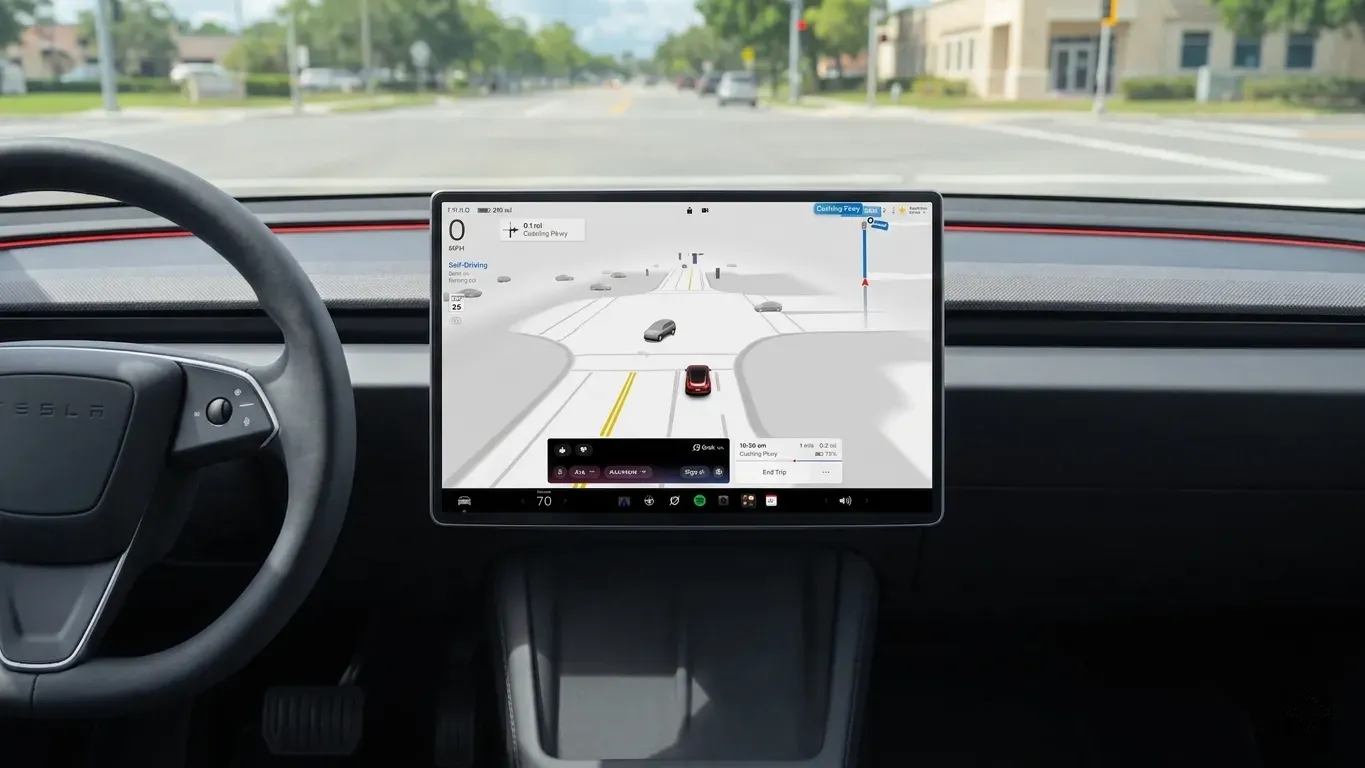

Tesla drivers will soon tell their cars exactly where to go using voice commands, and the company plans to connect its xAI assistant to the Full Self-Driving system. Elon Musk recently gave a timeline for this update, putting the long-awaited autonomous parking release around September 2026. And this changes how the software interacts with human passengers.
Elon Musk shares a release window
A Tesla owner recently posted an idea on X about making the software behave more like a human driver. The user wanted to say things like “Grok, turn right here” or “Drop us off right here, we’ll walk”. They wanted the car to drop passengers at the door and then park far away, and Musk replied to this post directly. He stated “this functionality will be there in about 3 months or so”. So his reply puts the release date around September 2026, when drivers would use voice commands instead of tapping the screen to change routes. But it remains unclear if Musk meant only the voice controls or the full parking sequence.

Tesla originally added the AI assistant to cars in 2025 through software version 2025.26. The early version did not control the vehicle at all, and it acted as a basic tool. The release notes confirmed existing voice controls remained the same. The Spring Update 2026 later added hands-free commands so drivers can ask for reminders or look up information. Yet the system still cannot control the air conditioning or music. The company offers multiple voices like “Storyteller” and “Unhinged” for the software. Then updates added more features for newer vehicles, letting cars with HW4 hardware running FSD v14.3 answer questions about disengagements. The software then reads sensor data to explain what happened.
What the reverse summon update does
The parking tool is widely known as Reverse Summon or Park Seek. Your car would let you out at a building entrance and drive away to find a spot, and you would later tap a button on your phone to call it back. The concept relies on upgraded neural networks to handle busy parking lots, when the front bumper camera watches for low curbs and cement blocks. And the system must recognize shopping carts and pedestrians in very tight spaces. The software needs more training data from urban garages before it can operate safely without a human inside. Recent updates taught the system how to handle the final stretch of a trip.
Musk noted that finding a parking spot causes the most human interventions right now. Drivers frequently complain that the software hesitates too much in parking lots, or the system often picks the wrong space. A future update will let the car remember your favorite spots at work or home. You could easily tell the assistant to park on a specific street or far away from a busy door. This saves drivers from taking over the steering wheel. The Spring 2026 update added a new screen with usage streaks to encourage people to use the software more often. Better voice controls make the software feel more cooperative.
But not every car gets the same features, and the 2025 release only worked on U.S. cars with AMD chips. Older Intel cars missed out completely. Recent reports confirm HW3 vehicles only receive basic voice commands. Only HW4 cars get the deep integration that explains driving decisions. Chinese owners cannot use the xAI assistant at all, since the company uses a local alternative there to follow data rules. And the tool always requires a Premium Connectivity subscription to access the cloud. Musk often gives optimistic timelines for new software. Government regulators might delay the launch to check safety rules, and the company clearly wants passengers to talk to their cars just like they talk to a human driver.
We’ve launched an official Tesla Owners Online Forum. Join early and claim your "Founding Fuel" badge.