Tesla has begun rolling out Full Self-Driving (Supervised) v14.3.4 with software update 2026.14.6.10, delivering a milestone feature for Cybertruck owners and meaningful improvements to parking navigation across the entire fleet.
Cybertruck’s big moment
The headline addition for Cybertruck is Actually Smart Summon (ASS), the long-awaited feature that lets owners use their Tesla app to call the truck to their location from up to 213 feet away or send it to park autonomously in a parking lot. After two and a half years since first deliveries, this free over-the-back update requires zero hardware changes, running on the FSD v14 stack and Cybertruck’s steer-by-wire system.
Early users in Florida reported receiving the download on Thursday, June 11, and the official Cybertruck account celebrated with a playful post: “I shall be summoned”. The feature also includes “Dumb Summon,” giving Cybertruck owners the same summon capabilities as the rest of Tesla’s fleet.
FSD v14.3.4: Neural network upgrades and safety enhancements
Under the hood, v14.3.4 includes significant upgrades to Tesla’s FSD neural network:
The update also enhanced responses to emergency vehicles, school buses, right-of-way violators, and other rare vehicles. Tesla improved handling of small animals by focusing RL training on harder examples and adding rewards for better proactive safety.
Traffic light handling at complex intersections with compound lights, curved roads, and yellow light stopping has been improved, driven by training on hard RL examples sourced from the Tesla fleet. The system also better handles rare and unusual objects extending, hanging, or leaning into the vehicle path.
Parking visualization gets a major upgrade
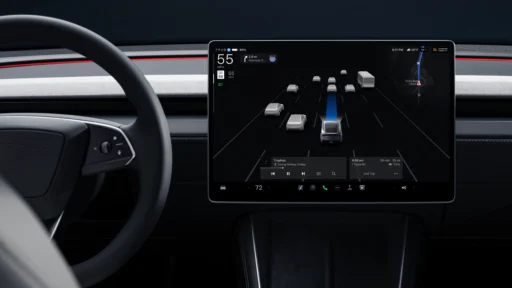
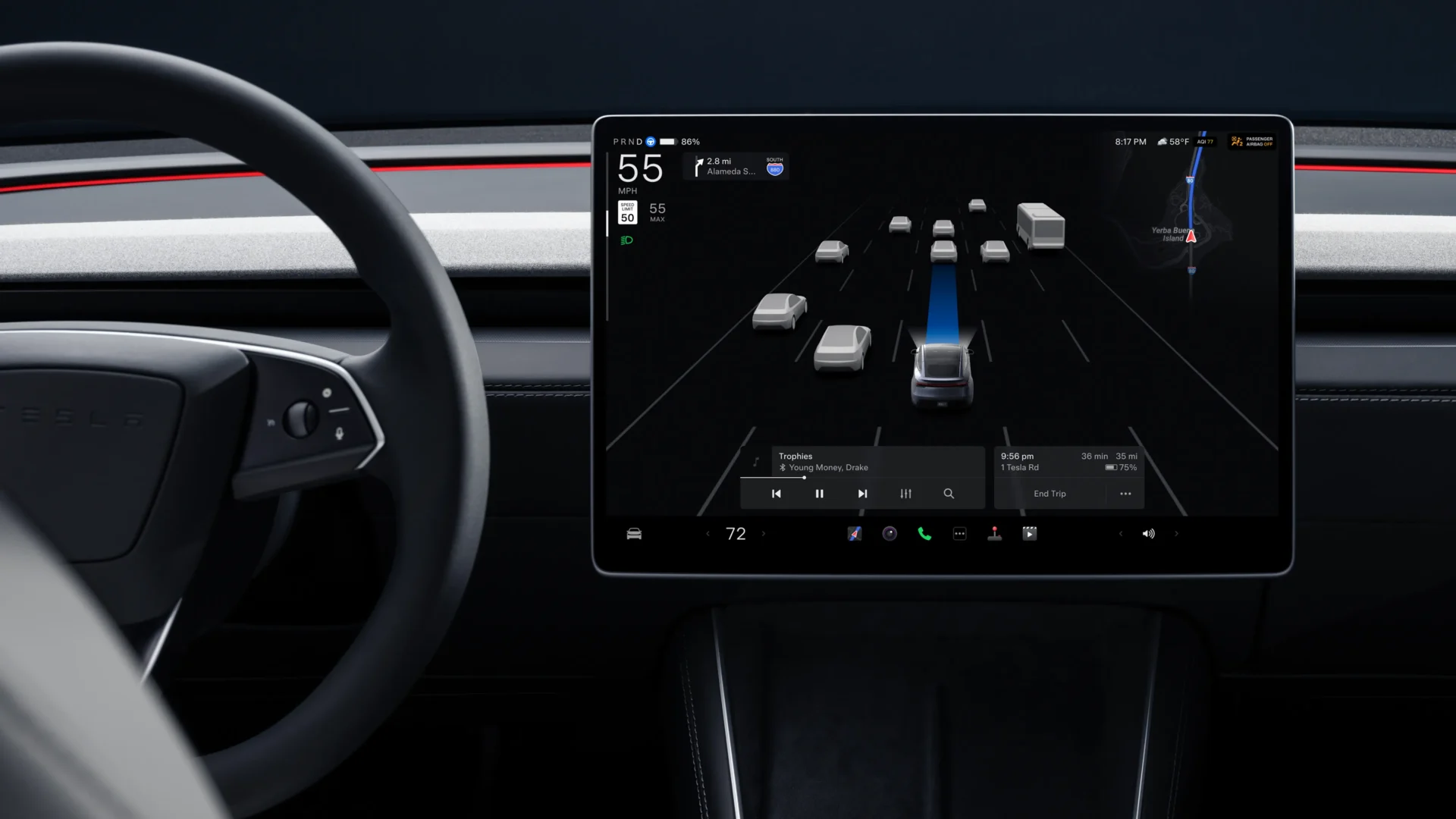
Parking options now display on the map when arriving at your destination. Available parking spots automatically pop up on the navigation screen, so you’re not circling around looking for a spot.
The update also includes improved parking location pin prediction, now shown on a map with a P icon. Combined with increased decisiveness in parking spot selection, the “P” icon tells you where the car thinks it’s going to park before it gets there. This addresses behavior where the car would previously roll into a lot and hesitate between spaces.
New self-driving statistics and driver monitoring
Tesla added useful new statistics for FSD users:
- You can now see distance traveled in FSD (Supervised) without an intervention
- The Self-Driving App will show your longest intervention-free streak
The driver monitoring system sensitivity has been improved with better eye gaze tracking, eye wear handling, and higher accuracy in variable lighting conditions. After taking over, drivers can now help Tesla improve Self-Driving by selecting an intervention reason on the main screen.
Rollout status and requirements
The update is currently rolling out to Cybertruck (AI4), Model S (Refresh) (AI4), and Model Y (AI4) in North America. Early install data shows 100% of recorded drives using FSD with this software version, though this represents a small sample of early testers.
As always, Tesla emphasizes that v14.3.4 is still a supervised system, drivers must remain attentive, keep their hands on the wheel, and use additional caution. Under your supervision, Full Self-Driving (Supervised) can drive your Tesla almost anywhere, making lane changes, navigating around vehicles and objects, and parking at your destination.
Upcoming improvements on the horizon
- Tesla has teased two upcoming improvements for future updates:
- Expand reasoning to all behaviors beyond destination handling
- Add pothole avoidance
Official release notes
Actually Smart Summon (ASS) for Cybertruck – ASS (Actually Smart Summon) and Dumb Summon are now available for Cybertruck!
Parking options now display on the map when arriving at your destination
Full Self-Driving (Supervised) v14.3.4 includes:
- Upgraded the Reinforcement Learning (RL) stage of training the FSD neural network, resulting in improvements in a wide variety of driving scenarios.
- Upgraded the neural network vision encoder, improving understanding in rare and low-visibility scenarios, strengthening 3D geometry understanding, and expanding traffic sign understanding.
- Rewrote the AI compiler and runtime from the ground up with MLIR, resulting in 20% faster reaction time and improving model iteration speed.
- Mitigated unnecessary lane biasing and minor tailgating behaviors.
- Increased decisiveness of parking spot selection and maneuvering.
- Improved parking location pin prediction, now shown on a map with a P icon.
- Enhanced response to emergency vehicles, school buses, right-of-way violators, and other rare vehicles.
- Improved handling of small animals by focusing RL training on harder examples and adding rewards for better proactive safety.
- Improved traffic light handling at complex intersections with compound lights, curved roads, and yellow light stopping — driven by training on hard RL examples sourced from the Tesla fleet.
- Improved handling for rare and unusual objects extending, hanging, or leaning into the vehicle path by sourcing infrequent events from the fleet.
- Improved handling of temporary system degradations by maintaining control and automatically recovering without driver intervention, reducing unnecessary disengagements.
- Improved driver monitoring system sensitivity with better eye gaze tracking, eye wear handling, and higher accuracy in variable lighting conditions.
- Unified the model between Actually Smart Summon, FSD, and Robotaxi for more capable and reliable behavior.
- Help Tesla improve Self-Driving by selecting an intervention reason on the main screen after taking over.
- You can now see distance traveled in FSD (Supervised) without an intervention. The Self-Driving App will also show your longest intervention-free streak.
- Parking options now display on the map when arriving at your destination.
Upcoming Improvements:
- Expand reasoning to all behaviors beyond destination handling.
- Add pothole avoidance.
Under your supervision, Full Self-Driving (Supervised) can drive your Tesla almost anywhere. It will start from a parked position, make lane changes, select forks to follow your navigation route, navigate around other vehicles and objects, make left and right turns and park at your destination.
We’ve launched an official Tesla Owners Online Forum. Join early and claim your "Founding Fuel" badge.