Tesla’s Full Self-Driving (Supervised) has gained a new, very human skill. The system can now recognize and react to hand signals from people directing traffic, according to CEO Elon Musk. He chose to call this out publicly, even though many drivers may see it as a quiet update in a long list of software changes.
Musk posted a short note on X: “Tesla self-driving now recognizes hand signals.” He shared this as a quote reply to a video from Tesla Europe.
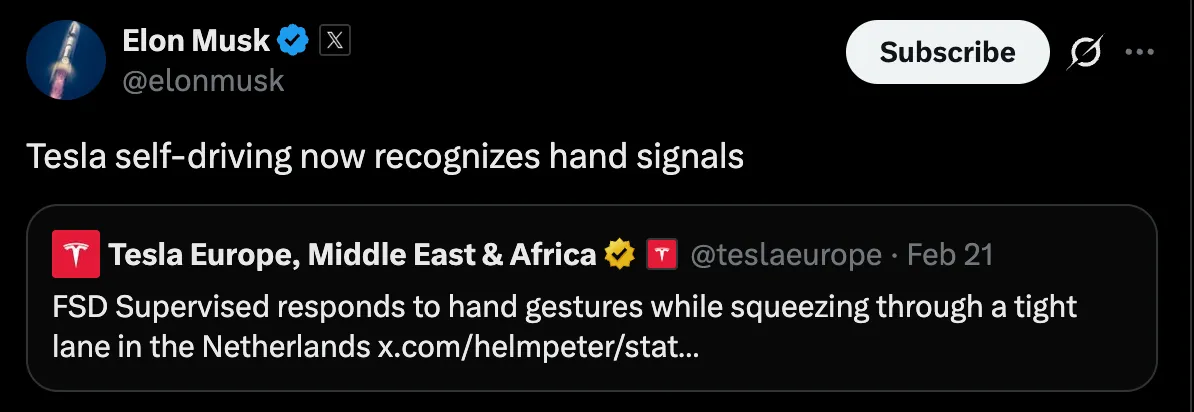
The clip shows a Tesla running Full Self-Driving (Supervised) on a tight lane in the Netherlands, with a person on the road directing traffic using hand gestures.
In that situation, the car waits while the worker manages oncoming vehicles. Then it proceeds when waved through.
Video:
Seit November kann jeder fast täglich FSD Probefahrten an diversen Orten in Europa testen. Die RDW, die niederländische Verkehrsbehörde, prüft Teslas Antrag auf die Ausnahmeregelung 39 der UN-ECE.
— Peter Helm(@HelmPeter) February 21, 2026
Dieses Beispiel in den Niederlanden zeigt die Leistungsfähigkeit des Assis. https://t.co/eAgYfhbzjF pic.twitter.com/hAWDUtquJt
This is a simple scene, yet it can be hard for automated systems. Many systems read traffic lights and road signs well, but human body language is harder. And that is where this update starts to matter.
Why hand signals are important on real roads
On real streets, not every instruction comes from a traffic signal. Road crews, police officers, parking attendants, school crossing guards and pedestrians often rely on their hands to control traffic. A raised palm can ask a driver to stop.
For an automated system that wants to work in mixed traffic, reading those cues is important for safety and for how natural the ride feels. Human drivers expect others to respond when a worker waves them forward through a blocked lane. If a car under automation freezes or moves at the wrong time, it can confuse people nearby and slow traffic.
Tesla leans on a vision-based approach, using cameras and neural networks instead of lidar. Hand signal recognition fits into that model. The software has to read a person’s pose, arm motion and context from camera feeds, then link that to driving decisions. It has to decide if someone is just standing near the road, or actively directing vehicles in the car’s path.
This new behavior comes alongside a broader round of Full Self-Driving (Supervised) updates. Recent versions, including v14.2 and its follow‑on builds, focus on stronger perception and more human‑like behavior in complex scenes. Tesla upgraded its vision encoder so it can pull more detail from the cameras, with higher‑resolution features feeding the neural networks.
Those updates target situations such as emergency vehicles, temporary obstacles, construction zones and complicated unprotected turns.
Tesla data indicates around 6 million miles were logged with FSD active in 2021. The number rose to about 80 million miles in 2022. In 2023, usage increased again to roughly 670 million miles. By 2024, the company reports about 2.25 billion miles on FSD (Supervised). Then in 2025, that total jumped to about 4.25 billion miles.
The start of 2026 has kept that trend going. In the first 50 days of the year, Tesla owners added another 1 billion miles with FSD engaged. That works out to more than 20 million miles per day on average. At this pace, analysts say the system is on track to reach around 10 billion miles during 2026.
Safety data and comparison with U.S. average
Tesla has also released updated safety numbers tied to its driver‑assistance features. In its latest North America report, covering all road types over a 12‑month span, the company states that vehicles using FSD (Supervised) recorded one major collision about every 5,300,676 miles.
For Teslas driven without FSD but with Active Safety features turned on, the rate was about one major collision every 2,175,763 miles. Cars without those active safety tools saw one major collision around every 855,132 miles. For comparison, Tesla cites a U.S. national average of one major collision every 660,164 miles over the same period.
Taken at face value, those figures suggest that a Tesla on FSD (Supervised) goes more than eight times farther between serious crashes than the average vehicle in the United States. Tesla also reports 830 major collisions with FSD active in that time window, versus more than 16,000 for manually driven Teslas with Active Safety and nearly 5 million across the wider U.S. driving population.
Hand signal support is not the only interaction feature on Tesla’s roadmap. Musk has said on X that voice prompts for FSD are coming. The idea is that drivers could give clear spoken instructions, such as asking the car to park closer to a building entrance, or to pick a spot farther away in an empty part of a parking lot.
Tesla’s vice president of AI, Ashok Elluswamy, has indicated that broader voice control sits on the development path, though any rollout will move through safety testing.
You may also like to read:
- Tesla eyes voice control for FSD, with Grok at the center »
- Tesla FSD v14.2.2.5 rollout begins with focus on refinement »
- Oregon Tesla owners get new 50% FSD insurance discount from Lemonade »
We’ve launched an official Tesla Owners Online Forum. Join early and claim your "Founding Fuel" badge.