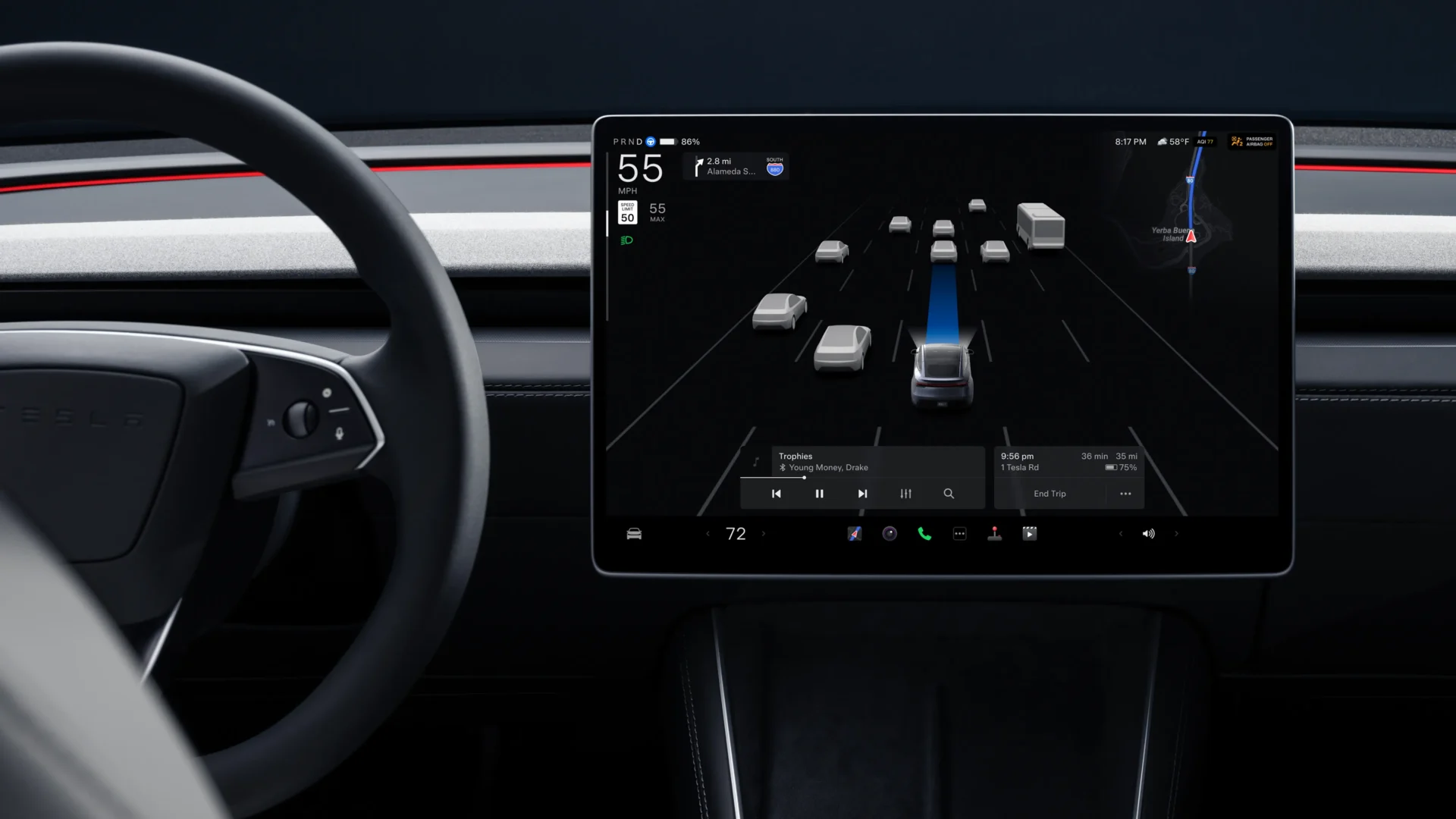

Tesla has stopped including Autopilot on new vehicles sold in the United States and Canada. New buyers now get Traffic-Aware Cruise Control as the standard driver-assistance feature instead of the previous Autopilot package, which combined lane-keeping and adaptive cruise control.
Traffic-Aware Cruise Control manages speed and distance from the car ahead, but drivers must steer and stay engaged at all times. Existing owners who already have Autopilot keep their features, yet new customers need to move up to Full Self-Driving (FSD) if they want more advanced automation.
Tesla has updated its online configurator to highlight FSD (Supervised) as the main upgrade path. The company still lets buyers purchase FSD outright for 8,000 dollars, but only until February 14. After that date, new buyers in the U.S. and Canada will lose the option to buy a permanent license and will have to use the subscription model instead.
The subscription is priced at 99 dollars per month for “Full Self-Driving (Supervised).” Musk has confirmed this price point in public comments. New Tesla vehicles come with a 30-day free trial of FSD (Supervised), giving owners a month to test the system before they decide to subscribe or walk away.


Musk signals future price increases
Elon Musk has made clear that the 99 dollar monthly price is not fixed. He wrote that “the 99 dollars/month for supervised FSD will rise as FSD’s capabilities improve.”
He also pointed to a bigger goal. Musk said the “massive value jump is when you can be on your phone or sleeping for the entire ride (unsupervised FSD).” That kind of use case would move the system from supervised assistance, where the human remains responsible, to true unsupervised operation.

Tesla’s move tilts its business model further toward recurring software revenue. A one-time 8,000 dollar payment is a high hurdle for many owners, yet a 99 dollar monthly charge may feel easier to justify during periods when they drive more.
For Tesla’s engineers, more FSD subscribers likely mean more driving data. This data feeds Tesla’s neural networks and can help refine behavior such as lane selection, unprotected turns, and complex urban scenarios.
For a buyer trying to decide before February 14, the math is simple but still important. Paying 8,000 dollars upfront roughly matches 99 dollar monthly payments over a span of several years, though the exact break-even point depends on future price changes and how long the driver keeps the car.
Tesla faces competition from systems like GM’s Super Cruise and Ford’s BlueCruise, which offer hands-free driving on mapped highways. Those systems are often priced lower but cover narrower use cases.
The company is betting that software and autonomy will drive its next phase of growth, and this shift away from standard Autopilot toward paid FSD is a clear step in that direction.
You may also like to read:
- Tesla offers free upgrades on Model 3 and Y Inventory »
- Lemonade offers 50% insurance cut for Tesla owners using FSD »
- Musk says Tesla’s HW4 cars are ready for unsupervised FSD »
We’ve launched an official Tesla Owners Online Forum. Join early and claim your "Founding Fuel" badge.