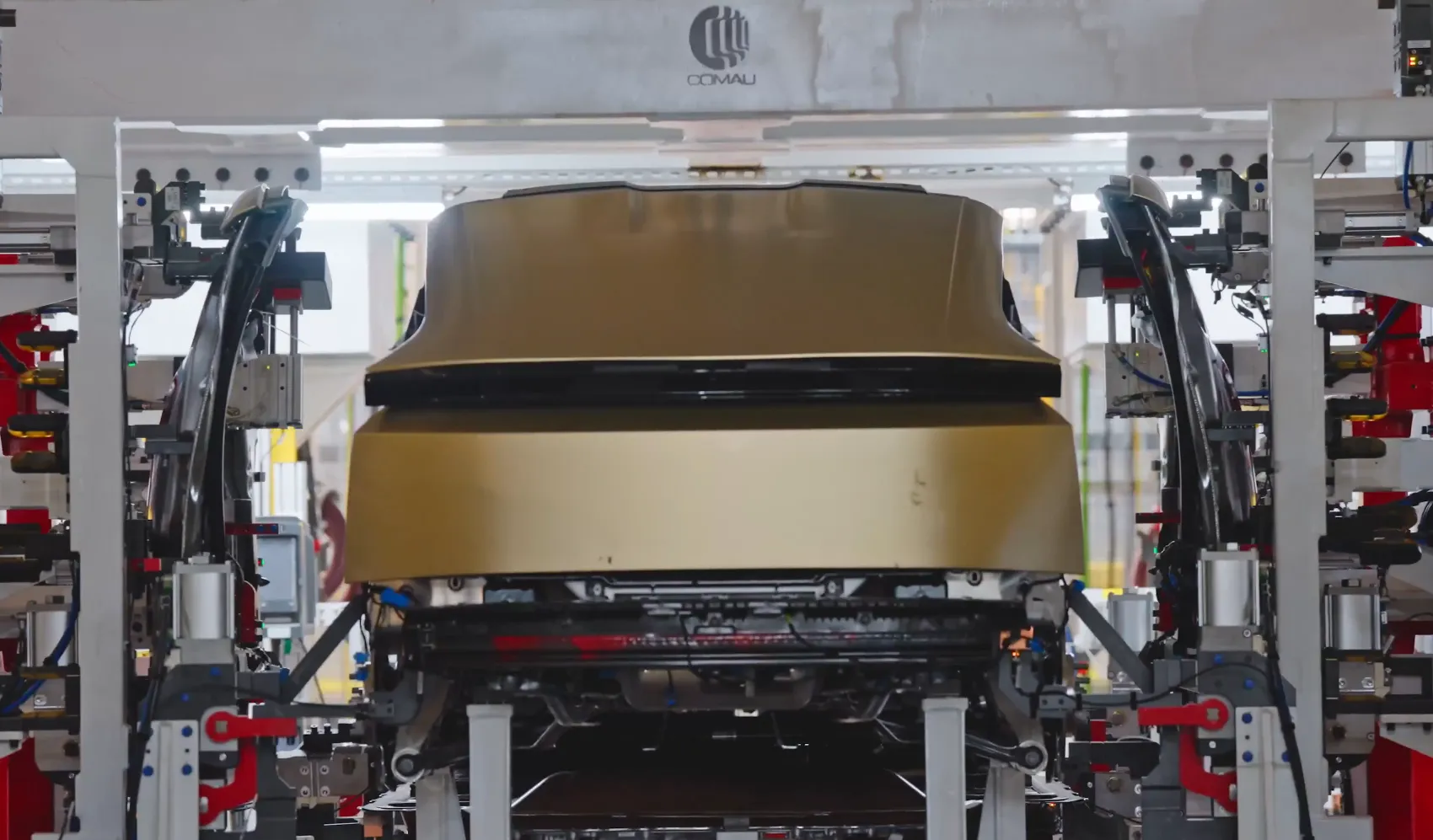

Tesla is moving closer to the start of Cybercab production, aiming to begin building the autonomous vehicle in April 2026 at its factory in Texas, less than 100 days from now. The project will be the first large-scale test of the company’s “unboxed” manufacturing process, which Tesla says can change how fast cars come off its lines.
The Cybercab is planned as a dedicated robotaxi built around Tesla’s Full Self-Driving software, with no steering wheel or pedals in its core concept. It is expected to be produced at Gigafactory Texas near Austin, where lines for the new model have been under construction and pre-production casting work has already begun.
Video:
Tesla Cybercab production starts in less than 100 days from today, which will use Tesla's revolutionary unboxed manufacturing process for the first time.
— Sawyer Merritt (@SawyerMerritt) January 20, 2026
One Cybercab will be able to roll off the production line in under 10 seconds versus 34 seconds for Model Y, with a long term… pic.twitter.com/NJyQcf7vvH
Elon Musk has said Cybercab and the Optimus robot will enter production with what he called an “agonizingly slow” initial output, before ramping to high volumes over time. He has argued that every major new Tesla product follows a similar S-curve, where production starts at low levels and then accelerates after manufacturing problems are solved.
From 34 seconds to under 10
Tesla is linking Cybercab to a step change in production speed. The company believes one Cybercab could eventually leave the line in under 10 seconds, compared with around 34 seconds per vehicle for the Model Y at current high-volume plants. Over time, the target is more aggressive, with an internal goal of about 5 seconds per car in the long run.
Musk has described what that could mean in output terms, saying a line that would typically build about 500,000 cars a year at a one-minute cycle could reach into the low millions if the 5–10 second range is achieved.
The unboxed process at the center of this plan breaks the car into large modules that are built in parallel instead of moving a mostly complete body down one long line. Tesla’s patents describe five main sections for this architecture including a front mega-casting, rear mega-casting, a structural battery pack, a pre-assembled interior module and exterior panels.
Each section is worked on in separate zones where robots and workers can access it from all sides, rather than reaching into a narrow cabin. This layout can shorten walking distances, increase operator density and reduce the footprint needed for a given output level. The system also relies heavily on adhesive bonding and casting, cutting the total number of parts and lowering the number of joining steps compared with traditional welded bodies.
Casting, design and factory impact
Cybercab development has gone hand in hand with new casting tools and molds at Gigafactory Texas, including larger or revised Giga Press equipment aimed at producing the front and rear structures.
The modular layout can reduce manufacturing cost per vehicle by using smaller buildings and fewer steps, which could support the company’s long-term target of a lower-priced autonomous vehicle, often reported around a 25,000 dollar level.
Cybercab sits at the center of Tesla’s push into robotaxis and AI-driven transport, with the company already running limited autonomous ride services in Austin based on existing models. Test programs in 2025 included vehicles operating without a safety driver in some parts of the city, using Tesla’s Full Self-Driving software and remote monitoring.
At the same time, regulators in the United States and abroad continue to weigh how to treat vehicles with no traditional controls. Musk has argued that safety data from supervised and unsupervised robotaxi fleets will support wider approval over time, but compliance and liability frameworks remain in flux.
If Tesla can make good on its timing and reach its long-term cycle time goals, then Cybercab could reshape expectations for both autonomous fleets and how fast electric cars can be built.
You may also like:
- Musk says Tesla’s HW4 cars are ready for unsupervised FSD »
- Tesla patent offers new life for HW3 FSD computers »
- Tesla to end one-time FSD sales, move fully to subscription »
We’ve launched an official Tesla Owners Online Forum. Join early and claim your "Founding Fuel" badge.