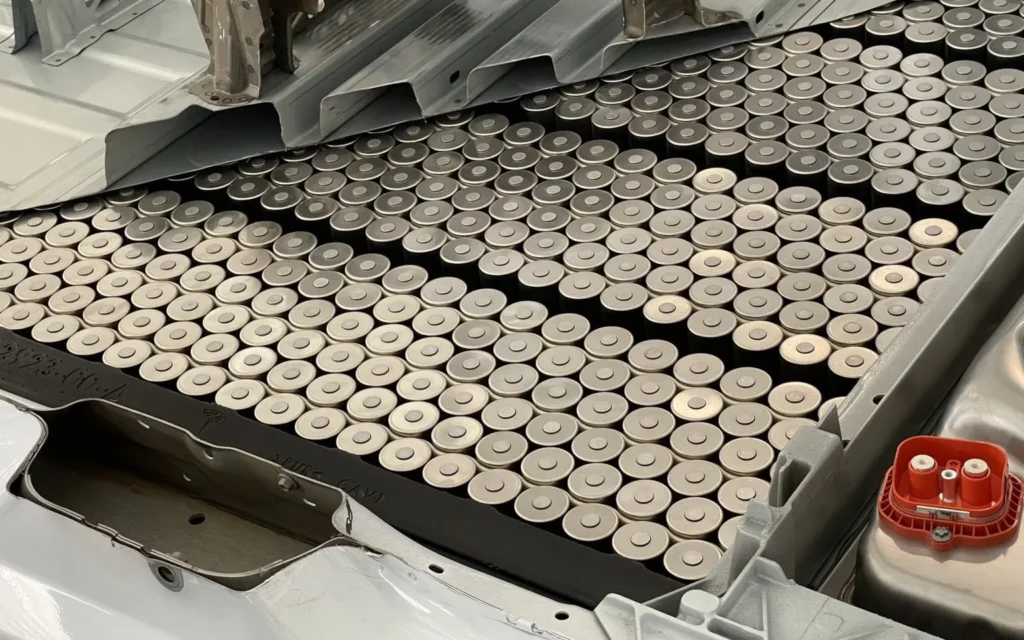
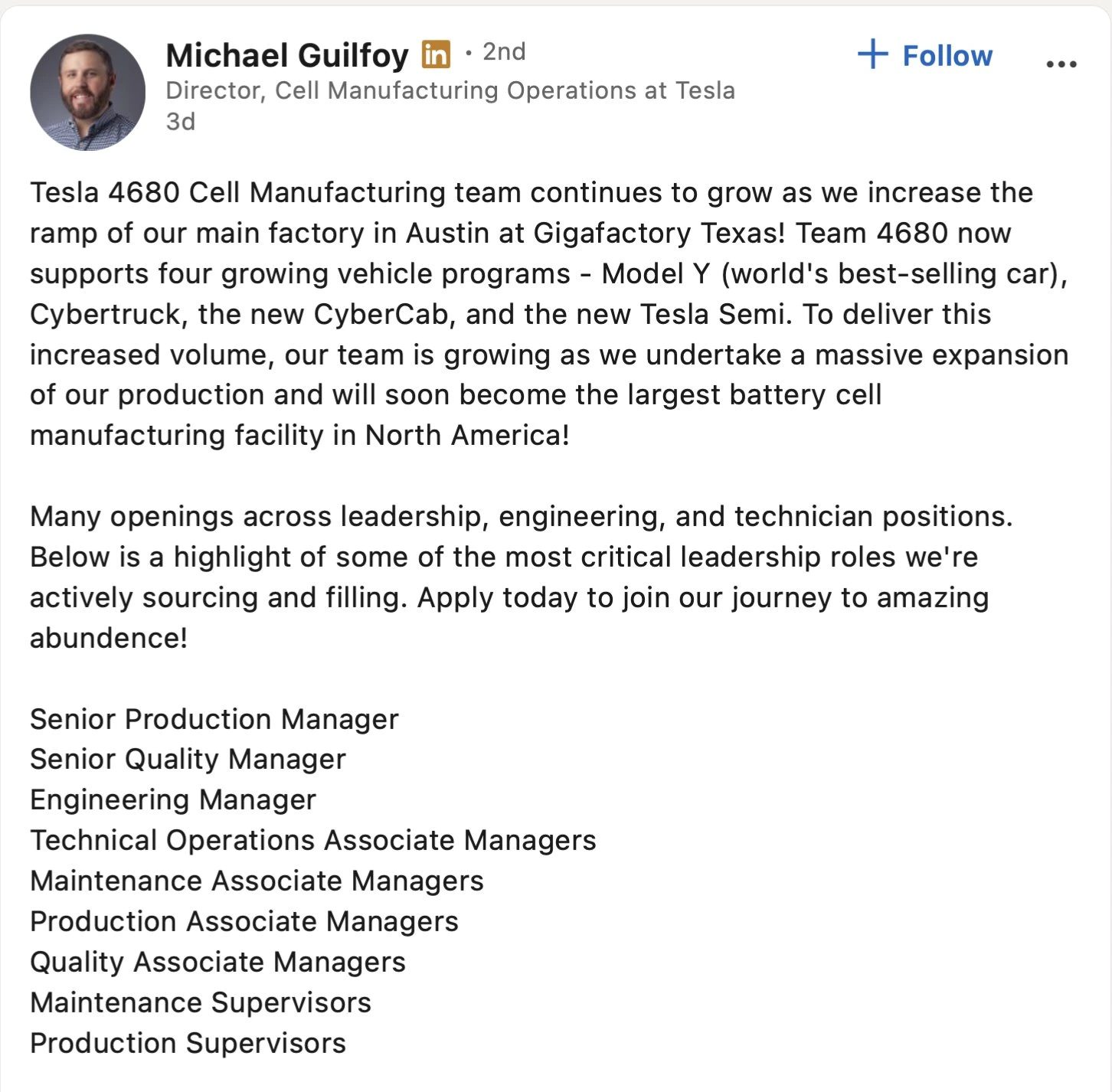
Tesla’s 4680 cell operation at Gigafactory Texas is set to become the largest battery cell manufacturing site in North America, according to Michael Guilfoy, Tesla’s Director of Cell Manufacturing Operations. The comment came in a LinkedIn post.
Guilfoy said the Austin cell team now supplies four vehicle programs, namely the Model Y, the Cybertruck, the new Cybercab and the redesigned Tesla Semi. He tied that growth to a large production expansion at the company’s main Texas factory, and he said his team is hiring to keep pace with the extra volume.
Two new programs and one on the way out
Two of the four programs started production in 2026. Cybercab output began at Giga Texas in April, and by September Tesla was selling paid rides to the public in parts of Austin. The robotaxi uses an 88S6P pack of 4680 cells housed in a steel enclosure, and its modules can be replaced one at a time when a single module fails.
The redesigned Semi went into volume production on April 29 at a new plant next to Gigafactory Nevada, a site Tesla plans to run at 50,000 trucks a year. Even so, the truck sits a little apart from the other three, since it is assembled in Nevada yet Guilfoy counts it among the programs his Texas team supports.
The Model Y is a comeback case. In early 2026 Tesla began fitting some Texas-built units with its own 4680 packs again, which gave the company another source of supply on top of the cells it buys from outside vendors.
The Cybertruck is headed the other way. Musk wrote on X on Nov. 6 that Tesla will wind down production at Giga Texas, the truck’s only factory, around mid-2027 to make room for more Cybercabs, and each truck Tesla stops building frees enough cells for about two and a half Cybercabs.
The math behind the Semi
A single Semi Long Range uses about 10 times as many 4680 cells as a Model Y. The Long Range truck carries 822 kWh of usable capacity. At the 91.5 to 98 Wh per cell found in Tesla’s other 4680 packs, it needs roughly 8,400 to 9,000 cells. By comparison, the original Model Y structural pack held 828 cells and the Cybertruck uses 1,344, according to teardown data and Tesla’s battery passport for the truck. In practical terms, one Long Range Semi takes about as many cells as 16 Cybercabs.
Tesla rates the Long Range at 500 miles with a full 82,000-pound load, and the Standard Range, built around a 548 kWh pack, at 325 miles.
Batteries, not buyers, are the limit, Tesla says
Tesla has told investors for much of 2026 that cell supply, rather than demand, is capping its vehicle output. Its third-quarter letter, released Oct. 21, said “battery availability continued to be the limiting factor” in growing auto volumes, and it added that 4680 output is rising to support the Cybercab and Semi ramps and higher Model Y volumes.
To close that gap, the company has moved most of its supply chain into Texas. In January it confirmed that the anode and the cathode for the 4680 are both made in Austin with its dry-electrode process. By August it was running what it called North America’s first large-scale cathode facility at the site. Then in late September, the first Cybertruck with cells made from lithium refined at Tesla’s Robstown, Texas, plant came off the line, and a day later Tesla finished its first Cybercab with in-house cathode material.
How far Austin has to go
To claim the top spot, Austin would have to pass Panasonic’s plant inside Tesla’s Giga Nevada complex. Panasonic says that factory has about 41 GWh of annual capacity and has shipped more than 11 billion cells since 2017.
Elsewhere, some rivals are pulling back from EV cells. Panasonic said in June it would repurpose its 32 GWh plant in De Soto, Kansas, to make batteries for data centers, and Ultium Cells, the joint venture between GM and LG Energy Solution, is converting its Tennessee plant to cells for energy storage.
Tesla has not released a 4680 capacity figure, so its fourth-quarter report, expected in late January 2027, will offer the first real look at how close Austin is.
Discuss this on Tesla Owners Forum →
We’ve launched an official Tesla Owners Online Forum. Join early and claim your "Founding Fuel" badge.