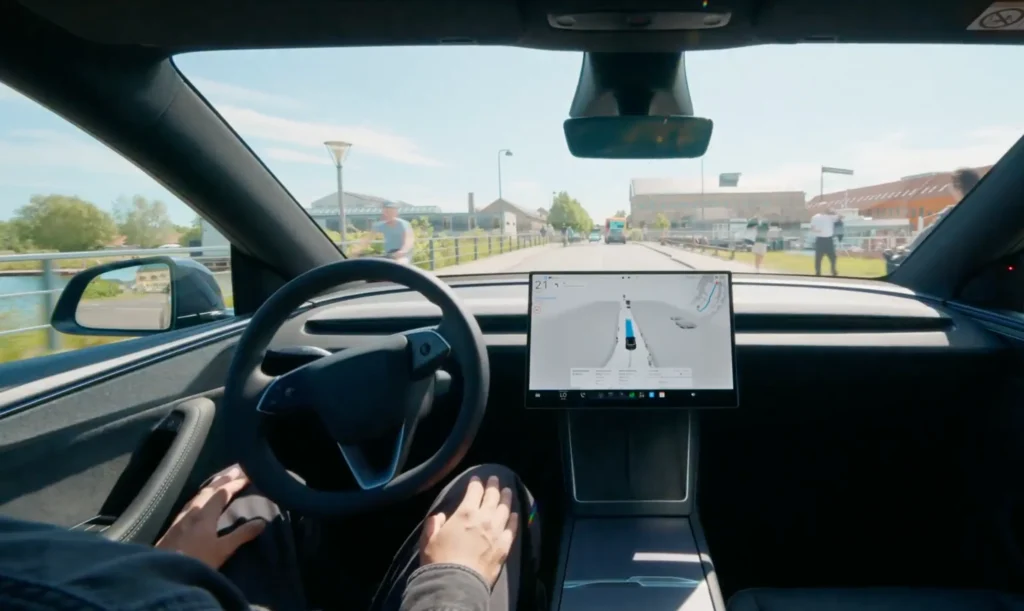
Tesla confirmed that its Full Self-Driving Supervised system is active in the Netherlands, Denmark, Belgium, Estonia, and Lithuania. More than 70,000 European drivers currently use the software, logging over one million kilometers of travel every day. Across 100 million kilometers tracked on public roads in Europe, vehicles operating with the software engaged were 4.1 times less likely to experience a collision compared to manual driving.
The carmaker shared the technical package with regulators across the continent in April 2026. That submission followed formal approval from RDW, the vehicle authority in the Netherlands, which evaluated the technology across an 18-month review. European officials recorded roughly 19,400 road fatalities in 2025, averaging 53 deaths per day. Tesla executives argue that widespread adoption of advanced driver assistance can cut those figures significantly by eliminating common human errors.
The safety numbers behind the Dutch approval
The technical dossier compares Tesla vehicles on Hardware 4 hardware against regular human driving baselines. When evaluated against manually driven Teslas equipped with standard active safety equipment, vehicles running the supervised system experienced 40 to 69% fewer major collisions across highway and city driving. The reduction reached 71 to 90% when measured against older vehicles that lack automatic collision-avoidance features.
Surrogate driving metrics in the report indicate similar performance gains. Automatic emergency braking events dropped between 74 and 84% compared to standard driving. High lateral acceleration events fell by 55% to 75%, and severe driver fatigue alerts dropped by 67%. In European validation testing, company engineering vehicles logged roughly 793,000 miles without a single crash, and fixed-route trials across six major European cities completed 230,000 scenario evaluations with a 99% pass rate.
| Safety Metric Category | Observed Reduction Rate |
|---|---|
| Major crashes vs manual driving with active safety features | 40% to 69% lower |
| Major crashes vs vehicles without active safety features | 71% to 90% lower |
| Automatic emergency braking activations | 74% to 84% lower |
| High lateral acceleration events | 55% to 75% lower |
| Driver drowsiness alerts | 67% lower |
Tesla noted certain data limits in the submission. The fleet-wide collision statistics do not isolate variables like bad weather, traffic density, and late-night driving. Company engineers state that road-class categories offer a dependable baseline for traffic complexity, but acknowledge that driver selection patterns could introduce minor variations into observational numbers.
Five regulatory exemptions filed under Article 39
Tesla built its supervised platform around the United Nations R-171 standard for Driver Control Assistance Systems. Yet the company filed for five specific exemptions under Article 39 of EU Regulation 2018/858 because the neural-network software differs from traditional rule-based mechanisms.
The requested exemptions cover several distinct vehicle behaviors:
- System-initiated steering maneuvers without continuous physical steering-wheel contact on highways when camera monitoring confirms driver attention
- System-initiated maneuvers without hands-on wheel requirements on secondary and urban roads
- Execution of automated maneuvers without suspension from brief driver-state warnings
- Lateral turning forces that exceed standard regulatory acceleration thresholds during tight turns
- Contextual vehicle speed adjustments that match surrounding traffic pace slightly above posted limits
Under the driver monitoring framework, the cabin camera continuously tracks driver attention. Across 513 million automated lane changes in the North American dataset, only 2.5% involved an inattentive driver warning in the seven seconds prior to the lane change. Drivers checked mirrors or side windows in over 90% of lane changes observed across European fleet testing.
High stakes for the upcoming Brussels vote
The Technical Committee on Motor Vehicles meets in Brussels on October 6 to decide on the application. A positive outcome requires a qualified majority representing at least 15 member states and 65% of the EU population. If approved, the European Commission will issue an implementing act that grants EU-wide validity to the Dutch authorization.
| Milestone / Date | Regulatory Status & Event |
|---|---|
| April 10, 2026 | Netherlands RDW issues initial Article 39 type approval |
| May – June 2026 | Denmark, Belgium, Estonia, and Lithuania grant recognition |
| June 30, 2026 | EU technical committee reviews file without holding a vote |
| August 31, 2026 | Tesla publishes full Article 39 safety evidence dashboard |
| October 6, 2026 | European member states hold scheduled vote on EU-wide access |
| January 2027 | Expected entry into force of UN R-171 Series 02 standards |
Some governments, including Sweden, have questioned specific provisions such as traffic-matching speed allowances . In addition, upcoming UN R-171 Series 02 rules entering into force in early 2027 will introduce more rigid driver-confirmation steps for automated maneuvers. If the October vote fails to pass, the current national approvals in the five active markets could expire within six months. A victory would clear the path for commercial deployment across 27 countries, opening the technology to millions of European motorists.
We’ve launched an official Tesla Owners Online Forum. Join early and claim your "Founding Fuel" badge.