Tesla has quietly updated the Cybertruck’s side repeater camera housing to use “passive geometry” that disturbs airflow and helps keep water off the lens in rain, without adding cost or moving parts. The change was disclosed this week by Cybertruck lead engineer Wes Morrill, who described it as a “pure vision improvement.”
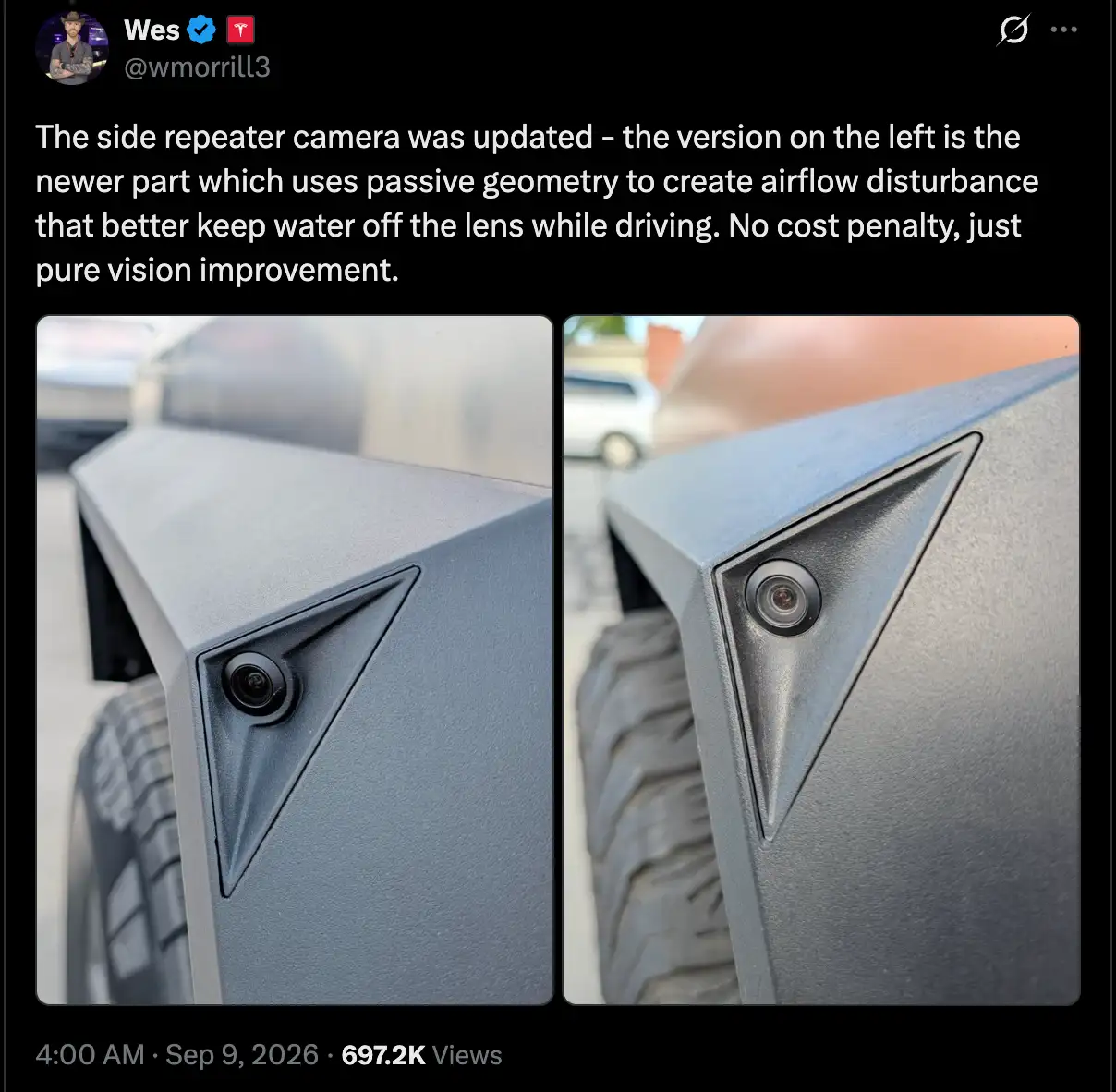
In a post on X, Morrill shared side‑by‑side photos of the old and new Cybertruck side repeater camera assemblies, noting that “the version on the left is the newer part.” He explained that the revised housing “uses passive geometry to create airflow disturbance that better keep water off the lens while driving,” improving visibility in wet conditions.
Morrill emphasized that the change adds “no cost penalty” and that the improvement comes entirely from the reshaped plastic housing around the camera rather than any new mechanical or electrical components. So, the update introduces no moving parts, no additional complexity and relies solely on the vehicle’s natural airstream to sweep water away from the lens.
Why Tesla is targeting camera visibility
Cybertruck, like other Teslas equipped with Autopilot and Full Self‑Driving, depends on multiple exterior cameras for lane‑keeping, object detection and blind‑spot monitoring, making lens clarity critical in rain, snow and off‑road conditions. Tesla’s owner manuals already instruct Cybertruck drivers to clean camera lenses regularly and to proactively dry condensation using cabin preconditioning and defroster settings when visibility is compromised.
In practice, side repeater cameras are exposed to spray, road grime and standing water, which can temporarily blind the sensors and trigger system warnings or limit driver‑assist features. By using shaped surfaces to manipulate airflow around the repeater camera, Tesla is effectively trying to reduce how often water sticks to the lens, cutting down on driver intervention and keeping vision systems online for longer in bad weather.
Cybertruck already stands out as the first Tesla with a dedicated washer for its front‑facing bumper camera, which can spray fluid automatically or on demand via the Camera app to clear dust and debris.
Back in early 2025, Tesla’s AI team confirmed on X that a “more comprehensive cleaning solution” for vehicle cameras was being developed after owners highlighted how quickly the Cybertruck’s rear camera can be obscured by dirt in wet and off‑road use. And a later patent filing have described potential systems that dispense fluid and wipe or blow it away, as well as ideas like hydrophobic lens coatings and pressurized air jets, though Tesla has not publicly detailed which of these will reach production vehicles.
Beyond the Cybertruck, camera washer hardware has already appeared on engineering prototypes for Tesla’s robotaxi‑focused Cybercab and Model Y robotaxis, where integrated sprayers have been spotted on rear and side camera housings. Against that backdrop of active cleaning systems for fleet and robotaxi applications, the Cybertruck’s new side camera uses a simpler, passive design change to improve visibility.
Production and retrofit questions
Morrill did not specify when the updated side repeater camera entered Cybertruck production, only noting that the revised part is “the newer” version now appearing on vehicles. And Morrill has previously described Cybertruck as a “living thing, constantly evolving and improving.”
Tesla’s public service documentation shows that the Cybertruck’s fender flare covers, which house the side repeater cameras, can be removed and replaced by service technicians. So, retrofits are technically possible, though Tesla has not announced any retrofit program for existing owners.
We’ve launched an official Tesla Owners Online Forum. Join early and claim your "Founding Fuel" badge.