Tesla has begun shipping a new Autopilot computer, informally known as “Hardware 4.5” or “AI4.5,” in certain 2026 Model Y vehicles built at its Fremont plant. The company has not announced this step, yet the pattern across part labels, catalog entries, and software clues points to a clear mid‑cycle hardware refresh.
Hardware 4.5 spotted in a January 2026 Model Y
An owner who picked up a Fremont‑built 2026 Model Y, manufactured on January 22, reported finding an Autopilot computer labeled “AP45” under the glove box, with part number 2261336‑02‑A printed on the module.
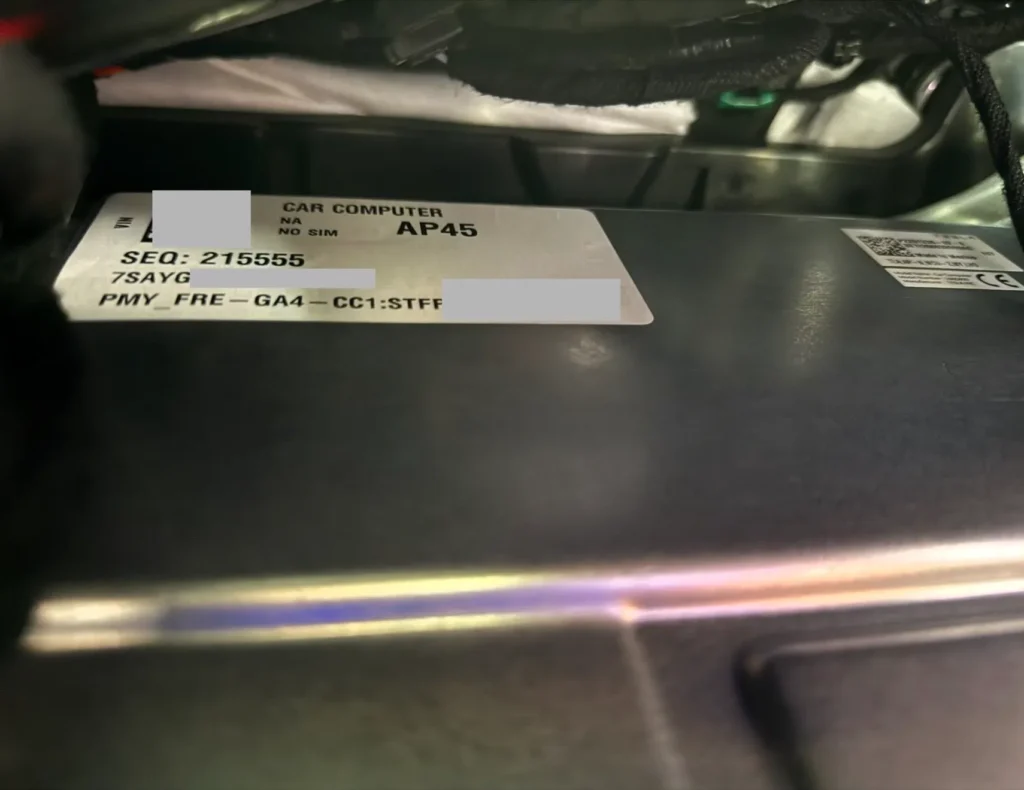
Credit: @Eric5un | X
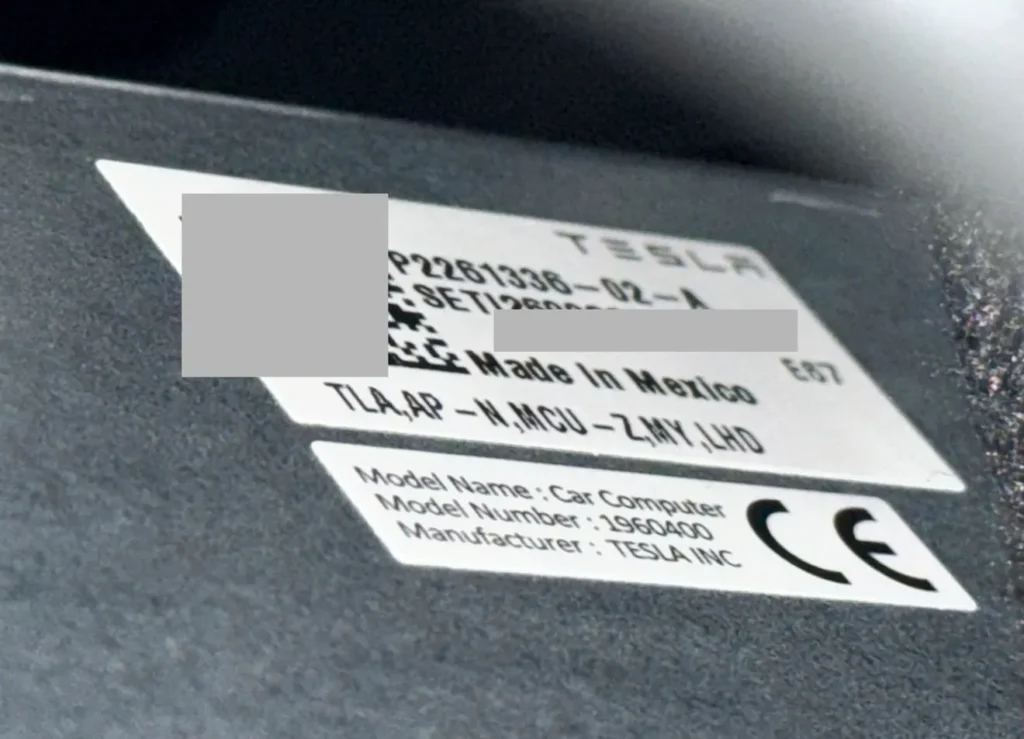
Credit: @Eric5un | X
The owner described the car as “one of the last w/ Autopilot,” noting that it uses the legacy Autopilot branding instead of Tesla’s newer “AI Driver” label.
The same vehicle includes Tesla’s updated front camera housing and a 16‑inch center screen.
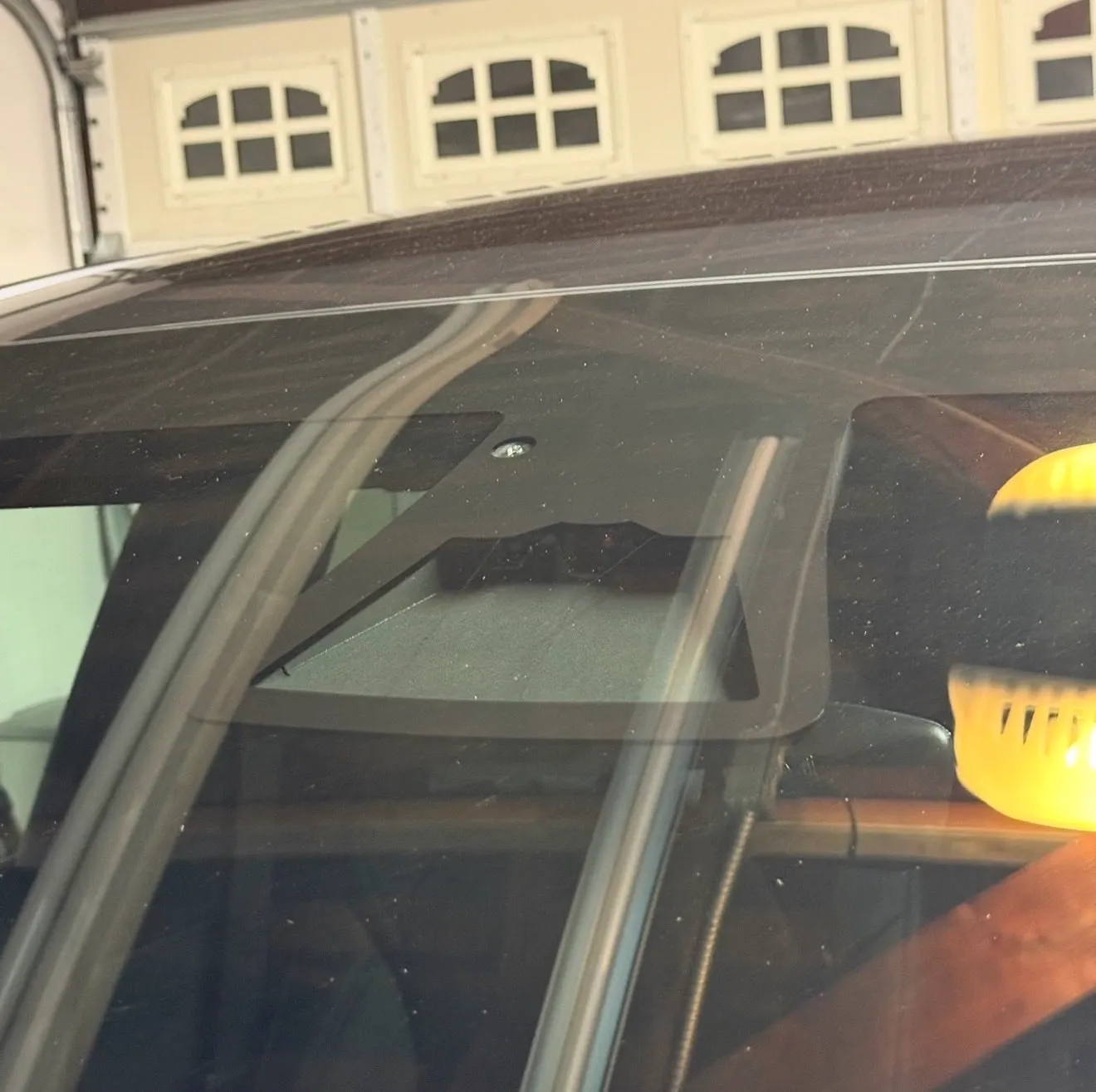
However, it does not have washers for the rear and side repeater cameras, which had been rumored for future trims. That mix hints that Tesla is updating the compute platform and interior hardware even as it continues to refine the camera and sensor package step by step.
Rerouted part numbers and “AP45” label
The 2261336‑02‑A part number aligns with an entry in Tesla’s electronic parts catalog that had already been described as “Controller Hardware 4.5.” Enthusiasts who checked VIN‑linked parts catalogs for late‑2025 and early‑2026 Model Y builds say they see this controller listed in association with HW4‑era vehicles.
Some owners report a curious split: the catalog still refers to the system in generic “Hardware 4.0/AI4” terms, yet the actual unit in the car carries an “AP45” marking. That gap has led to say Tesla may be rolling out a significant internal revision while keeping the public hardware generation label stable for now.
Multiple newer Model Y vehicles, including those tied to the “Juniper” refresh cycle, appear to contain the same AP45 computer behind the glove box. These cars tend to share the new front camera housing and the larger display, which signals that Tesla is combining several hardware changes within the same production window.
What hardware 4.5 likely brings
Tesla has not published technical specifications for Hardware 4.5, so current detail comes from catalog entries, firmware clues, and prior analysis of HW4. Software researcher “greentheonly” previously identified references in Tesla code to a three‑SoC architecture, in contrast to the dual‑SoC layout used in both HW3 and HW4. Observers now link those code references to the AP45 unit.
If the three‑SoC configuration is accurate, it could serve several purposes at once. It may increase total compute capacity for larger neural networks, provide triple modular redundancy for safety, and open room for “shadow mode” testing on a third chip. Triple modular redundancy allows two chips to outvote a third in case of a fault, which can improve resilience to errors. And a spare SoC can run experimental FSD stacks alongside the production system without affecting the active drive.
Earlier independent teardowns of HW4 boards revealed that Tesla had already upgraded to higher‑bandwidth GDDR6 memory and added more CPU cores compared with HW3. At the same time, Tesla cut RAM and storage in some HW4 Model Y variants, a cost decision that raised concerns about future headroom for larger FSD models. Hardware 4.5 now looks like a way to regain margin on the AI4 platform, instead of waiting for the much larger jump planned with AI5.
A bridge between AI4 and AI5
The arrival of Hardware 4.5 comes as Tesla works on its next‑generation AI5 chip, which is expected to deliver a major performance uplift over AI4. AI5 is targeting production in the second half of 2026, with broad deployment in customer vehicles more likely in 2027.
That timeline leaves a gap of at least a year in which Tesla still needs more compute for FSD expansion but cannot yet rely on AI5 in volume. So, hardware 4.5 is a practical bridge. It upgrades compute capacity and safety margin on current vehicles while AI5 completes design, validation, and ramp.
At the same time, Elon Musk has said repeatedly that HW4 cars can reach unsupervised FSD without hardware swaps. Hardware 4.5 fits inside that narrative. It stays within the same apparent generation from a branding standpoint, yet it gives Tesla more room to push heavier FSD networks in the near term and experiment with new software stacks.
What buyers can expect right now
For buyers, the picture is still emerging. Evidence so far points to new Model Y units from Fremont, and possibly other factories tied to the Juniper update, gaining the AP45 computer on late‑2025 and early‑2026 build dates. Owners have not reported a formal upgrade program from HW4 to HW4.5, and Tesla’s public documentation still does not distinguish the two for customers.
In practice, new owners who find an “AP45” label under the glove box are likely driving the most capable Tesla Autopilot / FSD computer that will be available until AI5 enters mainstream production. That may matter most for drivers who plan to keep their cars for several years and want the best chance of receiving future FSD software updates without hardware limits.
There is still plenty that remains unclear. Tesla has not said if AP45 will spread across all models, and it has not commented on whether Hardware 4.5 will ever appear in official spec sheets. For now, the picture comes from the ground up: from parts labels, catalog codes, software hints, and new owners comparing notes as they receive their 2026 Fremont‑built Model Y vehicles.
Update – Label clarification (Jan 29, 2026): Tesla sales advisors now say the “AP45” marking was a labeling error and that all recent deliveries use AI4 (HW4). Tesla has also updated its public parts catalog to remove any reference to HW4.5 and now lists only HW4, in line with the company’s statement that all vehicles delivered today come with HW4. The company plans to correct labels and related documentation to prevent confusion going forward.
You may also like to read:
- Musk: V14 Lite and free HW4 swap put HW3 Teslas back in focus »
- Tesla launches unsupervised Robotaxi rides in Austin »
- Musk says Tesla’s HW4 cars are ready for unsupervised FSD »
- Musk says unsupervised FSD is “pretty much solved” »
We’ve launched an official Tesla Owners Online Forum. Join early and claim your "Founding Fuel" badge.