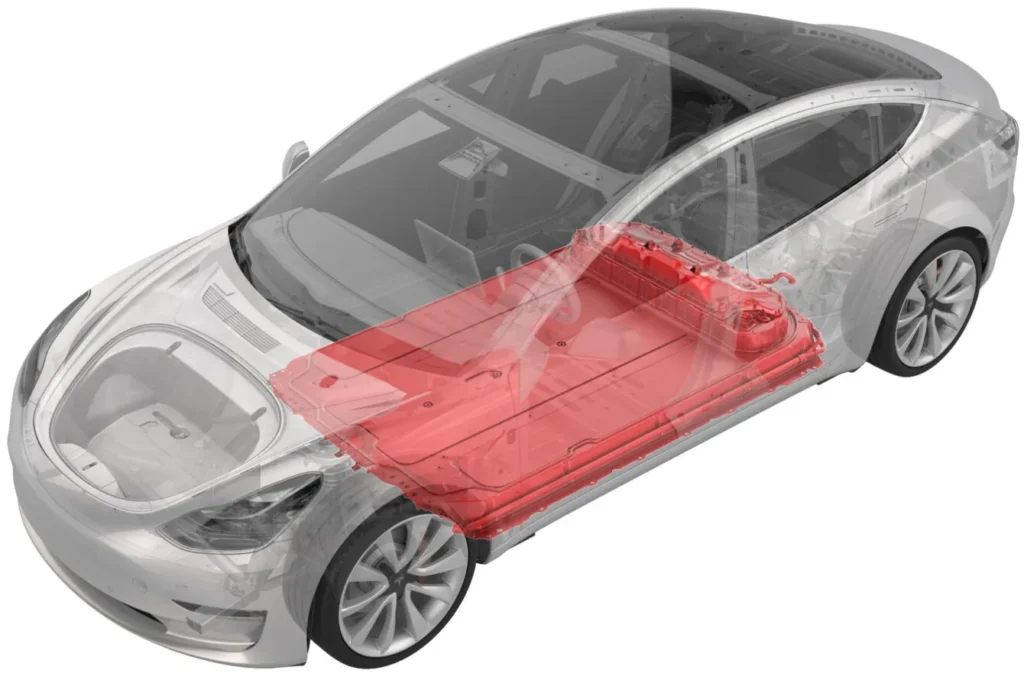
A newly published Tesla patent application describes a current collector built to do a second job most current collectors never touch: keeping the positive and negative sides of a battery apart. If the design works the way the filing describes, it could remove a part that every lithium-ion cell on the road today still relies on, the plastic separator.
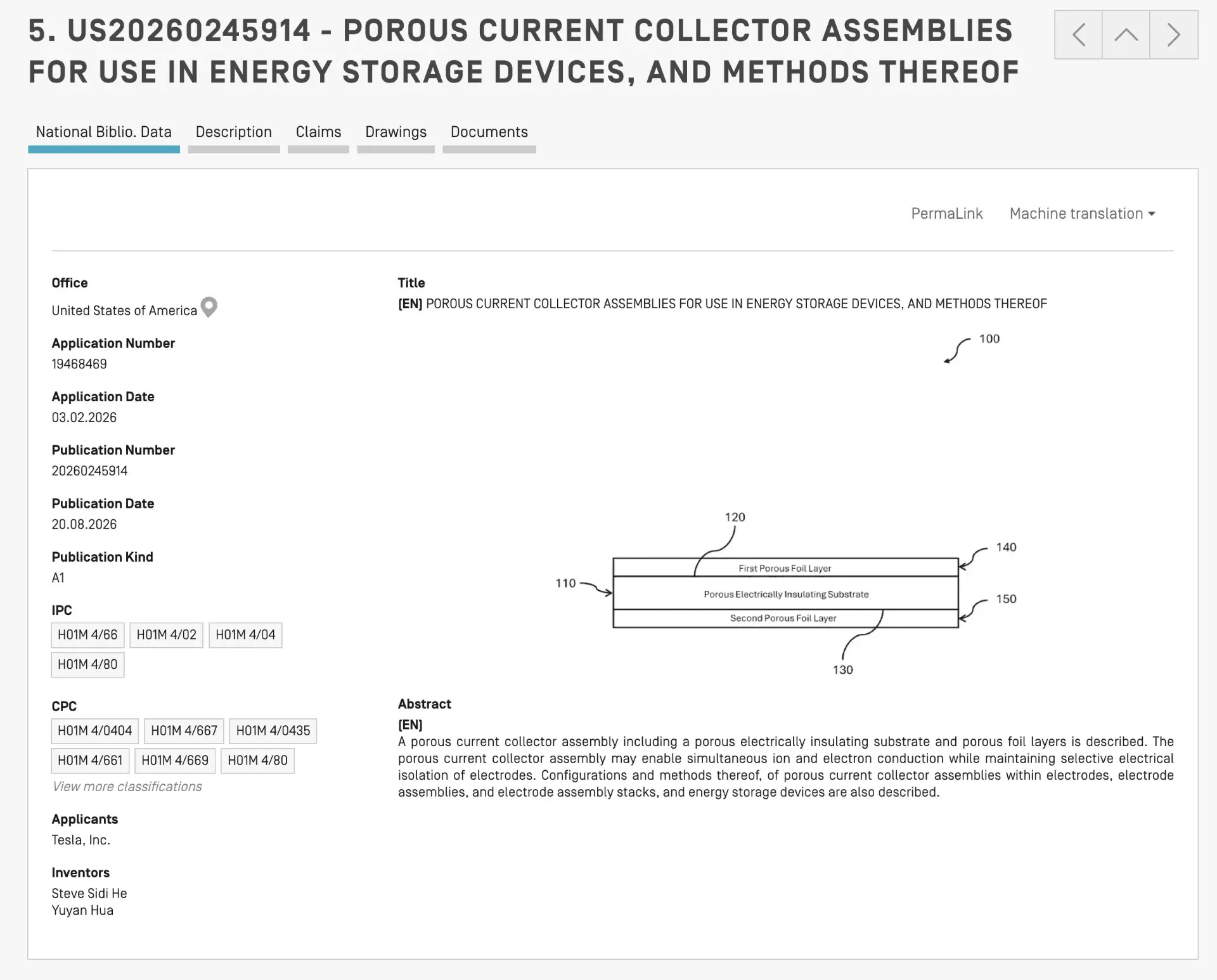
The application, US 2026/0245914 A1, was published on August 20, 2026, and it lays out what Tesla calls a porous composite current collector. The name sounds technical, and it is, but the goal behind it is not complicated. Tesla wants one part to carry current, keep the electrodes from touching, and let lithium ions pass through, all at once.
How today’s battery cells are built
Almost every lithium-ion cell sold right now uses solid metal foil to move current in and out, copper on one side and aluminum on the other. Those foils are solid, and ions cannot pass through them, so cell makers have to stack the electrodes in a strict order, positive facing negative, with a plastic separator between every layer.
That separator stops the cell from short-circuiting. It also stores no energy of its own. It takes up space and adds weight, and it has been treated as a fixed cost of doing business in battery design for decades. Tesla’s filing takes aim at that cost directly, and proposes turning the current collector itself into a part that can do the separator’s job too.
The design behind the filing
The patent describes a three-layer sandwich. At the center sits a porous, electrically insulating polymer sheet, and on both faces of that sheet sit thin, porous metal coatings. Because the whole structure is riddled with tiny channels, lithium ions can move straight through it, something a solid metal foil never allows.
When electrodes of opposite polarity are built onto each face, the part ends up doing three jobs on its own. It carries current, it keeps the two electrodes electronically apart, and it lets ions cross from one side to the other. Put that all together and a standalone separator layer is no longer needed, and the distance ions have to travel between electrodes drops by close to half, according to the application.
This is not a completely new idea in battery research. Academic groups have explored similar composite structures in recent years as a way to improve cell safety without giving up energy density, and at least one published study describes a multilayer separator and current collector composite built to replace standard all-metal current collectors for that reason. Tesla’s filing takes a version of that concept and ties it to a specific, manufacturing-ready design.
Two different metals on one sheet
One detail in the filing stands out. The metal coating on one face of the polymer core does not have to match the coating on the other face. Tesla describes coating one side with copper and the other with aluminum, mirroring the metal split used in conventional anodes and cathodes today, but now on a single sheet instead of two separate foils.
That opens up a different way to build a cell. Instead of the usual repeating stack of anode, separator, cathode, sheets of this composite could be layered so cathode-coated faces sit against other cathode-coated faces, and anode faces sit against anode faces. Layers of the same polarity do not need to be kept apart electrically, so a stack built this way would not need a separately installed separator sheet anywhere in the cell.
The application gets specific about size and structure. The porous metal layers would run between 0.1 and 10 microns thick, and the polymer core between 1 and 30 microns. Pore sizes span a wide range too, from single nanometers up to a full centimeter, and both the polymer core and the metal layers can be tuned to a porosity somewhere between 5 percent and 75 percent.
The polymer core itself is described as a high-temperature engineering plastic, with polyimide, aramid, and PTFE named as options. Tesla cites melting points as high as 450 degrees Celsius for the substrate, well above the point where a conventional metal foil would fail during a localized hot spot. The porous structure also gives internally generated gas a path to escape during cycling, which the filing says lowers the risk of electrode delamination and lithium plating over time.
What Tesla says the design could deliver
The application lays out several claimed benefits. Removing the separator’s dead volume could raise a cell’s energy capacity by roughly 5 to 10% without any change to the chemistry inside the cell. The shorter ion path could lower internal resistance, and that in turn could support faster charging without pushing the cell into thermal trouble as quickly. Tesla also says the design fits with its dry, solvent-free electrode process, where finished electrode film gets pressed straight onto the collector instead of coated from a wet slurry and dried in an oven.
If applied to Tesla’s 4680-format cells, used in vehicles including the Cybertruck and Model Y, a capacity gain in that range could add a meaningful amount of range in the same pack size, or let Tesla cut cell mass while holding range steady. On the manufacturing side, dropping a separately wound separator layer, and the equipment that installs it, is the kind of change that tends to matter more on a factory floor than on a spec sheet.
None of this means the design is heading into production. A published patent application is a legal disclosure, filed to protect an idea, and it is not confirmation that Tesla is building the part described or putting it into a vehicle any time soon. Battery makers file on concepts that never leave the lab far more often than they ship them, and getting a design like this to survive thousands of charge cycles at automotive scale is a separate engineering problem from proving the physics on paper.
This article is based on Tesla’s published patent application.
We’ve launched an official Tesla Owners Online Forum. Join early and claim your "Founding Fuel" badge.