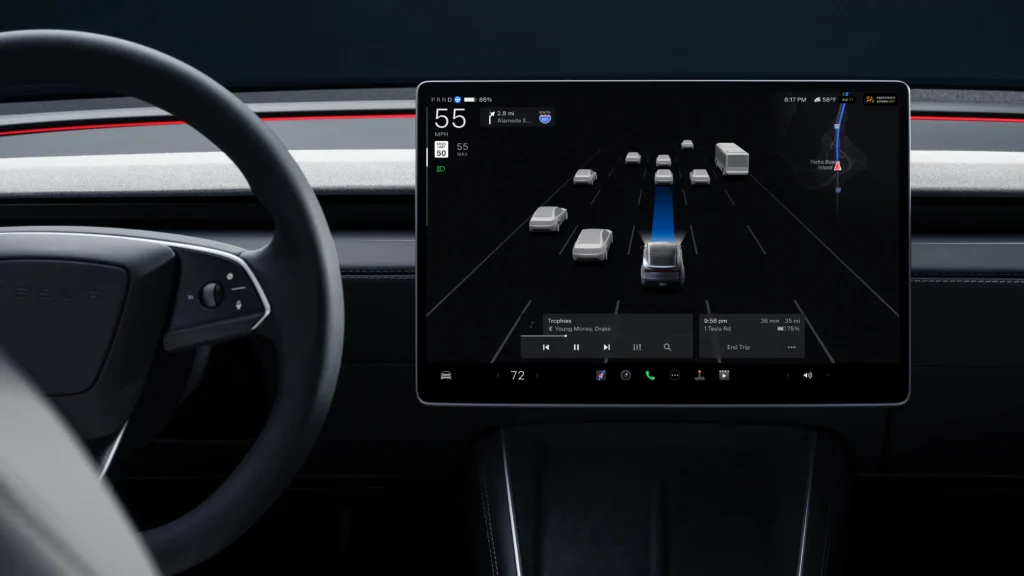
Tesla has started the wider release of Full Self-Driving Version 14.3, which Elon Musk describes as the “final big piece of the puzzle” in Tesla’s plan to reach full autonomy. The update focuses more on system improvements rather than new visual changes. And even before drivers finish installing this version, Musk is already turning attention to V15, which he says will move Tesla from a supervised driving system to one that operates entirely on its own.
FSD V14.3 first reached Tesla’s Early Access users earlier this week. The company rebuilt its AI compiler and runtime engine from the ground up. Tesla says this change improves response time by about 20 percent. Musk explained that the foundation of the system is now complete and the next few updates, labeled 14.3.x, will polish behavior on the road.
These will focus on eliminating small issues like hesitation during lane changes and sudden braking. Drivers have complained about those habits for years, and Tesla wants them cleared before moving to the next stage.
Preparing for the big jump to V15
Musk’s statement about the next major version caught the attention of the tech and auto industry. He said V15 would not be a small improvement but a major leap built on a model 10 times larger than what FSD uses today. “V15 will far exceed human levels of safety, even in completely unsupervised and complex situations,” Musk wrote on X.

Tesla’s latest safety data claims the current supervised system already performs about seven times safer than an average human driver based on miles between collisions. V15 aims to remove the human backup completely and rely on the vehicle alone.

Analysts think this step would be one of the biggest in the company’s software timeline, though it still faces strict regulatory conditions before wide release.
Handling edge cases without human eyes
For years, engineers and regulators have debated if a vision-only system can truly deal with unpredictable driving situations such as complex construction sites or harsh weather. Musk’s statement that V15 will handle these “unsupervised” means Tesla believes the large model upgrade gives the AI enough reasoning skill to manage such rare cases independently.
Many agree that FSD V14.3 feels more natural and human-like than past versions, but getting to a system that needs no human attention at all requires far more than just code, it also means reaching new levels of safety approval, testing, and insurance readiness across markets.
Tesla plans to keep working on smaller improvements through the next few months. The upcoming patch series will focus on the “Perfect Autopark” function and smoother driving in city areas. Another version called V14 Lite is planned for release by late Q2 2026 so that older vehicles with Hardware 3, known as AI 3, can stay compatible.
Musk continues to call the global Tesla fleet the company’s “living laboratory.” He believes that every mile driven helps train the system to handle real situations more safely than before. The next few months will reveal whether FSD V14.3 truly stands as the last necessary stage before unsupervised driving or just another milestone in Tesla’s long pursuit of full autonomy.
We’ve launched an official Tesla Owners Online Forum. Join early and claim your "Founding Fuel" badge.