Tesla’s Supercharger network quietly became one of Tesla’s most important businesses in Q4,2025. According to Tesla’s own year‑end charging recap and analyst breakdowns, the network handled 52 million Supercharger sessions in the fourth quarter, up 29% from a year earlier. That’s an average of more than 565,000 charging stops every single day. At the same time, Superchargers delivered roughly 6.7 terawatt‑hours of electricity across 2025, a record annual total and a clear step up from 2024.
Tesla’s data show around 1.4 TWh of energy delivered in Q1, 1.6 TWh in Q2, and 1.8 TWh in Q3, with Q4 holding near that peak on a much larger network.
The expansion pace behind those numbers is aggressive. In Q4 alone, Tesla added roughly 3,600 Supercharger stalls worldwide, a 19% year‑over‑year increase in new openings and about 40 fresh plugs going live every day. By the end of 2025, the company had passed 75,000 active Supercharger stalls at well over 7,000 sites.
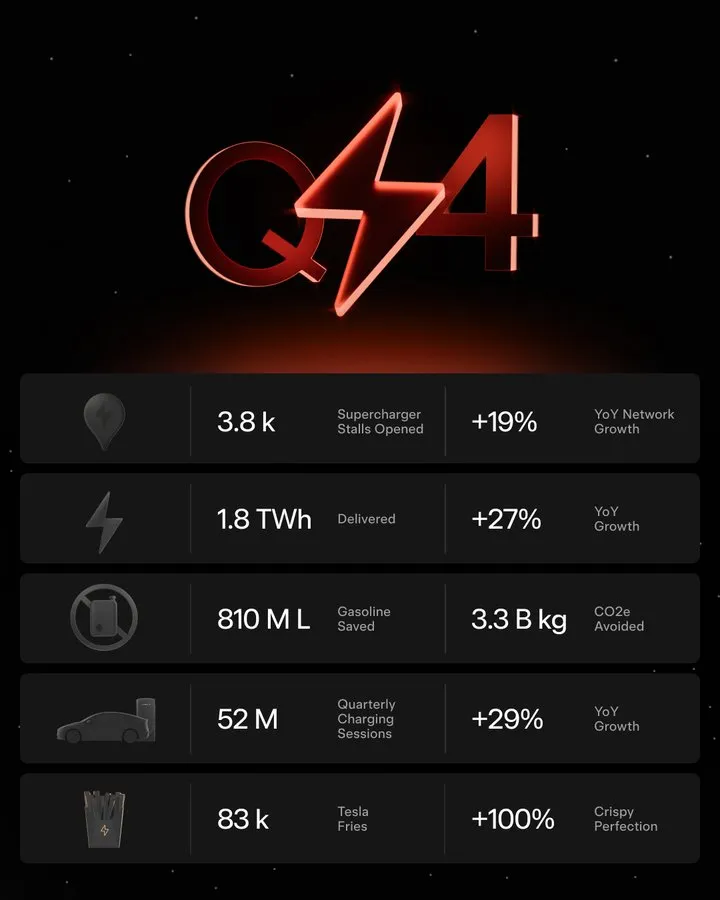
There’s also the emissions math. Using Tesla’s own assumptions, Q4 Supercharging saved about 810 million liters of gasoline and avoided around 3.3 billion kilograms of CO₂‑equivalent emissions. Stretch that across the full year and you’re talking on the order of billions of liters of fuel not burned.
V4 hardware shifts what “fast charging” means
Underneath the headline metrics, Tesla is already laying the groundwork for the next phase. In September 2025, it opened the first fully built V4 Supercharger site in Redwood City, California. The updated cabinets can push up to 500 kilowatts into passenger vehicles and up to 1.2 megawatts into the Tesla Semi.
Each cabinet now feeds up to eight stalls, double the old V3 configuration, while packing roughly three times the power density.
Right now, only the Cybertruck can really stretch the system, but even that’s enough to show what V4 can do. Early tests at the Redwood City station have seen the truck jump from near empty to 80 percent in roughly half an hour, with charge rates far above what legacy Tesla models can accept.
Opening the gates to everyone else
The other strategic move in 2025 was less visible on a map but just as important. Tesla’s fast chargers finally became a realistic option for non‑Tesla drivers.
Over the year, Ford, Rivian, GM, Mercedes‑Benz, Volvo, Polestar, BMW, Hyundai, Kia, Toyota, Nissan and Stellantis either rolled out adapters for Tesla’s North American Charging Standard plug or committed to ship new models with NACS hardware from the factory. Hyundai and Kia’s 2025 EVs are among the first non‑Teslas to come with a native NACS port.
By late 2025, roughly 15,000 Supercharger ports in North America were open to non‑Tesla EVs, mostly newer V3 and V4 sites. Older V1 and V2 locations remain Tesla‑only, which makes sense given their age and design. Every outside car that plugs in pays Tesla a fee, and at this point that revenue looks less like a side hustle and more like the early shape of a stand‑alone infrastructure business.
Also, the IONNA joint venture, backed by BMW, GM, Honda, Hyundai, Kia, Mercedes‑Benz, Stellantis and Toyota, plans to install at least 30,000 high‑power chargers in North America by decade’s end. If that network delivers on uptime and location quality, Tesla will finally have a serious competitor on its home turf.
Fifty‑two million sessions in three months is not a side business. It’s the backbone of Tesla’s claim that pure EVs can match, and in some ways beat the convenience of gasoline.
We’ve launched an official Tesla Owners Online Forum. Join early and claim your "Founding Fuel" badge.