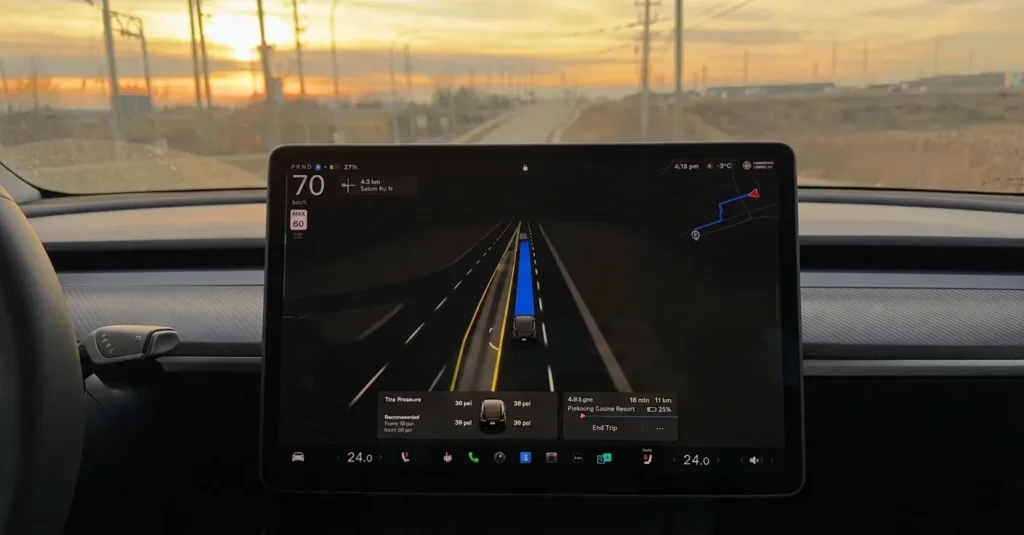
Tesla is beginning to roll out FSD (Supervised) v14 Lite to Hardware 3 (AI3) vehicles via 2026.20.5.1 Software Update, starting with an early‑access group ahead of a broader deployment over the coming weeks. The update brings many of the headline capabilities of FSD v14 on Hardware 4 to older HW3 cars by compressing the neural network and porting newer driving behaviors to the legacy platform.
FSD v14 Lite is now rolling out to AI3 early-access customers. Based on the feedback, will rollout to more customers over the next few weeks.
– Tesla VP Ashok Elluswamy
Since late 2025, Tesla’s most advanced FSD (Supervised) builds have focused on Hardware 4, leaving millions of HW3 vehicles effectively capped at FSD v12-era behavior, especially outside North America. On multiple earnings calls, Tesla AI chief Ashok Elluswamy confirmed that HW3 cannot safely support future unsupervised “robotaxi” autonomy, but that a v14 Lite build was being engineered to deliver next‑generation supervised driving to the legacy fleet. The company targeted a Q2 2026 release window for this build, lining up with today’s late‑June rollout to early‑access AI3 owners.
Distilled intelligence from HW4 to HW3
Elluswamy has repeatedly described v14 Lite as a distilled version of FSD v14 that runs within HW3’s more limited compute and camera stack. Rather than removing major features, Tesla has compressed the underlying neural networks so HW3 can “learn” from the behaviors already proven on HW4 v14, including reinforcement learning and updated offline models. HW3’s neural net is effectively guided by HW4’s larger models, allowing it to mimic many of the same driving decisions while respecting the older hardware’s constraints.
Key features coming with FSD v14 Lite
V14 Lite is designed to deliver near‑feature parity with FSD v14 on HW4, even if raw performance and reaction time will remain better on newer hardware. Owners can expect speed and driving‑style profiles (including more aggressive or more cautious modes), the ability to start self‑driving from park, and new arrival options that let drivers choose whether the car should stop in a parking lot, driveway, street, or curbside at the destination.
Parking, unparking, and reversing under FSD (Supervised) are also part of the package, extending the system beyond simple forward navigation on city streets. The distilled v14 behavior improves both proactive and reactive responsiveness in complex situations, from merges and forks to pedestrian interactions, traffic lights, cut‑ins, and construction zones, with a particular emphasis on safety and smoother comfort.
Rollout plan and regional availability
On Tesla’s Q1 2026 earnings call, the company reiterated that v14 Lite for HW3 would begin rolling out in the United States around the end of June, followed by international markets once technical and regulatory conditions are met. European and Middle Eastern HW3 owners are expected to receive the update later in 2026, in markets where FSD (Supervised) approvals or road trials are already underway. Tesla has emphasized that HW3 customers who previously purchased FSD will get v14 Lite automatically when their region is enabled, with separate hardware retrofit programs being prepared for owners who want future unsupervised autonomy.
Despite the aggressive feature push, Tesla has been clear that HW3 will not achieve unsupervised FSD; that capability is reserved for HW4 and forthcoming AI compute platforms. For HW3, v14 Lite is intended to maximize supervised day‑to‑day driving quality, smoother maneuvers, better handling of edge cases, and more human‑like behavior while keeping a human driver attentive and ready to intervene. Owners seeking true robotaxi‑grade autonomy will either need to retrofit to newer hardware (in markets where Tesla offers such upgrades) or move to a new vehicle.
For long‑time Tesla customers who bought HW3 vehicles and invested in FSD years ago, v14 Lite represents the largest single improvement they have seen since the v12 series. Instead of being permanently tied to older driving logic, their cars are now gaining access to the newer v14 behavior stack, ranging from improved comfort and lane centering to more decisive navigation through dense urban environments. While HW3 will still sit below HW4 in ultimate capability, the practical feature set for supervised driving start from park, destination parking, speed profiles, and richer maneuvering will be far closer than many owners expected.
Official release notes (V14 Lite) 2026.20.5.1
FSD (Supervised) v14 Lite includes:
- Distilled the intelligence from HW4 V14 into HW3. This allows HW3 to directly learn how to handle scenarios using HW4 V14 as a guide. This process unlocks the improvements that have been made to HW4 including Reinforcement Learning (RL) and offline models for HW3.
- Improved both proactive and reactive responsiveness across a wide variety of categories including navigation handling, merges and forks, pedestrian interactions, traffic lights, and vehicle cut-in scenarios.
- Improved general comfort in nominal scenarios through fewer false slowdowns, smoother steering and more consistent lane centering.
- Introduced parking, unparking, and reversing capabilities.
- Added Arrival Options for you to select where FSD should park: in a Parking Lot, on the Street, in a Driveway, or at the Curbside.
- Speed Profiles are now available at all times, to further customize driving style preference.
Arrival Options
Your preferences for arrival options and preferred parking positions are persisted for each destination.
You can now select an arrival option such as Parking Lot, Street, Driveway, and Curbside for Robotaxi-style drop offs.
Speed Profiles
FSD (Supervised) will now determine the appropriate speed based on a mix of driver profile, speed limit, and surrounding traffic.
- Introduced new Speed Profile SLOTH, which comes with lower speeds & more conservative lane selection than CHILL.
- Driver profile now has a stronger impact on behavior. The more assertive the profile, the higher the max speed.
- Right scroll-wheel up/down now adjusts Speed Profile setting rather than your precise max speed offset selection in mph/kph.
UI Improvments
Adjust settings like the Speed Profile and Arrival Options directly from the Self-Driving visualization on the center display.
Start Self-Driving From Park
A button will appear on the screen when driver requirements are met. Driver requirements include (but are not limited to):
- Driver is seated in driver’s seat
- Driver is buckled
- Cabin Camera is unobstructed
To engage FSD (Supervised), tap the Start Self-Driving button, then press and release the brake pedal. This feature does not make your vehicle autonomous and you must remain attentive and be ready to take over at any time. Only a licensed driver authorized to operate the vehicle should be allowed access to the driver’s seat position any time the vehicle is not in Theater or Arcade modes.
We’ve launched an official Tesla Owners Online Forum. Join early and claim your "Founding Fuel" badge.