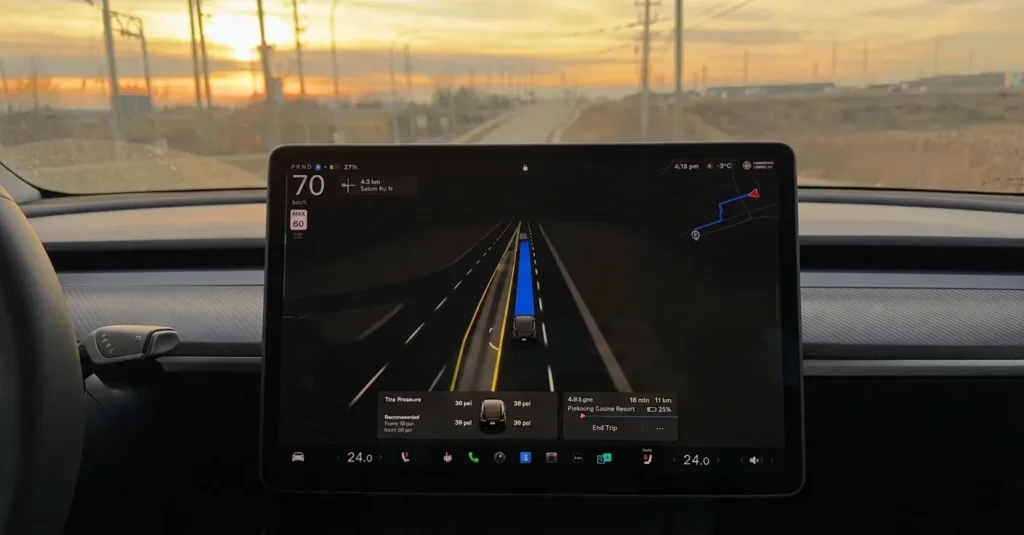
Tesla is rolling out 2026.20.6.10 to early-access HW3 and AI3 owners, bringing FSD (Supervised) v14 Lite and a new option to disable Brake Confirm for the first time on these older cars.
The update is part of Tesla’s FSD (Supervised) v14 Lite program for HW3 and AI3 vehicles. It follows the earlier 2026.20.5.1 rollout and keeps the same basic goal. Tesla wants to bring more of the v14 driving stack to older hardware without asking owners to switch cars.
The new build is not a full v14 release for HW3. Tesla has been using a distilled version of the newer system, and that version is meant to run on the older computer while still borrowing parts of the newer model’s behavior.
What v14 Lite brings
Tesla’s release text says v14 Lite distills intelligence from HW4 v14 into HW3. That gives the older hardware a way to learn from the newer system and use that knowledge in real driving situations.
The release notes say the build improves proactive and reactive response across navigation handling, merges and forks, pedestrian interactions, traffic lights, and vehicle cut-in scenarios. It is a broad set of changes.
Brake Confirm gets a new option
The main change in 2026.20.6.10 is, HW3 and AI3 owners can now disable Brake Confirm when starting FSD (Supervised) from park.
Before this update, the driver had to press and release the brake pedal before FSD could engage. Now the Start Self-Driving button can let the car take over after the tap, if driver checks pass. This update cuts one step from the routine and makes the handoff feel cleaner.
How the parking flow works
Tesla says a Start Self-Driving button appears once driver requirements are met. The car checks that the driver is seated, buckled, and detected before the button appears. When the button is used, the car can leave a parking spot and move into the drive path under FSD (Supervised).
If the system does not detect a valid driver, the brake press is still required. So the new setting does not remove the safety check. It only removes one step when the car has already confirmed the driver is there.
This is the first time Tesla has given HW3 and AI3 owners the option to disable Brake Confirm. For a long time, older Tesla hardware sat behind the newer cars on FSD features. v14 Lite already narrowed that gap, and this update narrows it a bit more.
It is part of Tesla’s wider plan to keep older cars current through software instead of hardware changes. Early-access rollout comes first, and wider release usually follows once Tesla is satisfied with the data.
Tesla still says FSD (Supervised) is not autonomous. The driver has to stay alert and ready to take over at any time.
Official release notes
FSD (Supervised) v14 Lite includes:
- Distilled the intelligence from HW4 V14 into HW3. This allows HW3 to directly learn how to handle scenarios using HW4 V14 as a guide. This process unlocks the improvements that have been made to HW4 including Reinforcement Learning (RL) and offline models for HW3.
- Improved both proactive and reactive responsiveness across a wide variety of categories including navigation handling, merges and forks, pedestrian interactions, traffic lights, and vehicle cut-in scenarios.
- Improved general comfort in nominal scenarios through fewer false slowdowns, smoother steering and more consistent lane centering.
- Introduced parking, unparking, and reversing capabilities.
- Added Arrival Options for you to select where FSD should pull over or park: in a Parking Lot, on the Street, in a Driveway.
- Speed Profiles are now available at all times, to further customize driving style preference.
Start Self-Driving from Park
A button will appear on the screen when driver requirements are met. Driver requirements include (but are not limited to):
- Driver is seated in driver’s seat
- Driver is buckled
- Cabin Camera is unobstructed
Brake Confirm requires the driver to press and release the brake pedal before FSD (Supervised) can be activated. When Brake Confirm is disabled, pressing the button will allow Self-Driving to apply the brakes and engage FSD (Supervised). If driver detection requirements are not met or if FSD (Supervised) does not detect a driver, you will be required to press and release the brake pedal to confirm. You can enable Brake Confirm in Self-Driving > Brake Confirm.
This feature does not make your vehicle autonomous and you must remain attentive and be ready to take over at any time. Only a licensed driver authorized to operate the vehicle should be allowed access to the driver’s seat position any time the vehicle is not in Theater or Arcade modes.
Full Self-Driving (Supervised)
Under your supervision, Full Self-Driving (Supervised) can drive your Tesla almost anywhere. It will start from a parked position, make lane changes, select forks to follow your navigation route, navigate around other vehicles and objects, make left and right turns and park at your destination.
You and anyone you authorize must use additional caution and remain attentive. It does not make your vehicle autonomous. Do not become complacent. Full Self-Driving (Supervised) is enabled on your vehicle. To use the feature, press the Start Self-Driving button on the UI, or press the right scroll wheel button once. You can disable Full Self-Driving (Supervised) in Self-Driving Settings.
Speed Profiles
FSD (Supervised) will now determine the appropriate speed based on a mix of driver profile, speed limit, and surrounding traffic.
- Introduced new Speed Profile SLOTH, which comes with lower speeds & more conservative lane selection than CHILL.
- Driver profile now has a stronger impact on behavior. The more assertive the profile, the higher the max speed.
- Right scroll-wheel up/down now adjusts Speed Profile setting rather than your precise max speed offset selection in mph/kph.
UI Improvements
Adjust settings like the Speed Profile and Arrival Options directly from the Self-Driving visualization on the center display.
Arrival Options
- You can now select an arrival option such as Parking Lot, Street, Driveway, and Pull Over for Robotaxi-style drop offs.
- Your preferences for arrival options and preferred parking positions are persisted for each destination.
We’ve launched an official Tesla Owners Online Forum. Join early and claim your "Founding Fuel" badge.