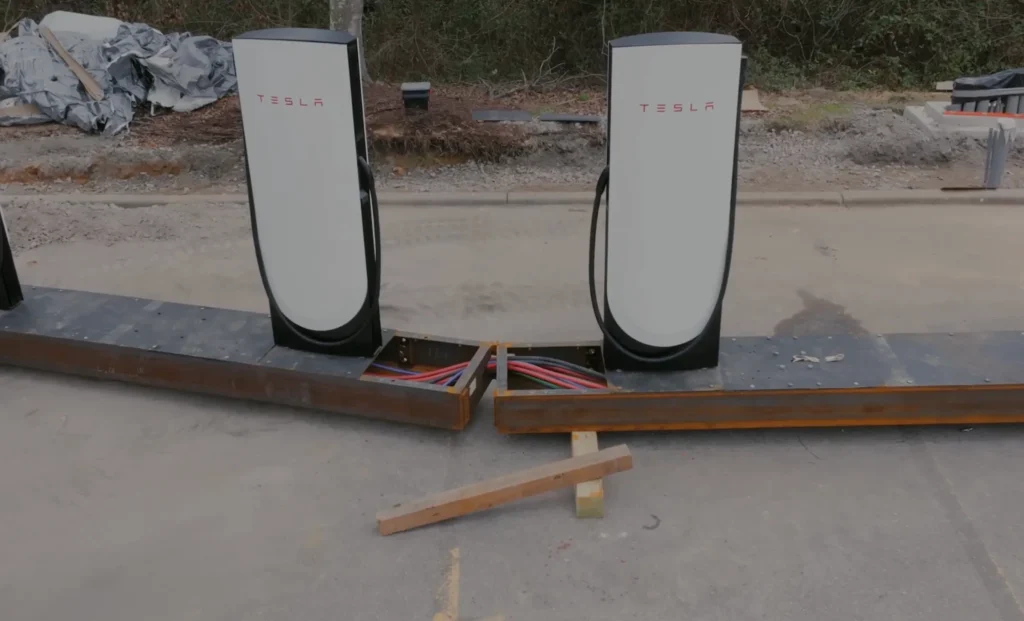
Tesla has officially unveiled its new Folding Unit (FU) Supercharger, a redesigned V4 charging system built from the ground up to deploy faster and cost less than ever before.
Video:
The Folding Unit is a pre-assembled V4 charging system that ships in two configurations, folded and unfolded, allowing it to be transported compactly and set up on-site with minimal effort. Each unit includes 8 charging posts powered by a single V4 cabinet capable of delivering up to 500 kW for passenger vehicles, and up to 1.2 MW for the Tesla Semi.
The most immediate change is in logistics. Tesla can now fit two Folding Units per truck, which means 16 Supercharger posts per delivery, up from 12 before. That’s a 33% improvement in shipping efficiency, cutting down on the number of trucks needed for large site deployments.
Faster, simpler Installation
Tesla has eliminated the DC busbar connection that was previously required between cabinets in the field, and power now flows from a single V4 cabinet directly to all 8 stalls. That change alone simplifies wiring, reduces potential failure points, and speeds up the process considerably.
Perhaps most notably, a Tesla service technician is no longer needed for commissioning. Sites can now be dropped into a parking lot, connected to grid power, and go live without waiting for a specialist to sign off. Combined, these changes allow new stations to deploy 2x faster than before.
Max de Zegher, Tesla’s Director of Charging, summed it up simply, “Save 20%+ on cost, improve build quality, and deploy 2X faster.”
V4 cabinet is already the new standard
Just days before this announcement, Tesla’s Gigafactory New York produced its final V3 Supercharger cabinet, ending a 7-year, 15,000-cabinet production run. Tesla has now committed to exclusively manufacturing and installing V4 hardware going forward.
The V4 cabinet supports twice the stalls per cabinet compared to V3, operates at three times the power density, and is future-proofed for 800V–1,000V vehicle architectures like the Cybertruck and Tesla Semi. For Model S, 3, X, and Y owners, charging speeds remain at up to 250 kW, but the infrastructure is ready for higher rates as vehicle hardware catches up.
Tesla is framing the Folding Unit as “Rev1” of a new hardware iteration, and already has Rev3 scheduled to launch in Q2 2026. The company hasn’t detailed what Rev3 will bring, but the pace of iteration suggests further reductions in cost, installation time, or both.
With Supercharger stall costs already reported to be under $40,000, already the lowest in the industry, the Folding Unit pushes that number down even further. As EV adoption accelerates globally, Tesla’s ability to expand its network faster and cheaper than competitors could prove to be just as important as the vehicles themselves.
You may also like to read:
- Musk replies to “make a minivan” with a cooler Tesla is coming »
- Tesla app to add photo-based repair estimates and total loss flow »
- Tesla FSD v14.3 enters testing phase, wide rollout only weeks away »
We’ve launched an official Tesla Owners Online Forum. Join early and claim your "Founding Fuel" badge.