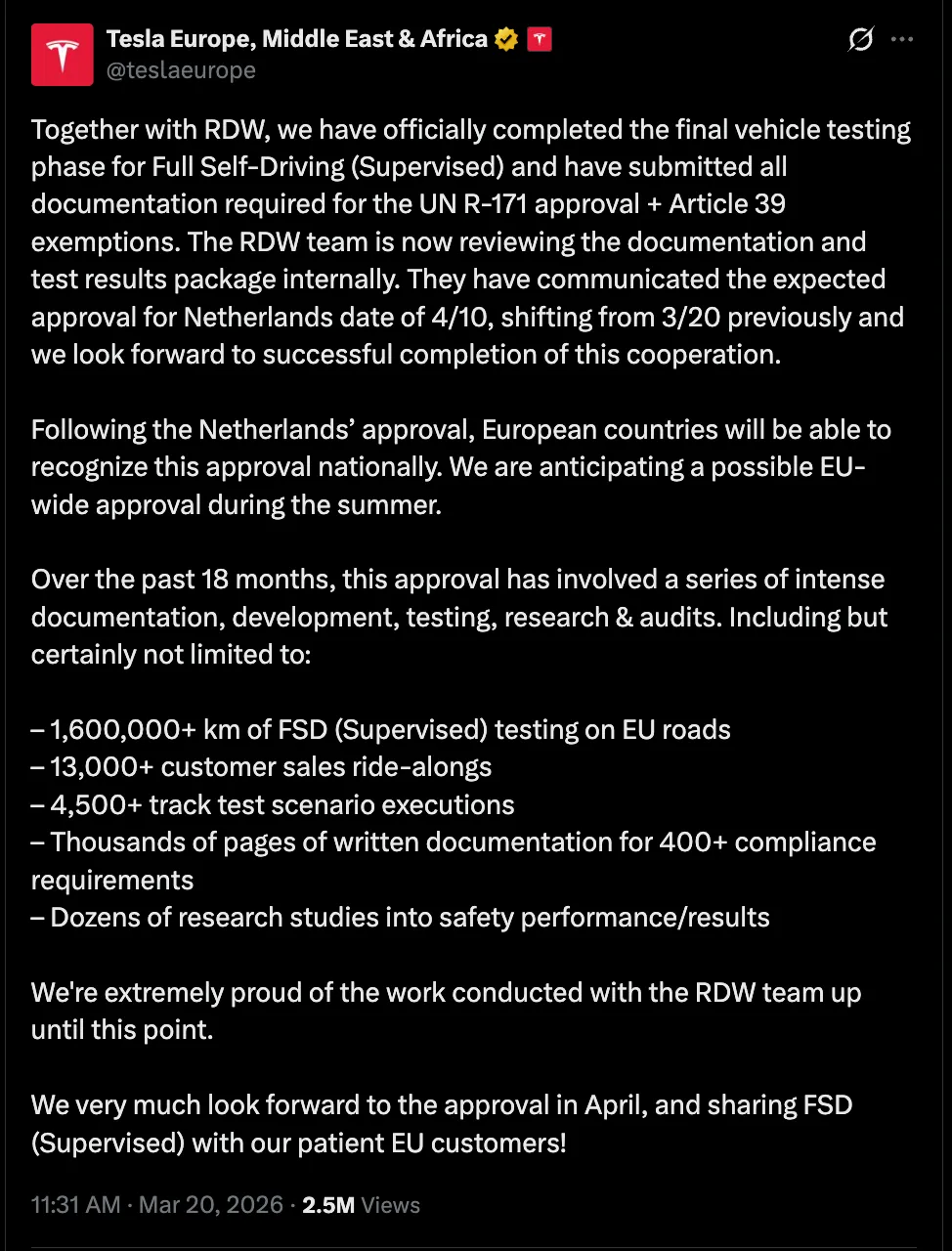
After years of regulatory groundwork, Tesla is closer than ever to launching its Full Self-Driving (Supervised) system on European roads. The company officially announced that approval from the Dutch vehicle authority RDW could come as early as April 10, with a broader rollout across Europe targeted for this summer.
18 Months of regulatory work
The company has spent over 18 months working directly with European regulators, submitting thousands of pages of documentation and satisfying more than 400 compliance requirements. The effort spans two regulatory tracks. Proving compliance with UN Regulation R-171, which governs driver control assistance systems. And filing Article 39 exemptions under EU law for behaviors not yet covered by existing rules, such as hands-free, system-initiated lane changes and Level 2 operation on certain road types.
Tesla has been transparent about why exemptions are necessary. Some EU regulations are rules-based and were written before systems like FSD existed. Modifying FSD to comply with those outdated rules, Tesla argues, would actually make the system less safe and less functional in real-world conditions.
The numbers behind the case
Tesla’s regulatory submission is backed by an extensive data package:
- 1,600,000+ km of FSD (Supervised) testing on EU roads
- 13,000+ customer ride-alongs across European cities and highways
- 4,500+ track test scenario executions
- Dozens of research studies covering safety performance and results
This builds on earlier internal testing across 17 EU countries, and a public ride-along program that launched in Germany, France, and Italy in late 2025, later expanding to the Netherlands in February 2026. These sessions gave both regulators and everyday drivers a firsthand look at how FSD handles European roads, roundabouts, dense urban streets, and highway driving included.
The Netherlands sits at the center of Tesla’s European strategy. RDW, the Dutch vehicle licensing authority, is the gateway to the entire EU market. Once the Netherlands grants national approval, other EU member states can immediately recognize the exemption and authorize their own local rollouts. Tesla would then bring the approval to the TCMV (Technical Committee on Motor Vehicles) for an official EU-wide decision.
If a majority vote is achieved in that committee, Tesla receives a bloc-wide exemption valid across all EU member states. If not, the Netherlands approval still stands, and individual countries can choose to adopt it on their own terms.
This is exactly the regulatory domino effect Tesla has been engineering. Approval in one strategically chosen country can unlock a continent.
Tesla originally targeted February 2026 for Netherlands approval, a date RDW cautioned was not guaranteed. Elon Musk later pointed to March 20, 2026 during a visit to Giga Berlin, citing information provided by Dutch authorities.
The updated target of April 10 represents Tesla’s latest milestone, backed by fully submitted documentation and a complete regulatory file.
How approval affects European owners
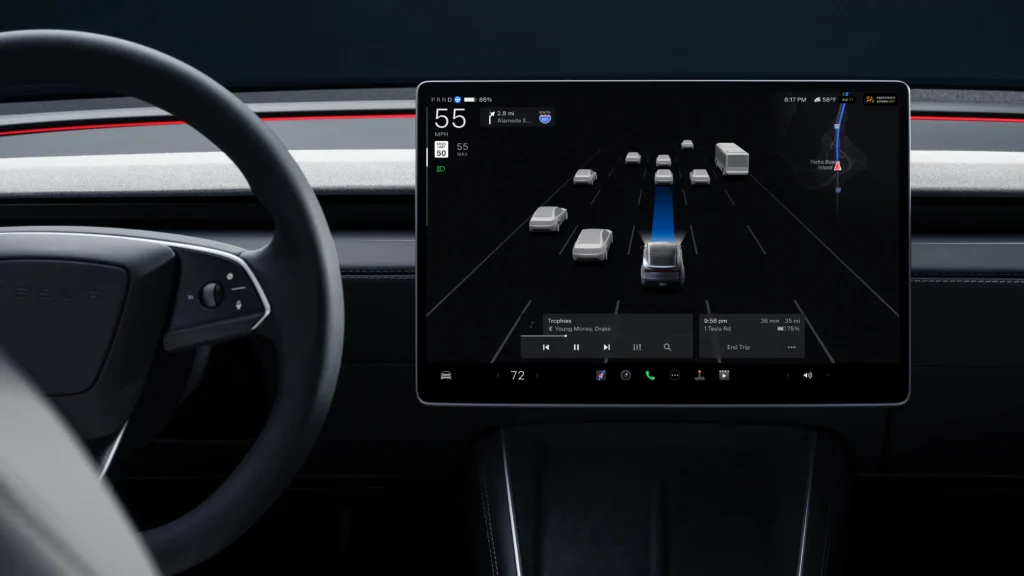
FSD (Supervised) enables Tesla vehicles to handle steering, acceleration, braking, and lane changes across city streets and highways, while requiring the driver to remain attentive and ready to intervene at any moment. It is not fully autonomous. The driver is always responsible.
Globally, Tesla’s FSD fleet has accumulated over 8 billion miles, with one major collision recorded every 5.3 million miles under FSD-active conditions, compared to one every 855,132 miles during manual driving. That safety data has been a cornerstone of Tesla’s regulatory argument in Europe.
For the hundreds of thousands of Tesla owners across the EU who have been waiting years for this feature, approval in the Netherlands would be more than symbolic.
Tesla has also been preparing the commercial side of its rollout. The company appears to be getting its pricing strategy in place ahead of time.
Subscription pricing of approximately €99 per month has been referenced in Tesla’s European website source code. So, it looks like the company may already have its plans finalized.
Overall, it indicates Tesla is ready to move quickly and flip the switch as soon as regulatory approval is granted.
We’ve launched an official Tesla Owners Online Forum. Join early and claim your "Founding Fuel" badge.