Tesla has started to send Full Self-Driving (Supervised) v14.2.2.2 (2025.45.7) to a small group of drivers as a follow-up to the larger 14.2.2 release and the new build brings bug fixes and tuning instead of headline features.
The update is reaching Early Access drivers and high‑engagement FSD accounts, while the wider fleet remains on 14.2.2 or 14.2.2.1. It is tied to the 2025.45 software branch that already carries FSD 14.2.2 and 14.2.2.1, and Cybertruck owners are included as well.
FSD 14.2.2 remains the foundation for today’s behavior, and v14.2.2.2 simply builds on that base. Public notes and driver feedback describe 14.2.2 as a meaningful change for daily use, even though much of the work happens inside neural networks and planning systems.
Arrival options and end‑of‑trip behavior
Arrival Options is one of the clearer user‑facing additions in 14.2.2. Owners can pick where the car should stop at the end of a route, such as a Parking Lot, Street, Driveway, Parking Garage, or Curbside. The navigation pin then moves to reflect that choice so the car targets a point that better matches the selected arrival style instead of a generic address. Tesla lists these Arrival Options for FSD (Supervised) v14 on hardware 4 vehicles, which includes newer Model S, 3, X, Y, and Cybertruck.
UI changes and daily use
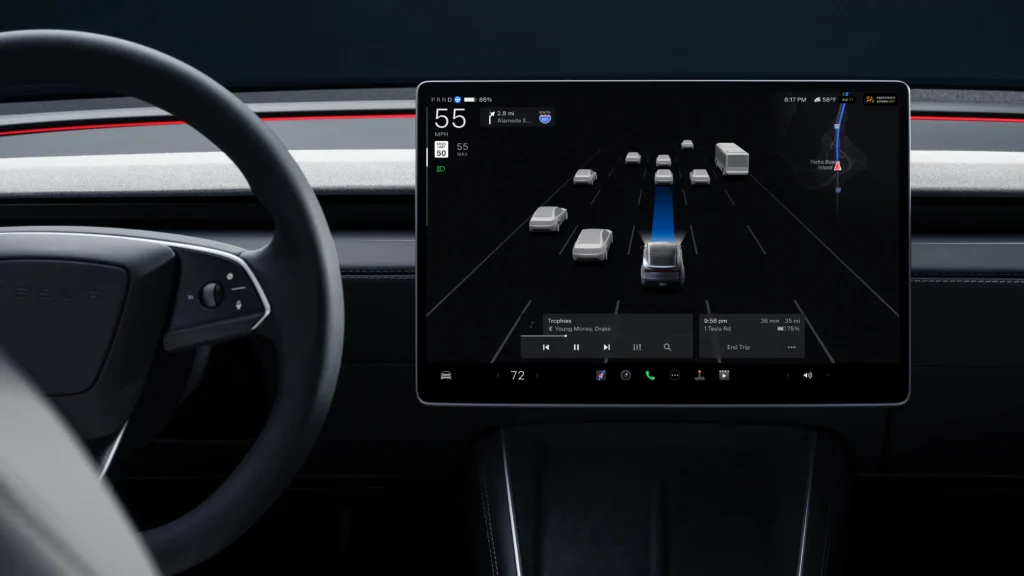
The update also changes how drivers start and manage FSD during a trip. A Self‑Driving statistics section under Controls > Autopilot gives drivers a view of FSD distance and usage. Self‑Driving can now be started with a tap on the touchscreen from Park or during a drive, and key settings like Speed Profile and Arrival Options can be adjusted directly from the Autopilot visualization.
Brake Confirm for the Start Self-Driving button is off by default now, so the system does not require a brake press to engage, though drivers can still re‑enable Brake Confirm in the Autopilot menu.
Vision, routing, and speed profiles
A large part of 14.2.2 is about neural‑network and planning upgrades. The vision encoder now uses higher‑resolution features, which improves detection of emergency vehicles, road debris, and human gestures. FSD can pull over or yield when police cars, fire trucks, or ambulances approach, and navigation and routing now feed directly into the vision‑based network to better handle blocked roads and detours in real time.
Speed Profiles have been reworked so FSD (Supervised) draws on driver profile, speed limits, and traffic to set speed. New profile SLOTH runs at lower speeds with more conservative lane behavior compared with CHILL, and new profile MAD MAX uses higher speeds and more frequent lane changes than HURRY. Driver profile has more impact on maximum speed, and the right scroll‑wheel now adjusts the Speed Profile rather than a simple offset.
Road behavior and reliability
Handling of unprotected turns, lane changes, vehicle cut‑ins, school buses, and both static and moving gates is improved in this release. FSD now offsets more naturally around tires, branches, and boxes in the road, and updated fault handling helps the system recover more smoothly from degraded states.
New alerts warn about residue on the inside of the windshield that may hinder front camera visibility and suggest a service visit when needed.
On 2026+ Model Y, automatic narrow field washing supports front camera self‑cleaning and manages aerodynamics at higher speeds, and Tesla notes that camera visibility can affect attention monitoring sensitivity on those models.
Within this broader context, v14.2.2.2 looks like a small but targeted patch.
Official FSD (Supervised) V14.2.2.2 (2025.45.7) release notes
Full Self-Driving (Supervised) v14.2.2.2 includes:
- Upgraded the neural network vision encoder, leveraging higher resolution features to further improve scenarios like handling emergency vehicles, obstacles on the road, and human gestures.
- Added Arrival Options for you to select where FSD should park: in a Parking Lot, on the Street, in a Driveway, in a Parking Garage, or at the Curbside.
- Added handling to pull over or yield for emergency vehicles (e.g. police cars, fire trucks, ambulances).
- Added navigation and routing into the vision-based neural network for real-time handling of blocked roads and detours.
- Added additional Speed Profile to further customize driving style preference.
- Improved handling for static and dynamic gates.
- Improved offsetting for road debris (e.g. tires, tree branches, boxes).
- Improve handling of several scenarios including: unprotected turns, lane changes, vehicle cut-ins, and school busses.
- Improved FSD’s ability to manage system faults and recover smoothly from degraded operation for enhanced reliability.
- Added alerting for residue build-up on interior windshield that may impact front camera visibility. If affected, visit Service for cleaning!
(2026+ Model Y only)
- Camera visibility can lead to increased attention monitoring sensitivity.
Upcoming Improvements:
- Overall smoothness and sentience.
- Parking spot selection and parking quality.
We’ve launched an official Tesla Owners Online Forum. Join early and claim your "Founding Fuel" badge.