Tesla’s Cybercab is getting attention after Lars Moravy, the company’s vice president of vehicle engineering, said it has become “the most efficient EV ever certified” with an energy use rating of 165 Wh per mile, or 103 Wh per kilometer. That works out to about 16.5 kWh per 100 miles, and if the figure holds in final certification it would place the robotaxi ahead of the most efficient production EVs now on sale.
The claim came from comments shared by attendees after internal briefings on Tesla’s robotaxi program. In those quotes, Moravy said the Cybercab is “officially the most efficient EV ever certified” at 165 Wh/mi.
Tesla has not released a full public spec sheet yet, so the number is still being tracked through executive remarks.
Efficiency target
The figure stands out next to current efficiency leaders such as the Tesla Model 3 Long Range and Lucid Air Pure. Those cars usually land in the 18 to 20 kWh per 100 miles range, depending on trim and test cycle, so the Cybercab would sit below that level if Tesla’s figure stays the same in final certification.
That is a sharp result for a vehicle built for autonomous ride service. It lines up with Tesla’s long-running plan to make the Cybercab small, light, and cheap to run. A lower energy draw helps a robotaxi spend less time charging and more time on the road.
Moravy did not say if the 165 Wh/mi figure comes from the EPA, WLTP, or another test method. That detail is still missing, and the exact certification path will matter when Tesla files the final numbers.
Battery and range
The new efficiency claim fits earlier comments from Moravy and chief designer Franz von Holzhausen, who told Sandy Munro that Tesla is aiming for a battery pack under 50 kWh. They said the Cybercab should still reach close to 300 miles of real-world range, which would only work with very low consumption.
Reports from the robotaxi reveal event and later analysis point to a pack in the 40 kWh to 50 kWh range. Some estimates place it near 51 kWh based on Tesla’s charging data and earnings material. That size would fit a city-focused robotaxi better than a long-range passenger car.
Tesla also appears to be using its NC05 battery cells in the Cybercab. And with a smaller pack, the vehicle should weigh less and cost less to build than most long-range EVs.
Design choices
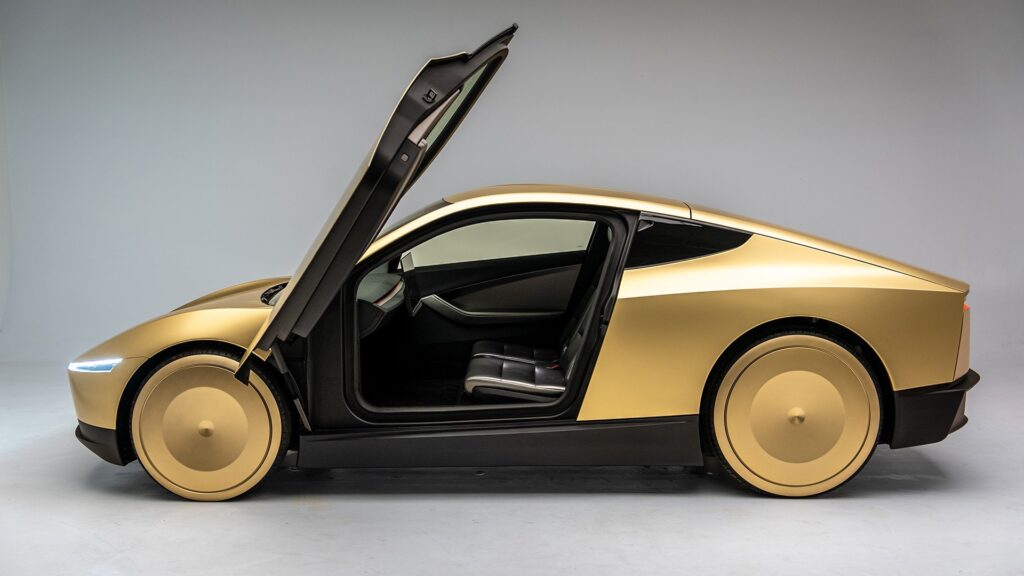
The efficiency goal seems tied to the body shape and layout. The Cybercab has a teardrop-like form with a very small front area, along with closed wheel covers that cut drag. That shape helps at speed and on city streets.
The cabin is simple and built around two seats. That setup keeps weight down and leaves out features that do not fit robotaxi use. So the vehicle can focus on utility, range and cost control.
Tesla has used this kind of trade-off before, but the Cybercab takes it further. It gives up space and long-haul flexibility in exchange for lower energy use and easier fleet economics.
A vehicle using 165 Wh per mile would have low operating cost per trip, which is a big deal for ride service fleets. Less energy per mile means less charging expense and less time spent plugged in. And that can improve vehicle use rates across the day.
The smaller battery pack should also help Tesla reduce upfront cost. Batteries remain one of the priciest parts of any EV, so a pack in the 40 kWh to 50 kWh range would be easier to price for a robotaxi model than the larger packs used in many consumer EVs.
The trade-off is range. A vehicle in the 200-mile class fits best in dense urban and suburban use, where charging is easier and trips are shorter. That is a reasonable fit for Tesla’s robotaxi plan, which seems built for high turnover rather than long highway drives.
Tesla has not yet released the final official paperwork that spells out the test cycle, battery size, or range for the Cybercab. The company’s public support pages still list only the Model S, 3, X, and Y for power consumption data, so the Cybercab entry is still missing.
However, the 165 Wh/mi figure is the strongest public clue about Tesla’s next robotaxi. And if the number is confirmed in final certification, the Cybercab will stand out as one of the most efficient EVs ever put on paper.
We’ve launched an official Tesla Owners Online Forum. Join early and claim your "Founding Fuel" badge.