Elon Musk says Tesla has started early production of its Cybercab robotaxi at Gigafactory Texas in Austin, and he still points to April 2026 for mass production at the same factory.
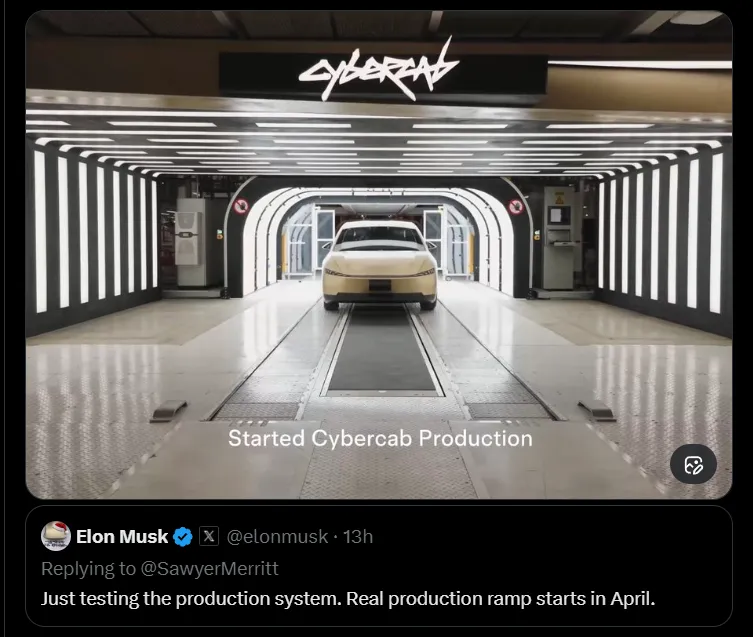
Tesla’s 2025 recap video confirms that Cybercab production has begun, even though it is still at an early stage.
Video:
Musk told investors Cybercab will be built “right here in this factory” in Texas and linked that line directly to the April target.
Factory concept
Musk describes the Cybercab production line as very different from Tesla’s current lines, and he says it looks closer to a high‑speed electronics line with strong focus on speed and modular work.
The factory plan uses Tesla’s “unboxed” process, which splits the car into a few large modules that workers assemble in parallel and then bring together near the end of the line. For Cybercab, those modules connect to big aluminum front and rear gigacastings that replace many smaller stamped parts.
Musk set an initial target of a 10‑second cycle time for each Cybercab, and he later talked about a longer‑term goal of about five seconds per vehicle. At those speeds, Tesla has floated a goal of at least 2 million Cybercabs a year once the line matures, and that figure would beat the current annual volume of any single Tesla model.
Vehicle design and pricing
Cybercab is a two‑seat robotaxi built for autonomous use, and Tesla describes the final version as having no steering wheel, pedals, and conventional mirrors. The cabin centers on a large screen with seats pushed back for more legroom and media or work use.
Tesla links Cybercab to an inductive wireless charging pad that lets the car recharge without a port or cable, and the company says this system runs at efficiency well above 90 percent. Reports mention test sessions at around 19 kW charging power and later at about 25 kW, and this work builds on Tesla’s 2023 acquisition of German wireless charging firm Wiferion.
Analysts expect Cybercab to use Tesla’s 4680 cells, and some coverage points to an estimated 300 miles of range from a roughly 50 kWh pack, though Tesla has not confirmed final numbers. Tesla reports a target starting price under $30,000, and that price would place Cybercab against many mass‑market compact and midsize cars.
Wider Tesla strategy
Cybercab sits inside a broader AI and robotics vision at Tesla, and Musk has said he expects most of Tesla’s long‑term value to come from Optimus humanoid robots rather than cars. He links Cybercab and Full Self‑Driving to the same AI infrastructure that will support Optimus, so work on one part of the stack can help the others.
Tesla’s 2025 recap lists major steps in energy storage and charging, as the company points to growth in the Supercharger network, more Powerwall installations, and a new Megablock 20 MWh system for large‑scale storage. Tesla also highlights progress on its Cortex 2 AI cluster near Giga Texas, and that system should raise training capacity for both FSD and Optimus models.
The recap ends with the line “See y’all in 2026 – the best is yet to come,” and Musk calls 2026 “epic,” tying that outlook to Cybercab production, FSD advances, and Tesla’s robotics plans.
You may also like to read:
- Tesla Semi gets new look and features ahead of 2026 production »
- Tesla plans Roadster unveiling for April 2026 »
- Tesla to offer new extended battery warranties starting in 2026 »
- Tesla Roadster may launch with flying tech before 2026 »
- Tesla to launch Optimus V3 robot in early 2026 »
- Tesla to launch lighter FSD V14 for hardware 3 by Mid-2026 »
- Tesla Offers Paid Acceleration Boost for 2026 Model Y »
We’ve launched an official Tesla Owners Online Forum. Join early and claim your "Founding Fuel" badge.