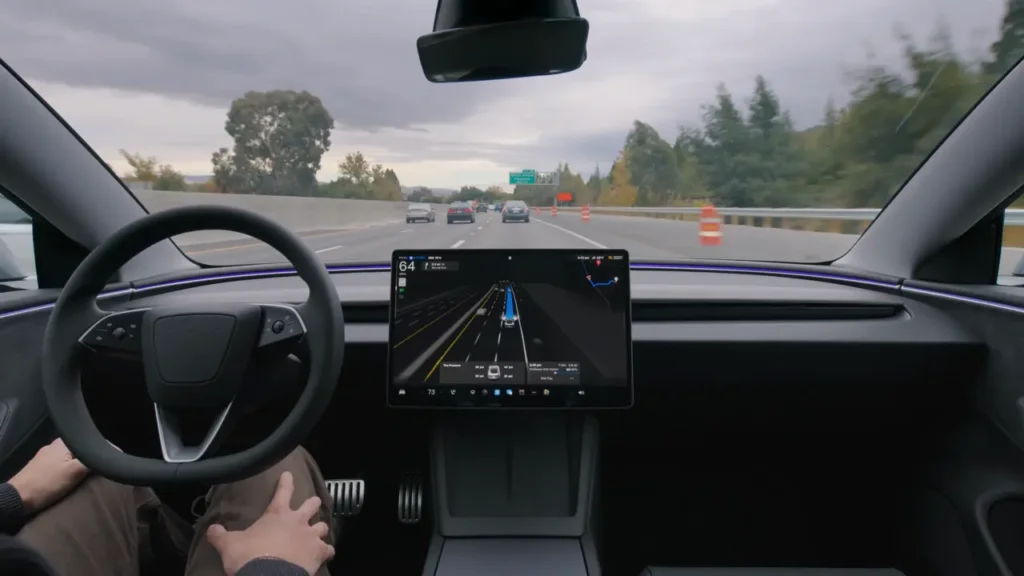
Tesla has begun rolling out FSD (Supervised) v14.3.3 in software version 2026.14.6.6, bringing the Spring Update to more vehicles and adding a notable boost to Actually Smart Summon. According to early release-note reports, the summon feature’s maximum speed has increased to 8 mph, a change that should make low-speed maneuvers quicker and more useful in larger parking lots.
Beyond the Smart Summon change, the update continues Tesla’s push to improve FSD behavior through reinforcement learning and model architecture upgrades. Reported notes mention a new neural network vision encoder for better low-visibility and rare-scenario understanding, along with a ground-up rewrite of the AI compiler and runtime using MLIR, which Tesla says delivers 20% faster reaction time and better model iteration speed.
The release also focuses on edge cases that matter in day-to-day driving. Tesla says the system has reduced unnecessary lane biasing and minor tailgating, improved parking spot selection, strengthened response to emergency vehicles and school buses, and better handled temporary system degradations without unnecessary disengagements.
Another practical change is the addition of new driver feedback tools inside the Self-Driving app. Owners can now view distance traveled in FSD (Supervised) without an intervention, and the app will also show the longest intervention-free streak, giving users a clearer sense of how the system is performing over time.
This rollout is also another step toward unifying behavior across FSD, Actually Smart Summon, and Robotaxi-style driving logic. That same direction was already highlighted in earlier versions, and the latest update appears to extend the shared-model approach while refining parking, traffic-light handling, unusual-object detection, and recovery from degraded conditions.
Official release notes
Full Self-Driving (Supervised) v14.3.3 includes:
- Upgraded the Reinforcement Learning (RL) stage of training the FSD neural network, resulting in improvements in a wide variety of driving scenarios.
- Upgraded the neural network vision encoder, improving understanding in rare and low-visibility scenarios, strengthening 3D geometry understanding, and expanding traffic sign understanding.
- Rewrote the AI compiler and runtime from the ground up with MLIR, resulting in 20% faster reaction time and improving model iteration speed.
- Mitigated unnecessary lane biasing and minor tailgating behaviors.
- Increased decisiveness of parking spot selection and maneuvering.
- Improved parking location pin prediction, now shown on a map with a P icon.
- Enhanced response to emergency vehicles, school buses, right-of-way violators, and other rare vehicles.
- Improved handling of small animals by focusing RL training on harder examples and adding rewards for better proactive safety.
- Improved traffic light handling at complex intersections with compound lights, curved roads, and yellow light stopping — driven by training on hard RL examples sourced from the Tesla fleet.
- Improved handling for rare and unusual objects extending, hanging, or leaning into the vehicle path by sourcing infrequent events from the fleet.
- Improved handling of temporary system degradations by maintaining control and automatically recovering without driver intervention, reducing unnecessary disengagements.
- Unified the model between Actually Smart Summon, FSD, and Robotaxi for more capable and reliable behavior.
- Actually Smart Summon max speed is now increased to 8 mph (13 km/h).
- Help Tesla improve Self-Driving by selecting an intervention reason on the main screen after taking over.
- You can now see distance traveled in FSD (Supervised) without an intervention. The Self-Driving App will also show your longest intervention-free streak.
Upcoming Improvements
- Expand reasoning to all behaviors beyond destination handling.
- Add pothole avoidance.
- Improve driver monitoring system sensitivity with better eye gaze tracking, eye wear handling, and higher accuracy in variable lighting conditions
We’ve launched an official Tesla Owners Online Forum. Join early and claim your "Founding Fuel" badge.