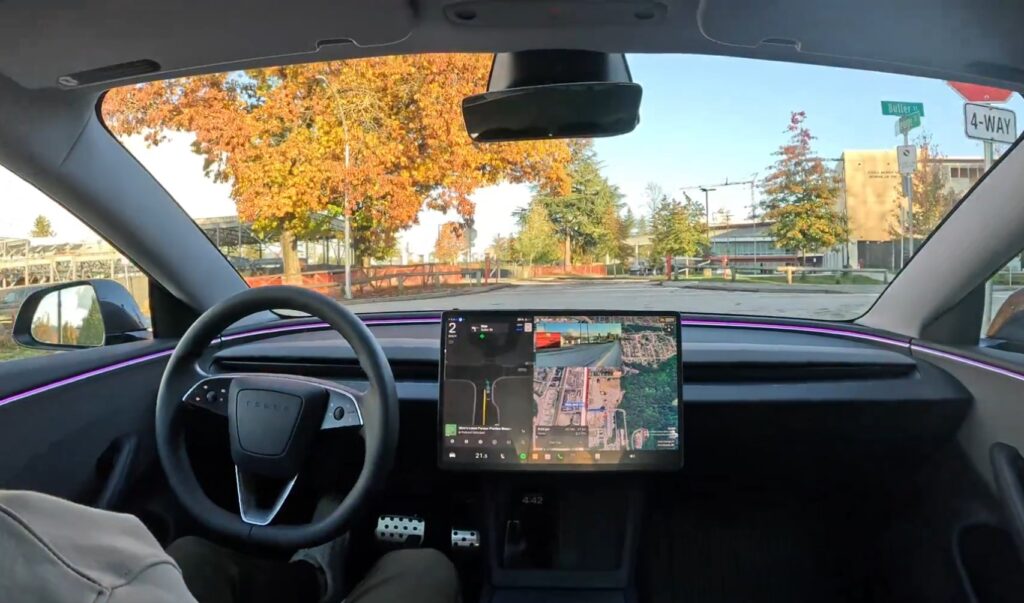
Wall Street Journal auto columnist Dan Neil has come out with a strongly positive take on Tesla’s Full Self-Driving Supervised system, following an extended test drive in a Model Y. Neil, who has covered cars for decades and has not always sided with Tesla in past write-ups, said it took about two hours on the road before the software won him over, writing that he was “bewitched” by that point and that “FSD is amazing.”
Neil described his reaction as building slowly, rather than arriving all at once, and he was upfront about the limits of his own test. He called himself “a sample group of one, with only the scantest evidence to work with,” and added that he still knows “good driving when I see it.” Mile after mile, he wrote, the system kept building his trust.
How the system handled highway traffic
The heaviest praise in Neil’s piece centered on rush-hour interstate driving, a setting where automated systems often struggle. He wrote that amid the “whitewater-like eddy and flow of rush-hour interstate traffic,” FSD “held its position beautifully,” keeping steady stopping distances, following gaps, and lane position. Neil said the acceleration, steering, and braking all blended into what he called “smoothly continuous linear functions.”
Tesla began rolling out version 14 to Hardware 4 vehicles earlier this year, and other reviewers testing that build have described changes that line up with what Neil experienced. One early tester with The Driven, an Australian outlet, said the update brought “noticeably smoother” driving along with new speed profiles and better behavior at the start and end of trips, and reported completing more than half of test drives without touching the wheel or pedals. Tesla has said the rewrite included a rebuilt AI compiler and runtime, changes the company has linked to a roughly 20 percent gain in reaction time.
Hardware 3 vehicles, which lack the newer AI4 computer, spent most of the year still running the older v12 software, but Tesla began pushing a pared-down build called FSD v14 Lite to those cars over the summer, distilling lessons learned from the Hardware 4 version onto older chips. Owners running early copies of that update reported smoother stops at intersections and more consistent handling of speed bumps, though rollout has been uneven.
Where the technology stands now
Tesla continues to market FSD Supervised as one of its biggest selling points against rival automakers, and the system still requires a driver to stay alert and ready to take over at any moment, even as it handles more of the driving itself. Tesla has said that legal liability, rather than technical limits alone, is part of why the system keeps a human in the loop instead of operating as a fully driverless product. The company currently prices the software at $99 a month, and buyers can also pay a one-time fee of eight thousand dollars instead. Underlying the system is a set of 8 external cameras providing 360-degree coverage, along with ultrasonic sensors for detecting nearby objects, all processed through Tesla’s onboard AI computer.
Neil’s review is the latest in a string of positive reports on Tesla’s newer FSD software.
We’ve launched an official Tesla Owners Online Forum. Join early and claim your "Founding Fuel" badge.